

2
3
Percent
with terata
<6
6-25
>25
<20
20-80
>80
Population
mortality'
<5%
5-20%
>20%
<5%
5-20%
>20%
2
3
Negligible
Slight to moderate
Major
Negligible
Slight to moderate
Major
TDI
rating
Anticipated
impact
Fish life
stage
Larvae
or fry
Juveniles
or adults
96
5. Teratogenic Deformity Index for Fish
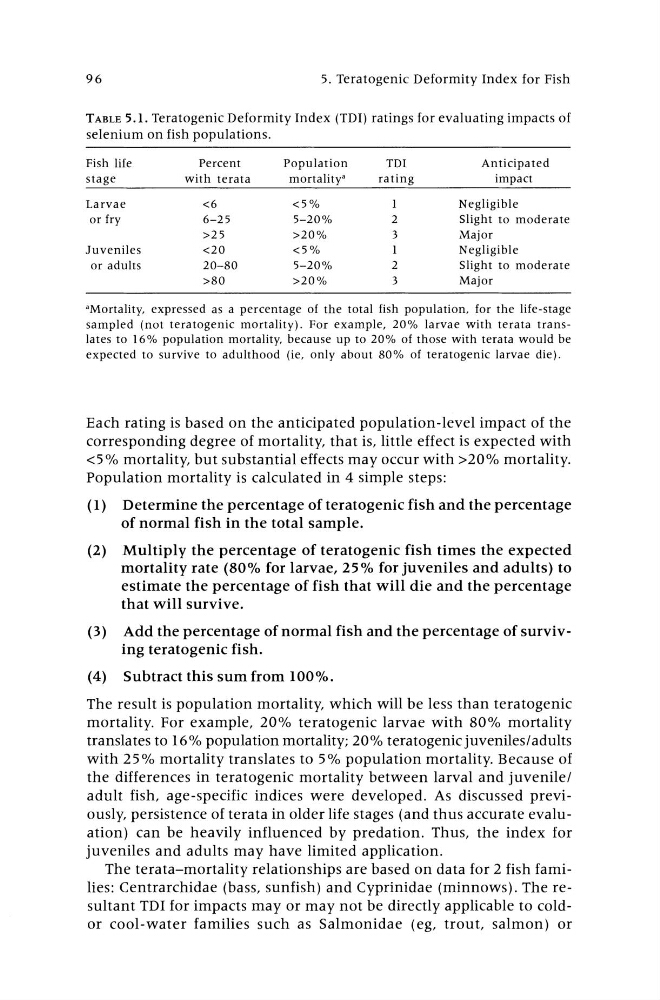
'Mortality, expressed as a percentage of the total fish population, for the life-stage
sampled (not teratogenic mortality). For example, 20% larvae with terata translates to 16% population mortality, because up to 20% of those with terata would be
expected to survive to adulthood (ie, only about 80% of teratogenic larvae die).
Each rating is based on the anticipated population-level impact of the
corresponding degree of mortality, that is, little effect is expected with
<5% mortality, but substantial effects may occur with >20% mortality.
Population mortality is calculated in 4 simple steps:
(1) Determine the percentage of teratogenic fish and the percentage
of normal fish in the total sample.
(2) Multiply the percentage of teratogenic fish times the expected
mortality rate (80% for larvae, 25% for juveniles and adults) to
estimate the percentage of fish that will die and the percentage
that will survive.
(3) Add the percentage of normal fish and the percentage of surviving teratogenic fish.
(4) Subtract this sum from 100%.
The result is population mortality, which will be less than teratogenic
mortality. For example, 20% teratogenic larvae with 80% mortality
translates to 16% population mortality; 20% teratogenic juveniles/adults
with 25% mortality translates to 5% population mortality. Because of
the differences in teratogenic mortality between larval and juvenile/
adult fish, age-specific indices were developed. As discussed previously, persistence of terata in older life stages (and thus accurate evaluation) can be heavily influenced by predation. Thus, the index for
juveniles and adults may have limited application.
The terata-mortality relationships are based on data for 2 fish families: Centrarchidae (bass, sunfish) and Cyprinidae (minnows). The resultant TDI for impacts mayor may not be directly applicable to coldor cool-water families such as Salmonidae (eg, trout, salmon) or
3
Percent
with terata
<6
6-25
>25
<20
20-80
>80
Population
mortality'
<5%
5-20%
>20%
<5%
5-20%
>20%
2
3
Negligible
Slight to moderate
Major
Negligible
Slight to moderate
Major
TDI
rating
Anticipated
impact
Fish life
stage
Larvae
or fry
Juveniles
or adults
96
5. Teratogenic Deformity Index for Fish
'Mortality, expressed as a percentage of the total fish population, for the life-stage
sampled (not teratogenic mortality). For example, 20% larvae with terata translates to 16% population mortality, because up to 20% of those with terata would be
expected to survive to adulthood (ie, only about 80% of teratogenic larvae die).
Each rating is based on the anticipated population-level impact of the
corresponding degree of mortality, that is, little effect is expected with
<5% mortality, but substantial effects may occur with >20% mortality.
Population mortality is calculated in 4 simple steps:
(1) Determine the percentage of teratogenic fish and the percentage
of normal fish in the total sample.
(2) Multiply the percentage of teratogenic fish times the expected
mortality rate (80% for larvae, 25% for juveniles and adults) to
estimate the percentage of fish that will die and the percentage
that will survive.
(3) Add the percentage of normal fish and the percentage of surviving teratogenic fish.
(4) Subtract this sum from 100%.
The result is population mortality, which will be less than teratogenic
mortality. For example, 20% teratogenic larvae with 80% mortality
translates to 16% population mortality; 20% teratogenic juveniles/adults
with 25% mortality translates to 5% population mortality. Because of
the differences in teratogenic mortality between larval and juvenile/
adult fish, age-specific indices were developed. As discussed previously, persistence of terata in older life stages (and thus accurate evaluation) can be heavily influenced by predation. Thus, the index for
juveniles and adults may have limited application.
The terata-mortality relationships are based on data for 2 fish families: Centrarchidae (bass, sunfish) and Cyprinidae (minnows). The resultant TDI for impacts mayor may not be directly applicable to coldor cool-water families such as Salmonidae (eg, trout, salmon) or