

14
600.0
500.0
E
400.0
.s
ci. 300.0
'0
Q)
La.. 200.0
100.0
R. G. Lawford
-
Summer(N*Jun,S*Dec)
Winter(N*Dec,S*Jun)
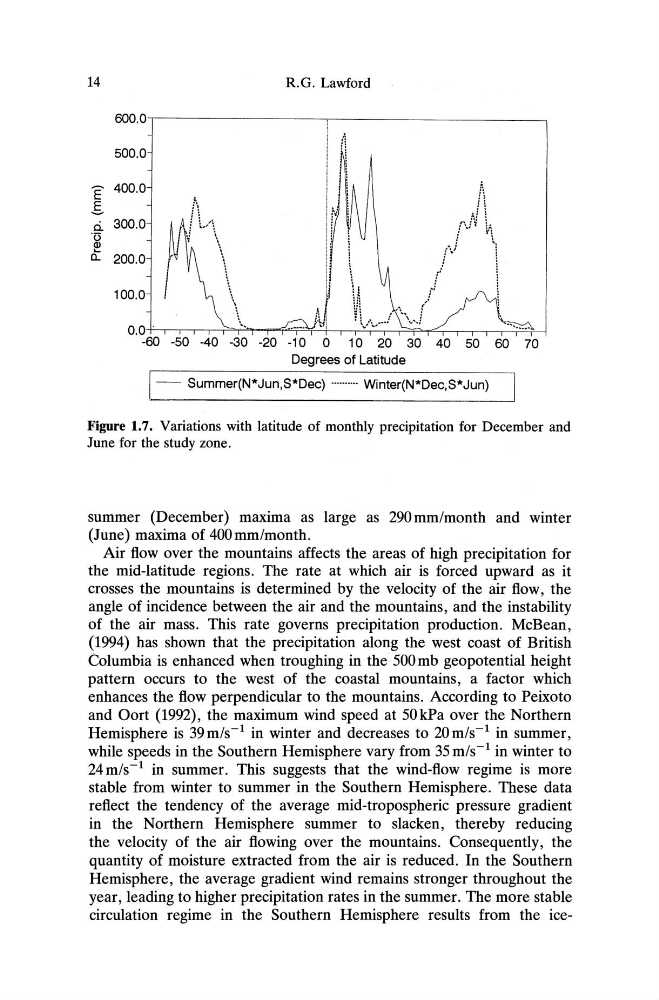
Figure 1.7. Variations with latitude of monthly precipitation for December and
June for the study zone.
summer (December) maxima as large as 290mm/month and winter
(June) maxima of 400mm/month.
Air flow over the mountains affects the areas of high precipitation for
the mid-latitude regions. The rate at which air is forced upward as it
crosses the mountains is determined by the velocity of the air flow , the
angle of incidence between the air and the mountains, and the instability
of the air mass. This rate governs precipitation production. McBean,
(1994) has shown that the precipitation along the west coast of British
Columbia is enhanced when troughing in the 500mb geopotential height
pattern occurs to the west of the coastal mountains , a factor which
enhances the flow perpendicular to the mountains. According to Peixoto
and Oort (1992), the maximum wind speed at 50kPa over the Northern
Hemisphere is 39m/s1
in winter and decreases to 20m/s1
in summer,
while speeds in the Southern Hemisphere vary from 35m/s1
in winter to
24m/s"? in summer. This suggests that the wind-flow regime is more
stable from winter to summer in the Southern Hemisphere. These data
reflect the tendency of the average mid-tropospheric pressure gradient
in the Northern Hemisphere summer to slacken, thereby reducing
the velocity of the air flowing over the mountains. Consequently, the
quantity of moisture extracted from the air is reduced. In the Southern
Hemisphere, the average gradient wind remains stronger throughout the
year, leading to higher precipitation rates in the summer. The more stable
circulation regime in the Southern Hemisphere results from the ice-
600.0
500.0
E
400.0
.s
ci. 300.0
'0
Q)
La.. 200.0
100.0
R. G. Lawford
-
Summer(N*Jun,S*Dec)
Winter(N*Dec,S*Jun)
Figure 1.7. Variations with latitude of monthly precipitation for December and
June for the study zone.
summer (December) maxima as large as 290mm/month and winter
(June) maxima of 400mm/month.
Air flow over the mountains affects the areas of high precipitation for
the mid-latitude regions. The rate at which air is forced upward as it
crosses the mountains is determined by the velocity of the air flow , the
angle of incidence between the air and the mountains, and the instability
of the air mass. This rate governs precipitation production. McBean,
(1994) has shown that the precipitation along the west coast of British
Columbia is enhanced when troughing in the 500mb geopotential height
pattern occurs to the west of the coastal mountains , a factor which
enhances the flow perpendicular to the mountains. According to Peixoto
and Oort (1992), the maximum wind speed at 50kPa over the Northern
Hemisphere is 39m/s1
in winter and decreases to 20m/s1
in summer,
while speeds in the Southern Hemisphere vary from 35m/s1
in winter to
24m/s"? in summer. This suggests that the wind-flow regime is more
stable from winter to summer in the Southern Hemisphere. These data
reflect the tendency of the average mid-tropospheric pressure gradient
in the Northern Hemisphere summer to slacken, thereby reducing
the velocity of the air flowing over the mountains. Consequently, the
quantity of moisture extracted from the air is reduced. In the Southern
Hemisphere, the average gradient wind remains stronger throughout the
year, leading to higher precipitation rates in the summer. The more stable
circulation regime in the Southern Hemisphere results from the ice-