

R.G . Lawford
-5 0 5 10 15 20 25 30 35 40 45 50 55 60 65 70 75
Degrees of Latitude
12
10
(j)
9
.c
8
C Q) 7
~
... 6
Q)
~ 5
o
"U
4
B
(3
3
(ij
2
<5
f1
0
-10
1-- North ........ South .............. North (Baja)
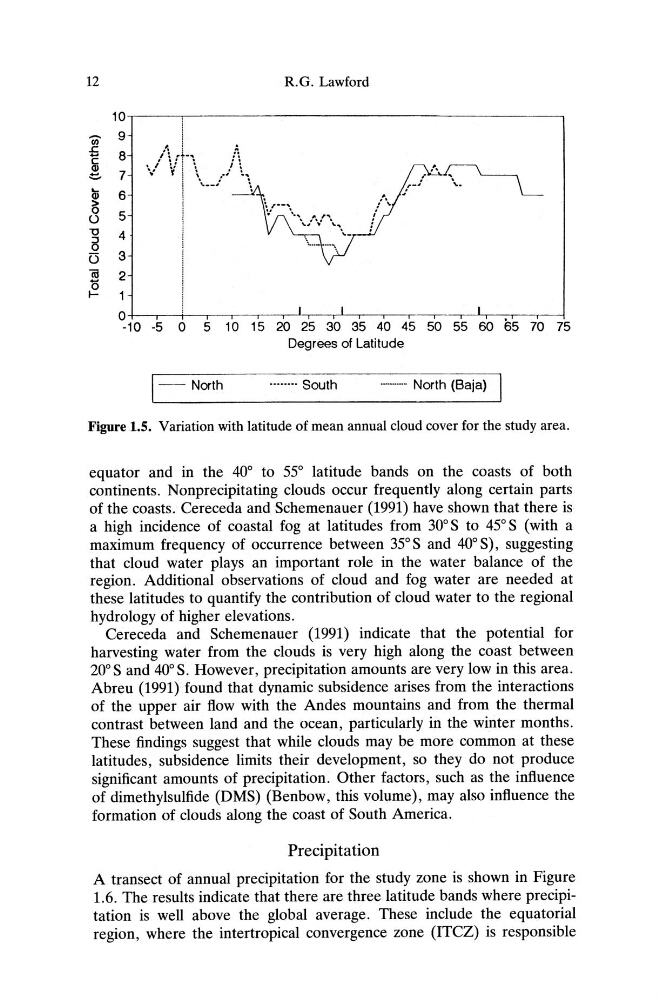
Figure 1.5. Variation with latitude of mean annual cloud cover for the study area.
equator and in the 40° to 55° latitude bands on the coasts of both
continents. Nonprecipitating clouds occur frequently along certain parts
of the coasts. Cereceda and Schemenauer (1991) have shown that there is
a high incidence of coastal fog at latitudes from 30°S to 45°S (with a
maximum frequency of occurrence between 35°S and 40
0S)
, suggesting
that cloud water plays an important role in the water balance of the
region . Additional observations of cloud and fog water are needed at
these latitudes to quantify the contribution of cloud water to the regional
hydrology of higher elevations.
Cereceda and Schemenauer (1991) indicate that the potential for
harvesting water from the clouds is very high along the coast between
20°Sand 40°S. However, precipitation amounts are very low in this area.
Abreu (1991) found that dynamic subsidence arises from the interactions
of the upper air flow with the Andes mountains and from the thermal
contrast between land and the ocean, particularly in the winter months.
These findings suggest that while clouds may be more common at these
latitudes, subsidence limits their development, so they do not produce
significant amounts of precipitation. Other factors , such as the influence
of dimethylsulfide (DMS) (Benbow , this volume) , may also influence the
formation of clouds along the coast of South America.
Precipitation
A transect of annual precipitation for the study zone is shown in Figure
1.6. The results indicate that there are three latitude bands where precipitation is well above the global average. These include the equatorial
region, where the intertropical convergence zone (ITCZ) is responsible
-5 0 5 10 15 20 25 30 35 40 45 50 55 60 65 70 75
Degrees of Latitude
12
10
(j)
9
.c
8
C Q) 7
~
... 6
Q)
~ 5
o
"U
4
B
(3
3
(ij
2
<5
f1
0
-10
1-- North ........ South .............. North (Baja)
Figure 1.5. Variation with latitude of mean annual cloud cover for the study area.
equator and in the 40° to 55° latitude bands on the coasts of both
continents. Nonprecipitating clouds occur frequently along certain parts
of the coasts. Cereceda and Schemenauer (1991) have shown that there is
a high incidence of coastal fog at latitudes from 30°S to 45°S (with a
maximum frequency of occurrence between 35°S and 40
0S)
, suggesting
that cloud water plays an important role in the water balance of the
region . Additional observations of cloud and fog water are needed at
these latitudes to quantify the contribution of cloud water to the regional
hydrology of higher elevations.
Cereceda and Schemenauer (1991) indicate that the potential for
harvesting water from the clouds is very high along the coast between
20°Sand 40°S. However, precipitation amounts are very low in this area.
Abreu (1991) found that dynamic subsidence arises from the interactions
of the upper air flow with the Andes mountains and from the thermal
contrast between land and the ocean, particularly in the winter months.
These findings suggest that while clouds may be more common at these
latitudes, subsidence limits their development, so they do not produce
significant amounts of precipitation. Other factors , such as the influence
of dimethylsulfide (DMS) (Benbow , this volume) , may also influence the
formation of clouds along the coast of South America.
Precipitation
A transect of annual precipitation for the study zone is shown in Figure
1.6. The results indicate that there are three latitude bands where precipitation is well above the global average. These include the equatorial
region, where the intertropical convergence zone (ITCZ) is responsible