

10
R.G. Lawford
are barren deserts, with some semidesert shrubs and grasses on the higher
terrain. South of 30°S, broadleaf evergreen shrubs increase, and south of
36°S, needleleaf evergreen shrubs are present.
At least two generalizations can be drawn from Figure 1.3. First,
the boundaries between different vegetation covers are well defined,
especially in the extratropics, where vegetation cover changes from rainforest to desert over distances of 5° of latitude. Second, distinct northsouth asymmetries exist in the vegetative covers of the coasts of the two
continents. Needleleaf forests (with some deciduous trees interspersed)
are much more common at mid-latitudes in North America than in South
America. On the other hand, desert and semidesert vegetation types are
much more, dominant in the 00-to-30° latitude band in South America .
Asymmetries between the coasts of the two hemispheres are most dramatic at the tropical and the subtropical latitudes.
Temperature
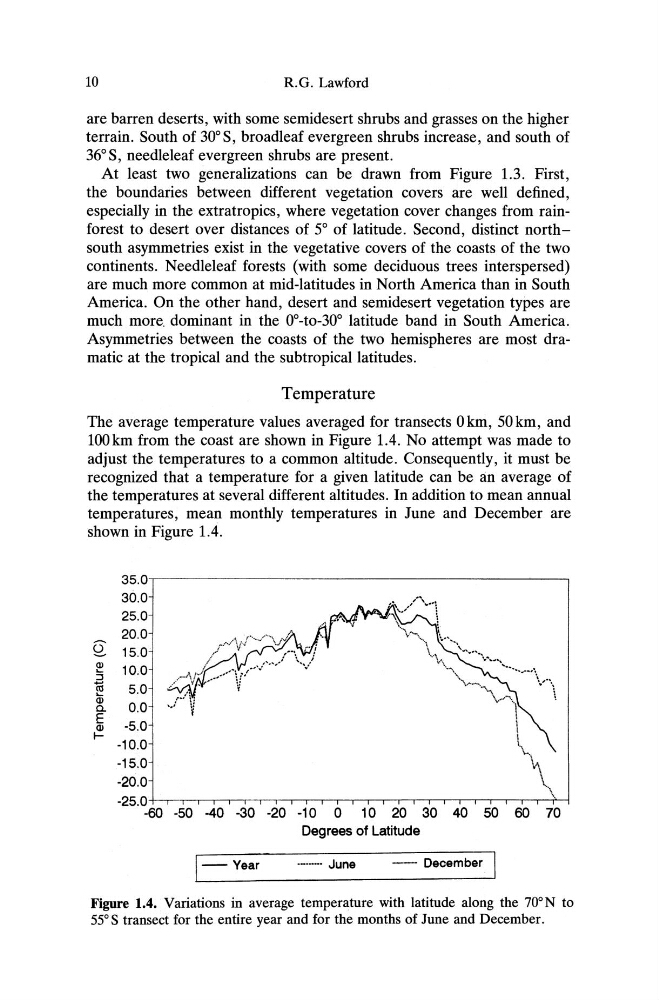
The average temperature values averaged for transects 0 km, 50 km, and
100km from the coast are shown in Figure 1.4. No attempt was made to
adjust the temperatures to a common altitude. Consequently, it must be
recognized that a temperature for a given latitude can be an average of
the temperatures at several different altitudes. In addition to mean annual
temperatures, mean monthly temperatures in June and December are
shown in Figure 1.4.
-50 -40 -30 -20 -10 0 10 20 30 40 50 60 70
Degrees of Latitude
Q)
:J
'§
Q)
c.
E Q)
I35.0.,-------~---------------~-----,
30 .0
25 .0
20 .0
~ 15.0
10.0
5.0
0.0
-5.0
-10.0
-15.0
-20.0
-25.0-l-r-T--r--.-,---,--,,,--r,-,---,.,-,----.-,---,--,,,--.,-,---,.,---r-T-I
-60
I-Year
......... June
- - December I
Figure 1.4. Variations in average temperature with latitude along the 70
0N to
55°S transect for the entire year and for the months of June and December.
R.G. Lawford
are barren deserts, with some semidesert shrubs and grasses on the higher
terrain. South of 30°S, broadleaf evergreen shrubs increase, and south of
36°S, needleleaf evergreen shrubs are present.
At least two generalizations can be drawn from Figure 1.3. First,
the boundaries between different vegetation covers are well defined,
especially in the extratropics, where vegetation cover changes from rainforest to desert over distances of 5° of latitude. Second, distinct northsouth asymmetries exist in the vegetative covers of the coasts of the two
continents. Needleleaf forests (with some deciduous trees interspersed)
are much more common at mid-latitudes in North America than in South
America. On the other hand, desert and semidesert vegetation types are
much more, dominant in the 00-to-30° latitude band in South America .
Asymmetries between the coasts of the two hemispheres are most dramatic at the tropical and the subtropical latitudes.
Temperature
The average temperature values averaged for transects 0 km, 50 km, and
100km from the coast are shown in Figure 1.4. No attempt was made to
adjust the temperatures to a common altitude. Consequently, it must be
recognized that a temperature for a given latitude can be an average of
the temperatures at several different altitudes. In addition to mean annual
temperatures, mean monthly temperatures in June and December are
shown in Figure 1.4.
-50 -40 -30 -20 -10 0 10 20 30 40 50 60 70
Degrees of Latitude
Q)
:J
'§
Q)
c.
E Q)
I35.0.,-------~---------------~-----,
30 .0
25 .0
20 .0
~ 15.0
10.0
5.0
0.0
-5.0
-10.0
-15.0
-20.0
-25.0-l-r-T--r--.-,---,--,,,--r,-,---,.,-,----.-,---,--,,,--.,-,---,.,---r-T-I
-60
I-Year
......... June
- - December I
Figure 1.4. Variations in average temperature with latitude along the 70
0N to
55°S transect for the entire year and for the months of June and December.