

1500
1. North-South Variations in West Coast Hydrometeorological Parameters 9
latitudes 7° and 35°, the average elevation within 100km of the coast is
more than 1000m higher in South America than in North America. At
latitudes of 10°S to 12°S, elevations at distances of 100km from the coast
exceed 4500m. The east-west topographical gradient in South America is
particularly steep between 0 km and 50 km from the coast for latitudes
from 7°S to 33°S, suggesting that orography may exert a significant
control on the atmospheric circulation at these latitudes.
Vegetation Cover
Climate and water cycling in the coastal areas of these two continents
affect the vegetation cover and the birds and animals that use this cover
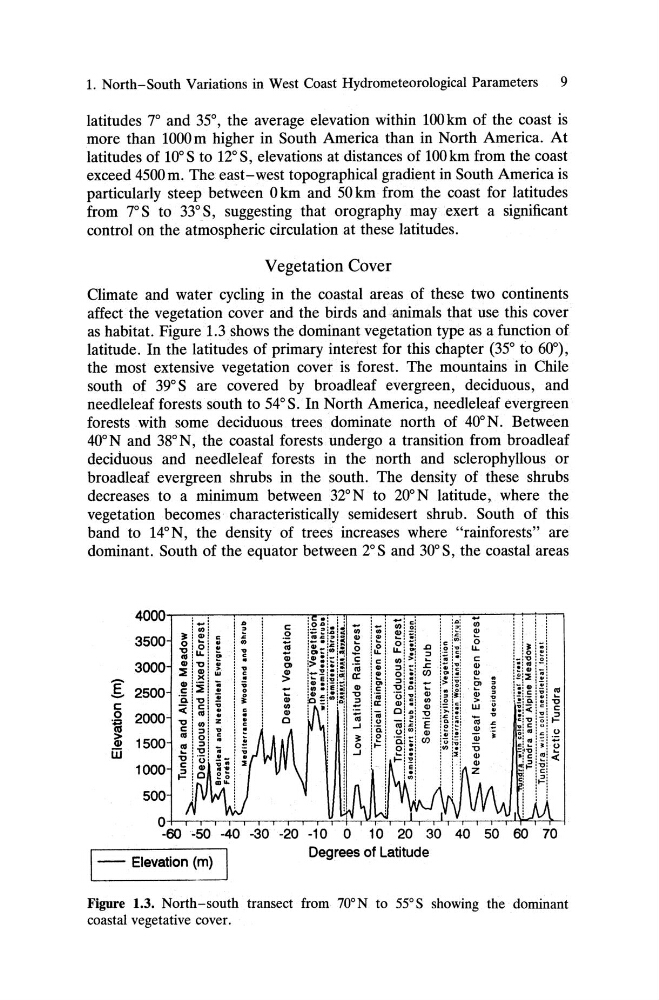
as habitat. Figure 1.3 shows the dominant vegetation type as a function of
latitude. In the latitudes of primary interest for this chapter (35° to 60°),
the most extensive vegetation cover is forest. The mountains in Chile
south of 39°S are covered by broadleaf evergreen, deciduous, and
needleleaf forests south to 54°S. In North America, needle leaf evergreen
forests with some deciduous trees dominate north of 40°N. Between
40°Nand 38°N, the coastal forests undergo a transition from broadleaf
deciduous and needleleaf forests in the north and sclerophyllous or
broadleaf evergreen shrubs in the south . The density of these shrubs
decreases to a minimum between 32°N to 20
0N
latitude , where the
vegetation becomes characteristically semidesert shrub. South of this
band to 14°N , the density of trees increases where " rainforests" are
dominant. South of the equator between 2°Sand 30°S, the coastal areas
4000.,...-..,.....;--,..--,...-;----;-;..-=-"':'"""!r---,-~-,--,.-.,..,...,.;-..-::;----.--,........,.........
3500
3000
g 2500
c
.g 2000
~
iii
1000
500
-30 -20 -10 0 10 20 30 40 50 60 70
Degrees of Latitude
Figure 1.3. North-south transect from 70
0N
to 55°S showing the dominant
coastal vegetative cover.
1. North-South Variations in West Coast Hydrometeorological Parameters 9
latitudes 7° and 35°, the average elevation within 100km of the coast is
more than 1000m higher in South America than in North America. At
latitudes of 10°S to 12°S, elevations at distances of 100km from the coast
exceed 4500m. The east-west topographical gradient in South America is
particularly steep between 0 km and 50 km from the coast for latitudes
from 7°S to 33°S, suggesting that orography may exert a significant
control on the atmospheric circulation at these latitudes.
Vegetation Cover
Climate and water cycling in the coastal areas of these two continents
affect the vegetation cover and the birds and animals that use this cover
as habitat. Figure 1.3 shows the dominant vegetation type as a function of
latitude. In the latitudes of primary interest for this chapter (35° to 60°),
the most extensive vegetation cover is forest. The mountains in Chile
south of 39°S are covered by broadleaf evergreen, deciduous, and
needleleaf forests south to 54°S. In North America, needle leaf evergreen
forests with some deciduous trees dominate north of 40°N. Between
40°Nand 38°N, the coastal forests undergo a transition from broadleaf
deciduous and needleleaf forests in the north and sclerophyllous or
broadleaf evergreen shrubs in the south . The density of these shrubs
decreases to a minimum between 32°N to 20
0N
latitude , where the
vegetation becomes characteristically semidesert shrub. South of this
band to 14°N , the density of trees increases where " rainforests" are
dominant. South of the equator between 2°Sand 30°S, the coastal areas
4000.,...-..,.....;--,..--,...-;----;-;..-=-"':'"""!r---,-~-,--,.-.,..,...,.;-..-::;----.--,........,.........
3500
3000
g 2500
c
.g 2000
~
iii
1000
500
-30 -20 -10 0 10 20 30 40 50 60 70
Degrees of Latitude
Figure 1.3. North-south transect from 70
0N
to 55°S showing the dominant
coastal vegetative cover.