

256
1.1. Armesto et al.
is due mainly to the extended blooming of the hemiparasite Tristerix
corymbosus.
Fruiting Phenology
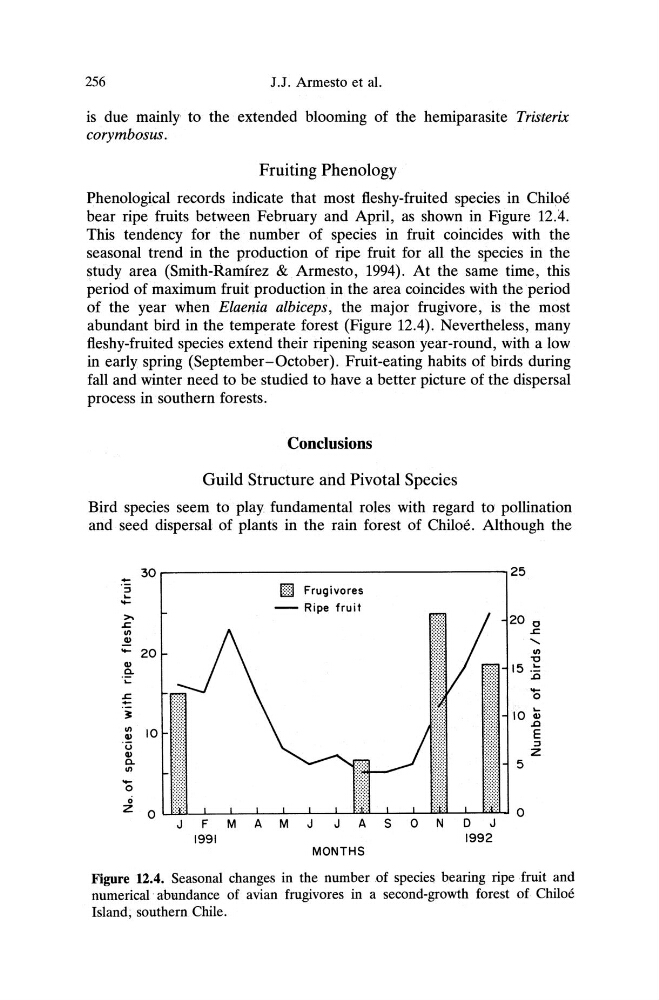
Phenological records indicate that most fleshy-fruited species in Chiloe
bear ripe fruits between February and April , as shown in Figure 12.4.
This tendency for the number of species in fruit coincides with the
seasonal trend in the production of ripe fruit for all the species in the
study area (Smith-Ramirez & Armesto, 1994). At the same time, this
period of maximum fruit production in the area coincides with the period
of the year when Elaenia albiceps, the major frugivore , is the most
abundant bird in the temperate forest (Figure 12.4). Nevertheless, many
fleshy-fruited species extend their ripening season year-round, with a low
in early spring (September-October). Fruit-eating habits of birds during
fall and winter need to be studied to have a better picture of the dispersal
process in southern forests.
Conclusions
Guild Structure and Pivotal Species
Bird species seem to play fundamental roles with regard to pollination
and seed dispersal of plants in the rain forest of Chiloe. Although the
20 0
s:
<,
III
"0
15 .:
.a
'0
\0 t
.a
E
::::J
Z
5
o J
1992
N
o
S
A
J
J
M
lillJ Frugivores
-
Ripe fruit
A
J
F
M
1991
30 r - - - - - - - - - - - - - - - - - - - - - - , 2 5
'+o
o
z 0 l-1:'1a.---l--JL.---l-_L---'-_L--=L--L---'-~=_........_"">:.:J...I 0
~
~ 10
'u
Q)
0III
>.
s:
III
~
'+- 20
Q)
0...
....
::::J
...
'+MONTHS
Figure 12.4. Seasonal changes in the number of species bearing ripe fruit and
numerical abundance of avian frugivores in a second-growth forest of Chiloe
Island; southern Chile.
1.1. Armesto et al.
is due mainly to the extended blooming of the hemiparasite Tristerix
corymbosus.
Fruiting Phenology
Phenological records indicate that most fleshy-fruited species in Chiloe
bear ripe fruits between February and April , as shown in Figure 12.4.
This tendency for the number of species in fruit coincides with the
seasonal trend in the production of ripe fruit for all the species in the
study area (Smith-Ramirez & Armesto, 1994). At the same time, this
period of maximum fruit production in the area coincides with the period
of the year when Elaenia albiceps, the major frugivore , is the most
abundant bird in the temperate forest (Figure 12.4). Nevertheless, many
fleshy-fruited species extend their ripening season year-round, with a low
in early spring (September-October). Fruit-eating habits of birds during
fall and winter need to be studied to have a better picture of the dispersal
process in southern forests.
Conclusions
Guild Structure and Pivotal Species
Bird species seem to play fundamental roles with regard to pollination
and seed dispersal of plants in the rain forest of Chiloe. Although the
20 0
s:
<,
III
"0
15 .:
.a
'0
\0 t
.a
E
::::J
Z
5
o J
1992
N
o
S
A
J
J
M
lillJ Frugivores
-
Ripe fruit
A
J
F
M
1991
30 r - - - - - - - - - - - - - - - - - - - - - - , 2 5
'+o
o
z 0 l-1:'1a.---l--JL.---l-_L---'-_L--=L--L---'-~=_........_"">:.:J...I 0
~
~ 10
'u
Q)
0III
>.
s:
III
~
'+- 20
Q)
0...
....
::::J
...
'+MONTHS
Figure 12.4. Seasonal changes in the number of species bearing ripe fruit and
numerical abundance of avian frugivores in a second-growth forest of Chiloe
Island; southern Chile.