

12. The Importance of Plant-Bird Mutualisms
255
of these species are seldom visited by insects. In a few cases where
insect visits have been reported, flower morphology should prevent insect
pollination (Smith-Ramirez , 1993). In addition, insect visitors of hummingbird flowers are known to be generalists, visiting the flowers of many
other plant species (Riveros , 1991), and hence it is unlikely that they can
be effective pollinators . Insect behavior contrasts sharply with the visiting
pattern of the hummingbird, which tends to concentrate on one species at
a time. It has also been noted that Sephanoides carries pollen of morphologically distinct flowers on different parts of its body, which may reduce
the chances of interspecific pollen transfer (Smith-Ramirez , personal
observation). This interesting observation needs to be quantified in future
work.
Flowering Phenology
In the temperate rainfores t region of Chile, hummingbirds are active all
year long, as can be observed in Figure 12.2, and, not surprisingly,
flowers visited by hummingbirds are found in bloom throughout the
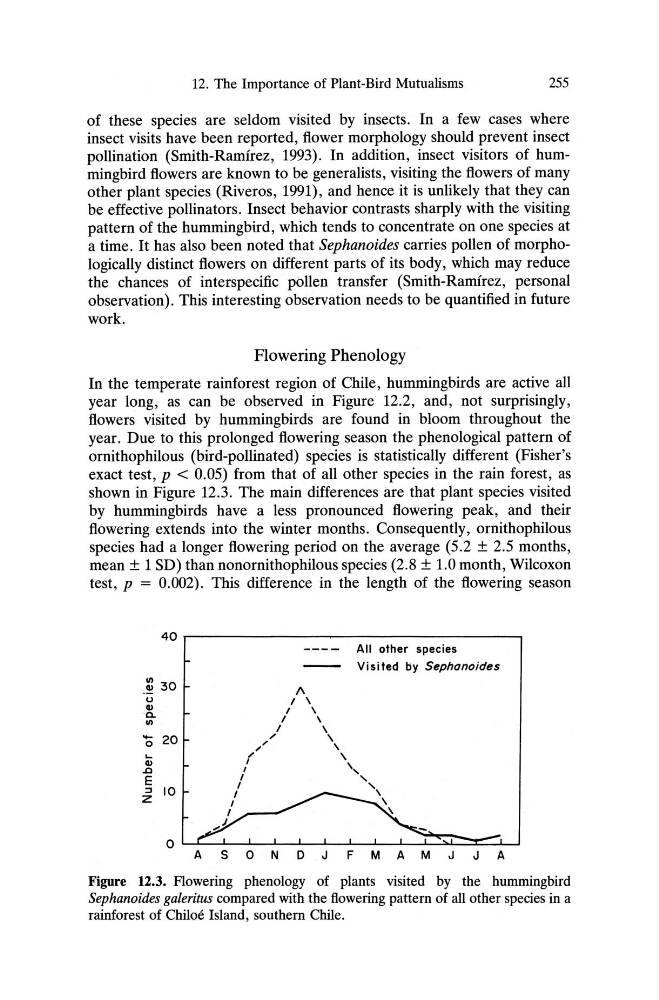
year. Due to this prolonged flowering season the phenological pattern of
ornithophilous (bird-pollinated) species is statistically different (Fisher's
exact test , p < 0.05) from that of all other species in the rain forest, as
shown in Figure 12.3. The main differences are that plant species visited
by hummingbirds have a less pronounced flowering peak , and their
flowering extends into the winter months. Consequently, ornithophilous
species had a longer flowering period on the average (5.2 ± 2.5 months,
mean ± 1 SD) than nonornithophilous species (2.8 ± 1.0 month, Wilcoxon
test , p = 0.002). This difference in the length of the flowering season
40
All ot her speci es
V i si t ed by Sephonoides
~ 30
A
0
\
Q)
\
'0t/)
\
\
.... 20
\
0
\
...
\
Q)
\ ,
.c
E
,
~
10
,
\
Z
\
\
0
A
S 0 N 0 J
F M A M
J
J
A
Figure 12.3. Flowering phenology of plants visited by the hummingbird
Sephanoides galeritus compared with the flowering pattern of all other species in a
rainforest of Chiloe Island, southern Chile.
255
of these species are seldom visited by insects. In a few cases where
insect visits have been reported, flower morphology should prevent insect
pollination (Smith-Ramirez , 1993). In addition, insect visitors of hummingbird flowers are known to be generalists, visiting the flowers of many
other plant species (Riveros , 1991), and hence it is unlikely that they can
be effective pollinators . Insect behavior contrasts sharply with the visiting
pattern of the hummingbird, which tends to concentrate on one species at
a time. It has also been noted that Sephanoides carries pollen of morphologically distinct flowers on different parts of its body, which may reduce
the chances of interspecific pollen transfer (Smith-Ramirez , personal
observation). This interesting observation needs to be quantified in future
work.
Flowering Phenology
In the temperate rainfores t region of Chile, hummingbirds are active all
year long, as can be observed in Figure 12.2, and, not surprisingly,
flowers visited by hummingbirds are found in bloom throughout the
year. Due to this prolonged flowering season the phenological pattern of
ornithophilous (bird-pollinated) species is statistically different (Fisher's
exact test , p < 0.05) from that of all other species in the rain forest, as
shown in Figure 12.3. The main differences are that plant species visited
by hummingbirds have a less pronounced flowering peak , and their
flowering extends into the winter months. Consequently, ornithophilous
species had a longer flowering period on the average (5.2 ± 2.5 months,
mean ± 1 SD) than nonornithophilous species (2.8 ± 1.0 month, Wilcoxon
test , p = 0.002). This difference in the length of the flowering season
40
All ot her speci es
V i si t ed by Sephonoides
~ 30
A
0
\
Q)
\
'0t/)
\
\
.... 20
\
0
\
...
\
Q)
\ ,
.c
E
,
~
10
,
\
Z
\
\
0
A
S 0 N 0 J
F M A M
J
J
A
Figure 12.3. Flowering phenology of plants visited by the hummingbird
Sephanoides galeritus compared with the flowering pattern of all other species in a
rainforest of Chiloe Island, southern Chile.