

8. Phytogeographic Relationships and Regional Richness Patterns
155
and there are fewer shade-tolerant angiosperms in the understory. In
the southern forests, absence of the woody bamboo Chusquea, a very
abundant plant of the understory north of about 48° S, is undoubtedly
another factor permitting higher shrub diversity.
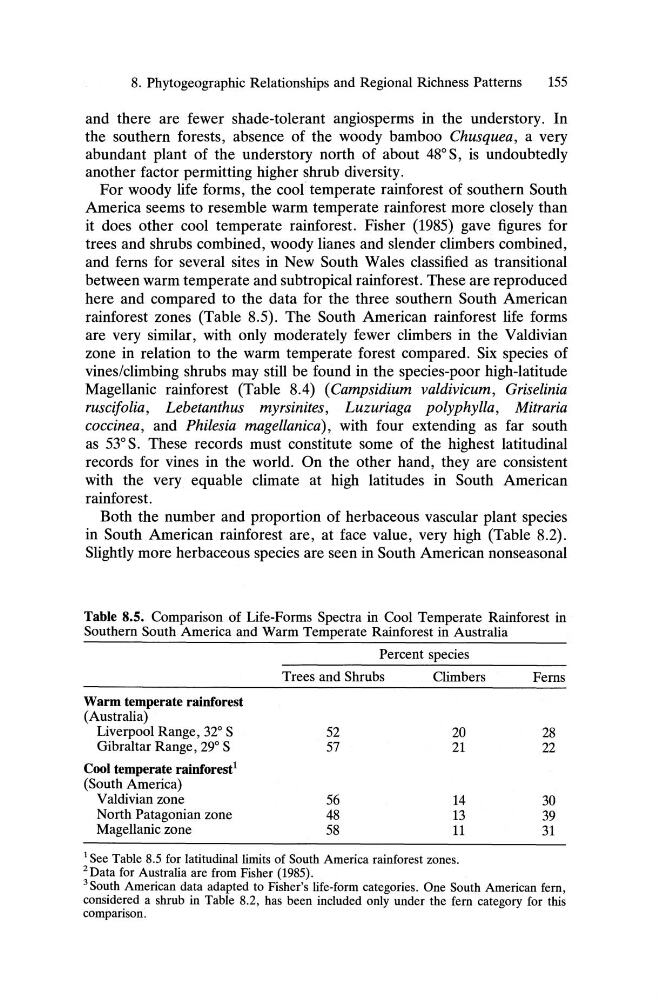
For woody life forms, the cool temperate rainforest of southern South
America seems to resemble warm temperate rainforest more closely than
it does other cool temperate rainforest. Fisher (1985) gave figures for
trees and shrubs combined, woody lianes and slender climbers combined,
and ferns for several sites in New South Wales classified as transitional
between warm temperate and subtropical rainforest. These are reproduced
here and compared to the data for the three southern South American
rainforest zones (Table 8.5). The South American rainforest life forms
are very similar, with only moderately fewer climbers in the Valdivian
zone in relation to the warm temperate forest compared. Six species of
vines/climbing shrubs may still be found in the species-poor high-latitude
Magellanic rainforest (Table 8.4) (Campsidium valdivicum, Griselinia
ruscifolia, Lebetanthus myrsinites, Luzuriaga polyphylla, Mitraria
coccinea, and Philesia magellanica), with four extending as far south
as 53° S. These records must constitute some of the highest latitudinal
records for vines in the world. On the other hand, they are consistent
with the very equable climate at high latitudes in South American
rainforest.
Both the number and proportion of herbaceous vascular plant . .species
in South American rainforest are, at face value, very high (Table 8.2).
Slightly more herbaceous species are seen in South American nonseasonal
Table 8.5. Comparison of Life-Forms Spectra in Cool Temperate Rainforest in
Southern South America and Warm Temperate Rainforest in Australia
Percent species
Trees and Shrubs
Climbers
Ferns
Warm temperate rainforest
(Australia)
Liverpool Range, 32° S
52
20
28
Gibraltar Range, 29° S
57
21
22
Cool temperate rainforest!
(South America)
Valdivian zone
56
14
30
North Patagonian zone
48
13
39
Magellanic zone
58
11
31
1 See Table 8.5 for latitudinal limits of South America rainforest zones.
2Data for Australia are from Fisher (1985).
3 South American data adapted to Fisher's life-form categories. One South American fern,
considered a shrub in Table 8.2, has been included only under the fern category for this
comparison.
155
and there are fewer shade-tolerant angiosperms in the understory. In
the southern forests, absence of the woody bamboo Chusquea, a very
abundant plant of the understory north of about 48° S, is undoubtedly
another factor permitting higher shrub diversity.
For woody life forms, the cool temperate rainforest of southern South
America seems to resemble warm temperate rainforest more closely than
it does other cool temperate rainforest. Fisher (1985) gave figures for
trees and shrubs combined, woody lianes and slender climbers combined,
and ferns for several sites in New South Wales classified as transitional
between warm temperate and subtropical rainforest. These are reproduced
here and compared to the data for the three southern South American
rainforest zones (Table 8.5). The South American rainforest life forms
are very similar, with only moderately fewer climbers in the Valdivian
zone in relation to the warm temperate forest compared. Six species of
vines/climbing shrubs may still be found in the species-poor high-latitude
Magellanic rainforest (Table 8.4) (Campsidium valdivicum, Griselinia
ruscifolia, Lebetanthus myrsinites, Luzuriaga polyphylla, Mitraria
coccinea, and Philesia magellanica), with four extending as far south
as 53° S. These records must constitute some of the highest latitudinal
records for vines in the world. On the other hand, they are consistent
with the very equable climate at high latitudes in South American
rainforest.
Both the number and proportion of herbaceous vascular plant . .species
in South American rainforest are, at face value, very high (Table 8.2).
Slightly more herbaceous species are seen in South American nonseasonal
Table 8.5. Comparison of Life-Forms Spectra in Cool Temperate Rainforest in
Southern South America and Warm Temperate Rainforest in Australia
Percent species
Trees and Shrubs
Climbers
Ferns
Warm temperate rainforest
(Australia)
Liverpool Range, 32° S
52
20
28
Gibraltar Range, 29° S
57
21
22
Cool temperate rainforest!
(South America)
Valdivian zone
56
14
30
North Patagonian zone
48
13
39
Magellanic zone
58
11
31
1 See Table 8.5 for latitudinal limits of South America rainforest zones.
2Data for Australia are from Fisher (1985).
3 South American data adapted to Fisher's life-form categories. One South American fern,
considered a shrub in Table 8.2, has been included only under the fern category for this
comparison.