

154
M.T.K. Arroyo et al.
ferns are abundant (Jarman, Brown, & Kantvilas, 1984). In the New
Zealand cool temperate rainforest, nevertheless, vines and vascular
epiphytes can be numerous (Dickinson, Mark , & Dawkins, 1993).
South American forests also differ from their northern counterparts in
the proportional representation of shrubs . Although the number of shrubs
in the nonseasonal rainforest is similar to that reported by Alaback (this
volume) , they are in lower proportion relative to trees and all woody
species. This lower representation of shrubs might reflect an often dense
understory of shade -tolerant angiosperm saplings. South American shrubs
tend to be more common in gaps and on the forest edge , failing to form a
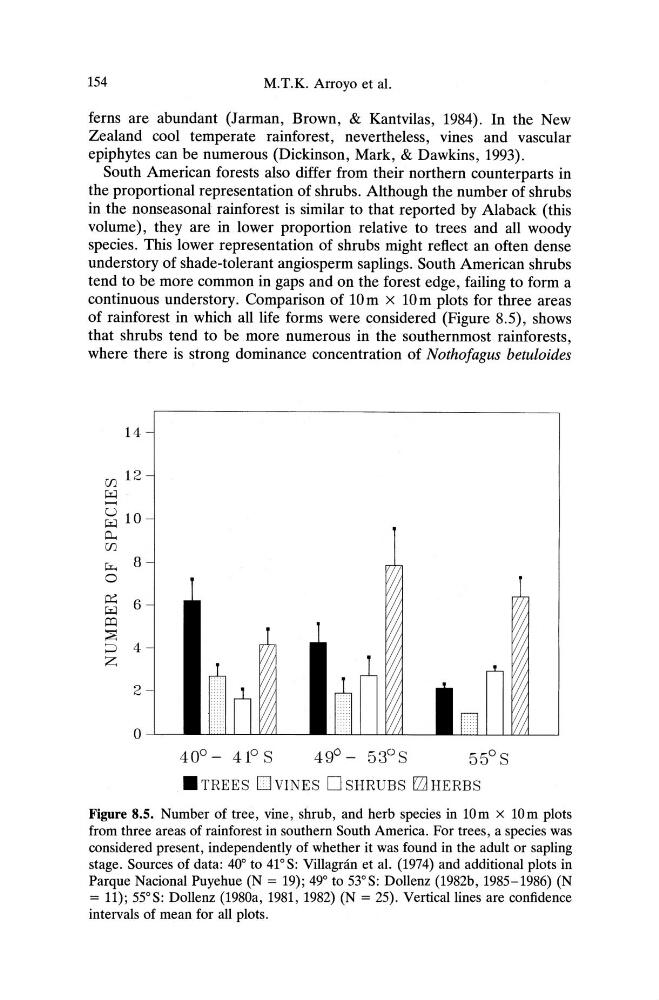
continuous understory. Comparison of 10m X 10m plots for three areas
of rainforest in which all life forms were considered (Figure 8.5), shows
that shrubs tend to be more numerous in the southernmost rainforests,
where there is strong dominance concentration of Nothofagus betuloides
14
o: 1 2
~
-
u 10
~
0...
tr:
~
8
0
P::: 6
~
CO
::E
::::J 4
Z
2
0
4 0° - 4 1° S
4 9° - 53° S
5 5°S
• TREES 0 VI NES 0 SHRUBS fZJ HERBS
Figure 8.5. Number of tree , vine, shrub , and herb species in 10m x 10m plots
from three areas of rainforest in southern South America . For trees , a species was
considered present , independently of whether it was found in the adult or sapling
stage. Sources of data : 40° to 41°S: Villagran et al. (1974) and additional plots in
Parque Nacional Puyehue (N = 19); 49° to 53°S: Dollenz (1982b, 1985-1986) (N
= 11); 55°S: Dollenz (1980a , 1981, 1982) (N = 25). Vertical lines are confidence
intervals of mean for all plots.
M.T.K. Arroyo et al.
ferns are abundant (Jarman, Brown, & Kantvilas, 1984). In the New
Zealand cool temperate rainforest, nevertheless, vines and vascular
epiphytes can be numerous (Dickinson, Mark , & Dawkins, 1993).
South American forests also differ from their northern counterparts in
the proportional representation of shrubs . Although the number of shrubs
in the nonseasonal rainforest is similar to that reported by Alaback (this
volume) , they are in lower proportion relative to trees and all woody
species. This lower representation of shrubs might reflect an often dense
understory of shade -tolerant angiosperm saplings. South American shrubs
tend to be more common in gaps and on the forest edge , failing to form a
continuous understory. Comparison of 10m X 10m plots for three areas
of rainforest in which all life forms were considered (Figure 8.5), shows
that shrubs tend to be more numerous in the southernmost rainforests,
where there is strong dominance concentration of Nothofagus betuloides
14
o: 1 2
~
-
u 10
~
0...
tr:
~
8
0
P::: 6
~
CO
::E
::::J 4
Z
2
0
4 0° - 4 1° S
4 9° - 53° S
5 5°S
• TREES 0 VI NES 0 SHRUBS fZJ HERBS
Figure 8.5. Number of tree , vine, shrub , and herb species in 10m x 10m plots
from three areas of rainforest in southern South America . For trees , a species was
considered present , independently of whether it was found in the adult or sapling
stage. Sources of data : 40° to 41°S: Villagran et al. (1974) and additional plots in
Parque Nacional Puyehue (N = 19); 49° to 53°S: Dollenz (1982b, 1985-1986) (N
= 11); 55°S: Dollenz (1980a , 1981, 1982) (N = 25). Vertical lines are confidence
intervals of mean for all plots.