

6. Constraints on Terrestrial Primary Productivity
95
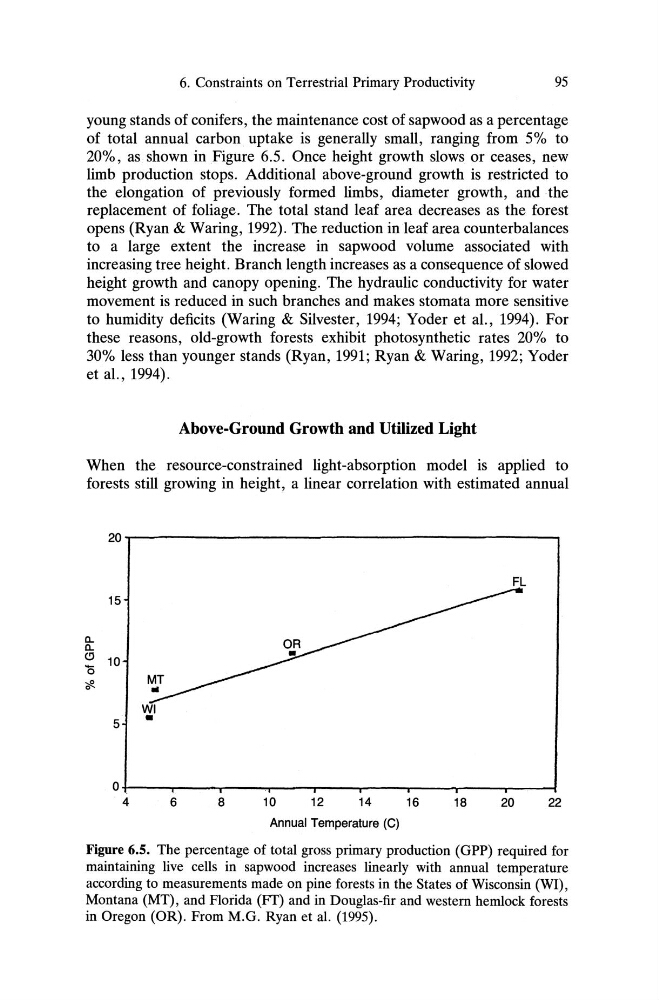
young stands of conifers, the maintenance cost of sapwood as a percentage
of total annual carbon uptake is generally small, ranging from 5% to
20%, as shown in Figure 6.5. Once height growth slows or ceases, new
limb production stops. Additional above-ground growth is restricted to
the elongation of previously formed limbs, diameter growth, and the
replacement of foliage. The total stand leaf area decreases as the forest
opens (Ryan & Waring, 1992). The reduction in leaf area counterbalances
to a large extent the increase in sapwood volume associated with
increasing tree height. Branch length increases as a consequence of slowed
height growth and canopy opening. The hydraulic conductivity for water
movement is reduced in such branches and makes stomata more sensitive
to humidity deficits (Waring & Silvester, 1994; Yoder et al., 1994). For
these reasons, old-growth forests exhibit photosynthetic rates 20% to
30% less than younger stands (Ryan, 1991; Ryan & Waring, 1992; Yoder
et al., 1994).
Above-Ground Growth and Utilized Light
When the resource-constrained light-absorption model is applied to
forests still growing in height, a linear correlation with estimated annual
20
FL
15
a..
a..
C)
10
15
5
•
22
20
18
16
14
12
10
8
6
O+---.--,--~--,----r---.------r---.--~
4
Annual Temperature (C)
Figure 6.5. The percentage of total gross primary production (GPP) required for
maintaining live cells in sapwood increases linearly with annual temperature
according to measurements made on pine forests in the States of Wisconsin (WI),
Montana (MT), and Florida (FT) and in Douglas-fir and western hemlock forests
in Oregon (OR) . From M.G. Ryan et al. (1995).
95
young stands of conifers, the maintenance cost of sapwood as a percentage
of total annual carbon uptake is generally small, ranging from 5% to
20%, as shown in Figure 6.5. Once height growth slows or ceases, new
limb production stops. Additional above-ground growth is restricted to
the elongation of previously formed limbs, diameter growth, and the
replacement of foliage. The total stand leaf area decreases as the forest
opens (Ryan & Waring, 1992). The reduction in leaf area counterbalances
to a large extent the increase in sapwood volume associated with
increasing tree height. Branch length increases as a consequence of slowed
height growth and canopy opening. The hydraulic conductivity for water
movement is reduced in such branches and makes stomata more sensitive
to humidity deficits (Waring & Silvester, 1994; Yoder et al., 1994). For
these reasons, old-growth forests exhibit photosynthetic rates 20% to
30% less than younger stands (Ryan, 1991; Ryan & Waring, 1992; Yoder
et al., 1994).
Above-Ground Growth and Utilized Light
When the resource-constrained light-absorption model is applied to
forests still growing in height, a linear correlation with estimated annual
20
FL
15
a..
a..
C)
10
15
5
•
22
20
18
16
14
12
10
8
6
O+---.--,--~--,----r---.------r---.--~
4
Annual Temperature (C)
Figure 6.5. The percentage of total gross primary production (GPP) required for
maintaining live cells in sapwood increases linearly with annual temperature
according to measurements made on pine forests in the States of Wisconsin (WI),
Montana (MT), and Florida (FT) and in Douglas-fir and western hemlock forests
in Oregon (OR) . From M.G. Ryan et al. (1995).