

6. Constraints on Terrestrial Primary Productivity
93
interacting factors that limit stomata opening were combined into a
simulation model by Running, Waring , and Rydell (1975) to predict daily
transpiration. Models with both hourly and daily resolution have been
compared and proved in close agreement (Running, 1984). The equations
and defined thresholds that apply for this water balance model underlie
the curent FOREST-BGC ecosystem simulator.
Nutrition
In the Pacific Northwest, nitrogen is generally the most common element
limiting growth . Because of its organic origin, nitrogen is concentrated in
the upper soil horizons . When drought occurs , roots must extract water
from lower horizons, causing the concentration of nitrogen in the sap
stream to decrease significantly even if water uptake is not affected
(Goulden, 1991; Stark, Essig, & Baker, 1989). The resulting decrease in
the flux of nitrogen to leaves limits further growth of foliage much more
than it does photosynthesis. When nutrients are not readily available,
canopy development is restricted and the ability to absorb solar radiation
is reduced. Generally, there is also an increase in the proportion of
carbon allocated to root growth (Mooney, 1972; Running & Gower,
1991; Waring & Schlesinger , 1985).
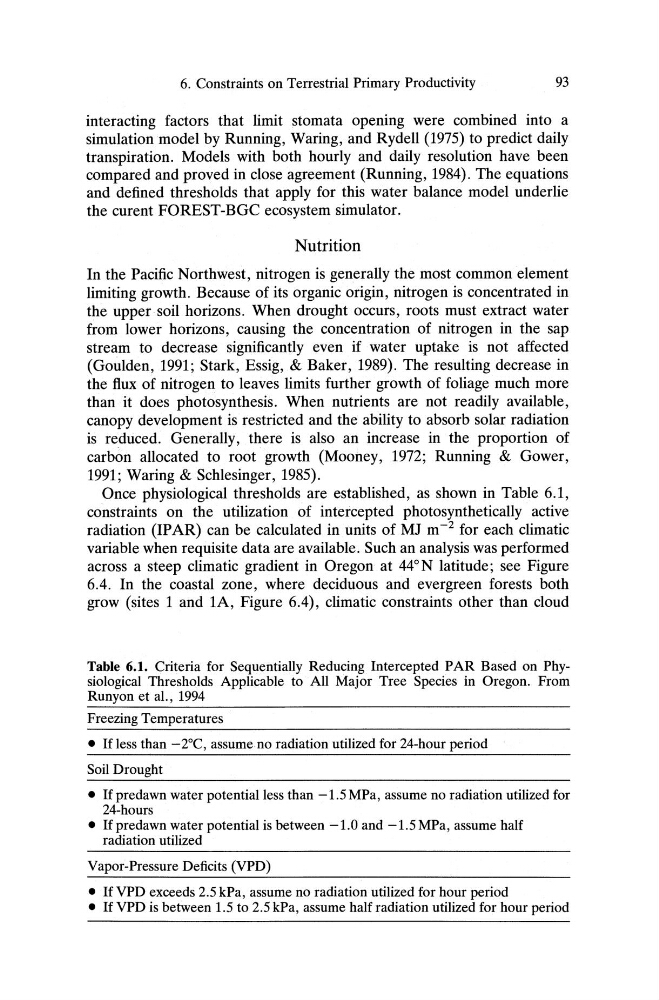
Once physiological thresholds are established, as shown in Table 6.1,
constraints on the utilization of intercepted photosynthetically active
radiation (IPAR) can be calculated in units of MJ m-2 for each climatic
variable when requisite data are available, Such an analysis was performed
across a steep climatic gradient in Oregon at 44°N latitude; see Figure
6.4. In the coastal zone, where deciduous and evergreen forests both
grow (sites 1 and lA, Figure 6.4), climatic constraints other than cloud
Table 6.1. Criteria for Sequentially Reducing Intercepted PAR Based on Physiological Thresholds Applicable to All Major Tree Species in Oregon . From
Runyon et aI., 1994
Freezing Temperatures
• If less than -2°C, assume no radiation utilized for 24-hour period
Soil Drought
• If predawn water potential less than -1.5 MPa, assume no radiation utilized for
24-hours
• If predawn water potential is between -1.0 and -1.5 MPa, assume half
radiation utilized
Vapor-Pressure Deficits (VPD)
• If VPD exceeds 2.5 kPa, assume no radiation utilized for hour period
• If VPD is between 1.5 to 2.5 kPa, assume half radiation utilized for hour period
93
interacting factors that limit stomata opening were combined into a
simulation model by Running, Waring , and Rydell (1975) to predict daily
transpiration. Models with both hourly and daily resolution have been
compared and proved in close agreement (Running, 1984). The equations
and defined thresholds that apply for this water balance model underlie
the curent FOREST-BGC ecosystem simulator.
Nutrition
In the Pacific Northwest, nitrogen is generally the most common element
limiting growth . Because of its organic origin, nitrogen is concentrated in
the upper soil horizons . When drought occurs , roots must extract water
from lower horizons, causing the concentration of nitrogen in the sap
stream to decrease significantly even if water uptake is not affected
(Goulden, 1991; Stark, Essig, & Baker, 1989). The resulting decrease in
the flux of nitrogen to leaves limits further growth of foliage much more
than it does photosynthesis. When nutrients are not readily available,
canopy development is restricted and the ability to absorb solar radiation
is reduced. Generally, there is also an increase in the proportion of
carbon allocated to root growth (Mooney, 1972; Running & Gower,
1991; Waring & Schlesinger , 1985).
Once physiological thresholds are established, as shown in Table 6.1,
constraints on the utilization of intercepted photosynthetically active
radiation (IPAR) can be calculated in units of MJ m-2 for each climatic
variable when requisite data are available, Such an analysis was performed
across a steep climatic gradient in Oregon at 44°N latitude; see Figure
6.4. In the coastal zone, where deciduous and evergreen forests both
grow (sites 1 and lA, Figure 6.4), climatic constraints other than cloud
Table 6.1. Criteria for Sequentially Reducing Intercepted PAR Based on Physiological Thresholds Applicable to All Major Tree Species in Oregon . From
Runyon et aI., 1994
Freezing Temperatures
• If less than -2°C, assume no radiation utilized for 24-hour period
Soil Drought
• If predawn water potential less than -1.5 MPa, assume no radiation utilized for
24-hours
• If predawn water potential is between -1.0 and -1.5 MPa, assume half
radiation utilized
Vapor-Pressure Deficits (VPD)
• If VPD exceeds 2.5 kPa, assume no radiation utilized for hour period
• If VPD is between 1.5 to 2.5 kPa, assume half radiation utilized for hour period