

367
(ecosystem-based disaster risk reduction). Although green infrastructure may be
inferior to gray infrastructure in terms of disaster prevention from inundation and
erosion, depending on the type of ecosystem, various other ecosystem services
including climate change mitigation can be expected by utilizing green
infrastructure.
Furthermore, by appropriately maintaining and managing green infrastructure,
we can not only prevent its deterioration, but also expect enhanced functioning via
the growth of ecosystem components. As a result, maintenance and management
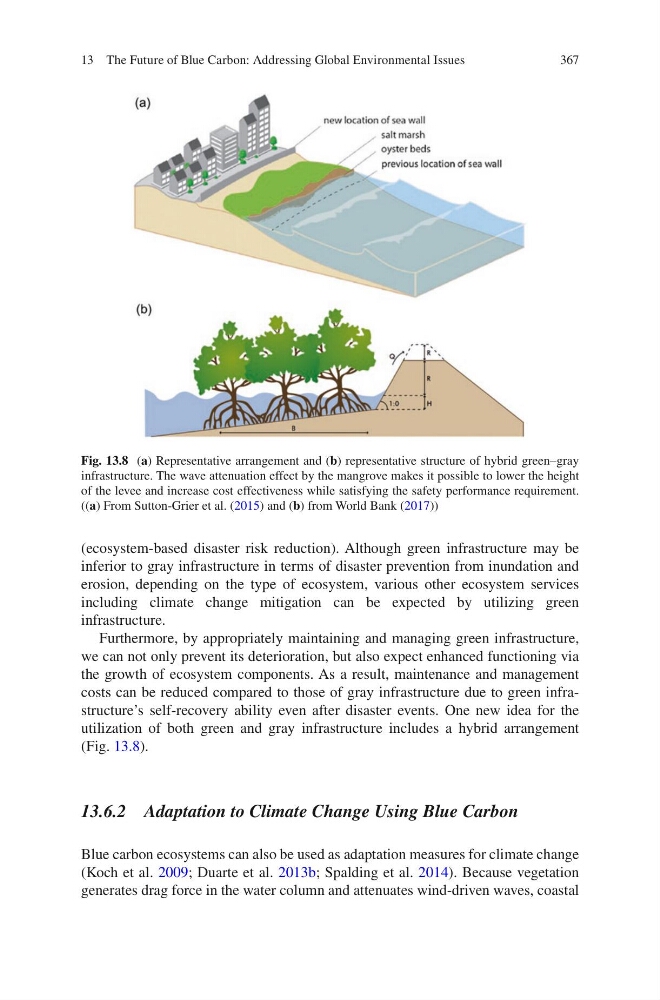
costs can be reduced compared to those of gray infrastructure due to green infrastructure’s self-recovery ability even after disaster events. One new idea for the
utilization of both green and gray infrastructure includes a hybrid arrangement
(Fig. 13.8).
13.6.2 Adaptation to Climate Change Using Blue Carbon
Blue carbon ecosystems can also be used as adaptation measures for climate change
(Koch et al. 2009; Duarte et al. 2013b; Spalding et al. 2014). Because vegetation
generates drag force in the water column and attenuates wind-driven waves, coastal
Fig. 13.8 (a) Representative arrangement and (b) representative structure of hybrid green–gray
infrastructure. The wave attenuation effect by the mangrove makes it possible to lower the height
of the levee and increase cost effectiveness while satisfying the safety performance requirement.
((a) From Sutton-Grier et al. (2015) and (b) from World Bank (2017))
13 The Future of Blue Carbon: Addressing Global Environmental Issues
(ecosystem-based disaster risk reduction). Although green infrastructure may be
inferior to gray infrastructure in terms of disaster prevention from inundation and
erosion, depending on the type of ecosystem, various other ecosystem services
including climate change mitigation can be expected by utilizing green
infrastructure.
Furthermore, by appropriately maintaining and managing green infrastructure,
we can not only prevent its deterioration, but also expect enhanced functioning via
the growth of ecosystem components. As a result, maintenance and management
costs can be reduced compared to those of gray infrastructure due to green infrastructure’s self-recovery ability even after disaster events. One new idea for the
utilization of both green and gray infrastructure includes a hybrid arrangement
(Fig. 13.8).
13.6.2 Adaptation to Climate Change Using Blue Carbon
Blue carbon ecosystems can also be used as adaptation measures for climate change
(Koch et al. 2009; Duarte et al. 2013b; Spalding et al. 2014). Because vegetation
generates drag force in the water column and attenuates wind-driven waves, coastal
Fig. 13.8 (a) Representative arrangement and (b) representative structure of hybrid green–gray
infrastructure. The wave attenuation effect by the mangrove makes it possible to lower the height
of the levee and increase cost effectiveness while satisfying the safety performance requirement.
((a) From Sutton-Grier et al. (2015) and (b) from World Bank (2017))
13 The Future of Blue Carbon: Addressing Global Environmental Issues