

305
from urban/agricultural land uses and wastewater treatment that reduces the labile
organic carbon load are important factors in a human-impacted SCE becoming a net
sink for atmospheric CO 2 .
However, the inflow of treated water may accelerate decomposition of refractory
organic matter in a SCE and may somewhat slow the decrease of CO 2 concentration
in seawater. This is due to the “priming effect” of decomposing refractory organic
matter, which is enhanced at high nutrient concentrations (Taylor and Townsend
2010; Jiao et al. 2014). This phenomenon occurs due to the presence of bacteria that
decompose and mineralize refractory organic matter using nutrients in the natural
environment. Therefore, how the interaction between refractory organic matter and
nutrients affects carbon storage is complex.
11.3.2 Freshwater Inflow, Stratification, and Hypoxic Water
Mass
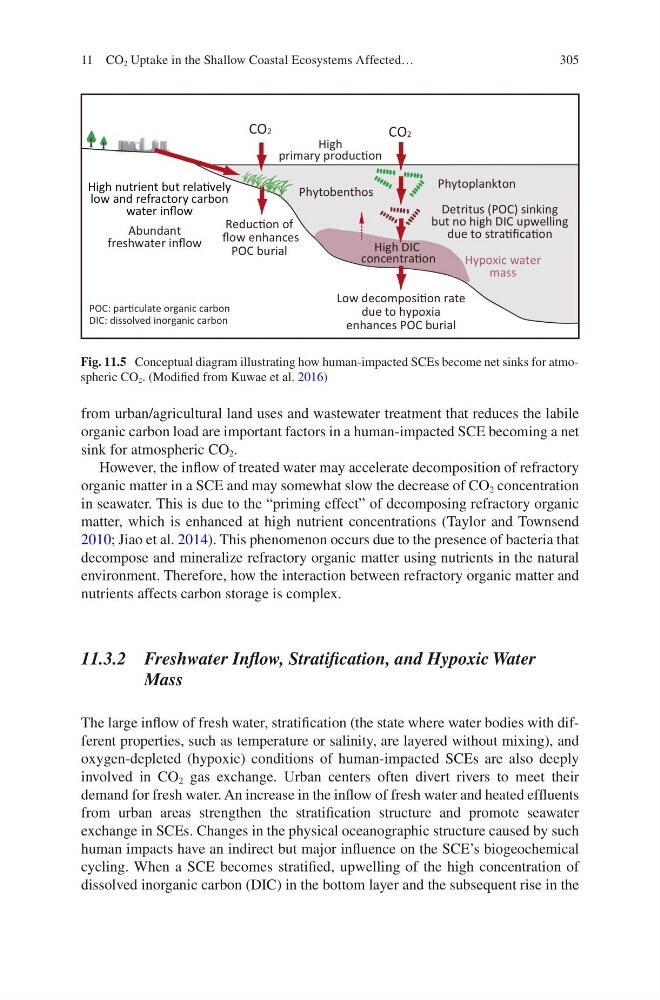
The large inflow of fresh water, stratification (the state where water bodies with different properties, such as temperature or salinity, are layered without mixing), and
oxygen-depleted (hypoxic) conditions of human-impacted SCEs are also deeply
involved in CO 2 gas exchange. Urban centers often divert rivers to meet their
demand for fresh water. An increase in the inflow of fresh water and heated effluents
from urban areas strengthen the stratification structure and promote seawater
exchange in SCEs. Changes in the physical oceanographic structure caused by such
human impacts have an indirect but major influence on the SCE’s biogeochemical
cycling. When a SCE becomes stratified, upwelling of the high concentration of
dissolved inorganic carbon (DIC) in the bottom layer and the subsequent rise in the
CO2
ReducƟon of
flow enhances
POC burial
Phytoplankton
Phytobenthos
Abundant
freshwater inflow
Hypoxic water
mass
Low decomposiƟon rate
due to hypoxia
enhances POC burial
Detritus (POC) sinking
but no high DIC upwelling
due to straƟficaƟon
CO2
High
primary producƟon
High DIC
concentraƟon
High nutrient but relaƟvely
low and refractory carbon
water inflow
POC: parƟculate organic carbon
DIC: dissolved inorganic carbon
Fig. 11.5 Conceptual diagram illustrating how human-impacted SCEs become net sinks for atmospheric CO 2 . (Modified from Kuwae et al. 2016)
11 CO 2 Uptake in the Shallow Coastal Ecosystems Affected…
from urban/agricultural land uses and wastewater treatment that reduces the labile
organic carbon load are important factors in a human-impacted SCE becoming a net
sink for atmospheric CO 2 .
However, the inflow of treated water may accelerate decomposition of refractory
organic matter in a SCE and may somewhat slow the decrease of CO 2 concentration
in seawater. This is due to the “priming effect” of decomposing refractory organic
matter, which is enhanced at high nutrient concentrations (Taylor and Townsend
2010; Jiao et al. 2014). This phenomenon occurs due to the presence of bacteria that
decompose and mineralize refractory organic matter using nutrients in the natural
environment. Therefore, how the interaction between refractory organic matter and
nutrients affects carbon storage is complex.
11.3.2 Freshwater Inflow, Stratification, and Hypoxic Water
Mass
The large inflow of fresh water, stratification (the state where water bodies with different properties, such as temperature or salinity, are layered without mixing), and
oxygen-depleted (hypoxic) conditions of human-impacted SCEs are also deeply
involved in CO 2 gas exchange. Urban centers often divert rivers to meet their
demand for fresh water. An increase in the inflow of fresh water and heated effluents
from urban areas strengthen the stratification structure and promote seawater
exchange in SCEs. Changes in the physical oceanographic structure caused by such
human impacts have an indirect but major influence on the SCE’s biogeochemical
cycling. When a SCE becomes stratified, upwelling of the high concentration of
dissolved inorganic carbon (DIC) in the bottom layer and the subsequent rise in the
CO2
ReducƟon of
flow enhances
POC burial
Phytoplankton
Phytobenthos
Abundant
freshwater inflow
Hypoxic water
mass
Low decomposiƟon rate
due to hypoxia
enhances POC burial
Detritus (POC) sinking
but no high DIC upwelling
due to straƟficaƟon
CO2
High
primary producƟon
High DIC
concentraƟon
High nutrient but relaƟvely
low and refractory carbon
water inflow
POC: parƟculate organic carbon
DIC: dissolved inorganic carbon
Fig. 11.5 Conceptual diagram illustrating how human-impacted SCEs become net sinks for atmospheric CO 2 . (Modified from Kuwae et al. 2016)
11 CO 2 Uptake in the Shallow Coastal Ecosystems Affected…