

298
11.2 CO 2 Uptake and Carbon Storage in SCEs
11.2.1 Relationship Between Carbon Storage and CO 2 Uptake
The essential functions required when considering mitigating climate change by
utilizing blue carbon ecosystems are storing carbon (Miyajima and Hamaguchi
2018) and subsequently suppressing CO 2 emission to the atmosphere, net direct
atmospheric CO 2 uptake (Tokoro et al. 2018), or both. However, SCEs are generally
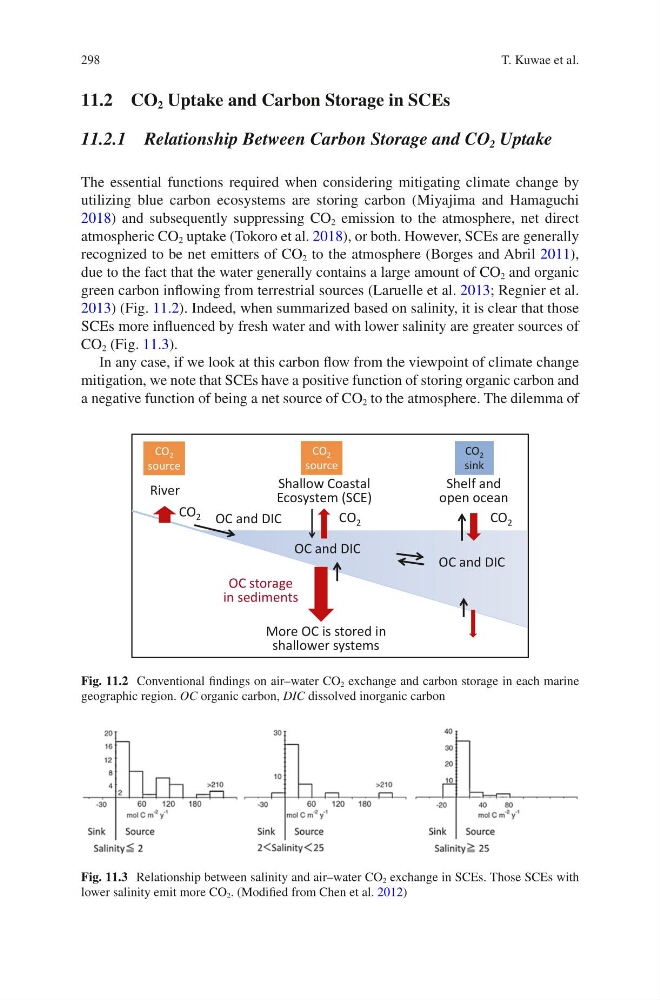
recognized to be net emitters of CO 2 to the atmosphere (Borges and Abril 2011),
due to the fact that the water generally contains a large amount of CO 2 and organic
green carbon inflowing from terrestrial sources (Laruelle et al. 2013; Regnier et al.
2013) (Fig. 11.2). Indeed, when summarized based on salinity, it is clear that those
SCEs more influenced by fresh water and with lower salinity are greater sources of
CO 2 (Fig. 11.3).
In any case, if we look at this carbon flow from the viewpoint of climate change
mitigation, we note that SCEs have a positive function of storing organic carbon and
a negative function of being a net source of CO 2 to the atmosphere. The dilemma of
River
CO 2
source
CO 2
sink
OC and DIC
CO 2
CO 2
source
CO 2
CO 2
Shelf and
open ocean
Shallow Coastal
Ecosystem (SCE)
OC and DIC
OC and DIC
OC storage
in sediments
More OC is stored in
shallower systems
Fig. 11.2 Conventional findings on air–water CO 2 exchange and carbon storage in each marine
geographic region. OC organic carbon, DIC dissolved inorganic carbon
Fig. 11.3 Relationship between salinity and air–water CO 2 exchange in SCEs. Those SCEs with
lower salinity emit more CO 2 . (Modified from Chen et al. 2012)
T. Kuwae et al.
11.2 CO 2 Uptake and Carbon Storage in SCEs
11.2.1 Relationship Between Carbon Storage and CO 2 Uptake
The essential functions required when considering mitigating climate change by
utilizing blue carbon ecosystems are storing carbon (Miyajima and Hamaguchi
2018) and subsequently suppressing CO 2 emission to the atmosphere, net direct
atmospheric CO 2 uptake (Tokoro et al. 2018), or both. However, SCEs are generally
recognized to be net emitters of CO 2 to the atmosphere (Borges and Abril 2011),
due to the fact that the water generally contains a large amount of CO 2 and organic
green carbon inflowing from terrestrial sources (Laruelle et al. 2013; Regnier et al.
2013) (Fig. 11.2). Indeed, when summarized based on salinity, it is clear that those
SCEs more influenced by fresh water and with lower salinity are greater sources of
CO 2 (Fig. 11.3).
In any case, if we look at this carbon flow from the viewpoint of climate change
mitigation, we note that SCEs have a positive function of storing organic carbon and
a negative function of being a net source of CO 2 to the atmosphere. The dilemma of
River
CO 2
source
CO 2
sink
OC and DIC
CO 2
CO 2
source
CO 2
CO 2
Shelf and
open ocean
Shallow Coastal
Ecosystem (SCE)
OC and DIC
OC and DIC
OC storage
in sediments
More OC is stored in
shallower systems
Fig. 11.2 Conventional findings on air–water CO 2 exchange and carbon storage in each marine
geographic region. OC organic carbon, DIC dissolved inorganic carbon
Fig. 11.3 Relationship between salinity and air–water CO 2 exchange in SCEs. Those SCEs with
lower salinity emit more CO 2 . (Modified from Chen et al. 2012)
T. Kuwae et al.