

297
treatment have large impacts on the cycling of biogeochemical elements (e.g., carbon, nitrogen, and phosphorus) in the ecosystem (McIntyre et al. 2000), they may
also have an impact on the uptake of atmospheric CO 2 and carbon storage within the
ecosystem.
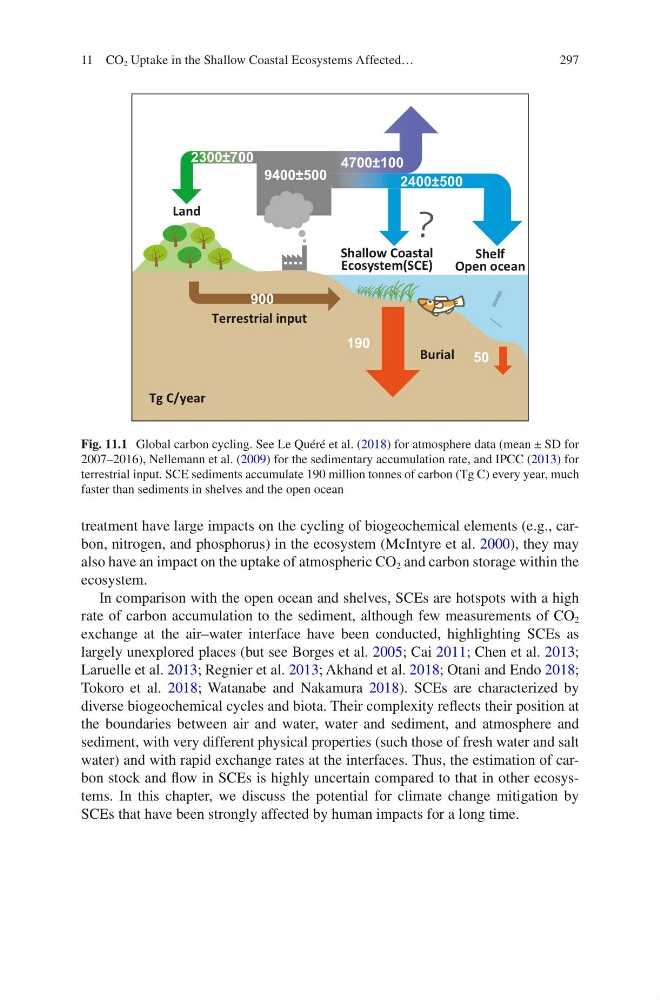
In comparison with the open ocean and shelves, SCEs are hotspots with a high
rate of carbon accumulation to the sediment, although few measurements of CO 2
exchange at the air–water interface have been conducted, highlighting SCEs as
largely unexplored places (but see Borges et al. 2005; Cai 2011; Chen et al. 2013;
Laruelle et al. 2013; Regnier et al. 2013; Akhand et al. 2018; Otani and Endo 2018;
Tokoro et al. 2018; Watanabe and Nakamura 2018). SCEs are characterized by
diverse biogeochemical cycles and biota. Their complexity reflects their position at
the boundaries between air and water, water and sediment, and atmosphere and
sediment, with very different physical properties (such those of fresh water and salt
water) and with rapid exchange rates at the interfaces. Thus, the estimation of carbon stock and flow in SCEs is highly uncertain compared to that in other ecosystems. In this chapter, we discuss the potential for climate change mitigation by
SCEs that have been strongly affected by human impacts for a long time.
9400±500
2300±700
4700±100
2400±500
900
190
50
Land
Shallow Coastal
Ecosystem(SCE)
Terrestrial input
Shelf
Open ocean
Burial
Tg C/year
Fig. 11.1 Global carbon cycling. See Le Quéré et al. (2018) for atmosphere data (mean ± SD for
2007–2016), Nellemann et al. (2009) for the sedimentary accumulation rate, and IPCC (2013) for
terrestrial input. SCE sediments accumulate 190 million tonnes of carbon (Tg C) every year, much
faster than sediments in shelves and the open ocean
11 CO 2 Uptake in the Shallow Coastal Ecosystems Affected…
treatment have large impacts on the cycling of biogeochemical elements (e.g., carbon, nitrogen, and phosphorus) in the ecosystem (McIntyre et al. 2000), they may
also have an impact on the uptake of atmospheric CO 2 and carbon storage within the
ecosystem.
In comparison with the open ocean and shelves, SCEs are hotspots with a high
rate of carbon accumulation to the sediment, although few measurements of CO 2
exchange at the air–water interface have been conducted, highlighting SCEs as
largely unexplored places (but see Borges et al. 2005; Cai 2011; Chen et al. 2013;
Laruelle et al. 2013; Regnier et al. 2013; Akhand et al. 2018; Otani and Endo 2018;
Tokoro et al. 2018; Watanabe and Nakamura 2018). SCEs are characterized by
diverse biogeochemical cycles and biota. Their complexity reflects their position at
the boundaries between air and water, water and sediment, and atmosphere and
sediment, with very different physical properties (such those of fresh water and salt
water) and with rapid exchange rates at the interfaces. Thus, the estimation of carbon stock and flow in SCEs is highly uncertain compared to that in other ecosystems. In this chapter, we discuss the potential for climate change mitigation by
SCEs that have been strongly affected by human impacts for a long time.
9400±500
2300±700
4700±100
2400±500
900
190
50
Land
Shallow Coastal
Ecosystem(SCE)
Terrestrial input
Shelf
Open ocean
Burial
Tg C/year
Fig. 11.1 Global carbon cycling. See Le Quéré et al. (2018) for atmosphere data (mean ± SD for
2007–2016), Nellemann et al. (2009) for the sedimentary accumulation rate, and IPCC (2013) for
terrestrial input. SCE sediments accumulate 190 million tonnes of carbon (Tg C) every year, much
faster than sediments in shelves and the open ocean
11 CO 2 Uptake in the Shallow Coastal Ecosystems Affected…