

283
Carbon export studies from coral reefs are obviously limited and need a more
integrated approach in the future. First, the carbon fluxes should be studied together
with in-reef productivity measurements to understand their interrelationships.
Seasonal variations as well as tidal effects on the carbon export should also be
examined; a higher carbon flux can be anticipated during spring tide compared to
neap tide. Characterization of the organic matter will also be required. The C/N
ratios of the organic particles captured in sediment traps have been reported
(Delesalle et al. 1998; Hata et al. 1998, 2002), but it will be necessary to know the
fatty acid composition or isotopic signatures of the particles to determine the origins
of the organic matter (Hata et al. 2002).
10.3 Relationships Between Coral Reefs and Other Tropical
and Subtropical Coastal Ecosystems
As noted in the Introduction, the distribution of coral reefs overlaps with those of
mangroves and tropical/subtropical seagrasses (Fig. 10.1), and we can expect close
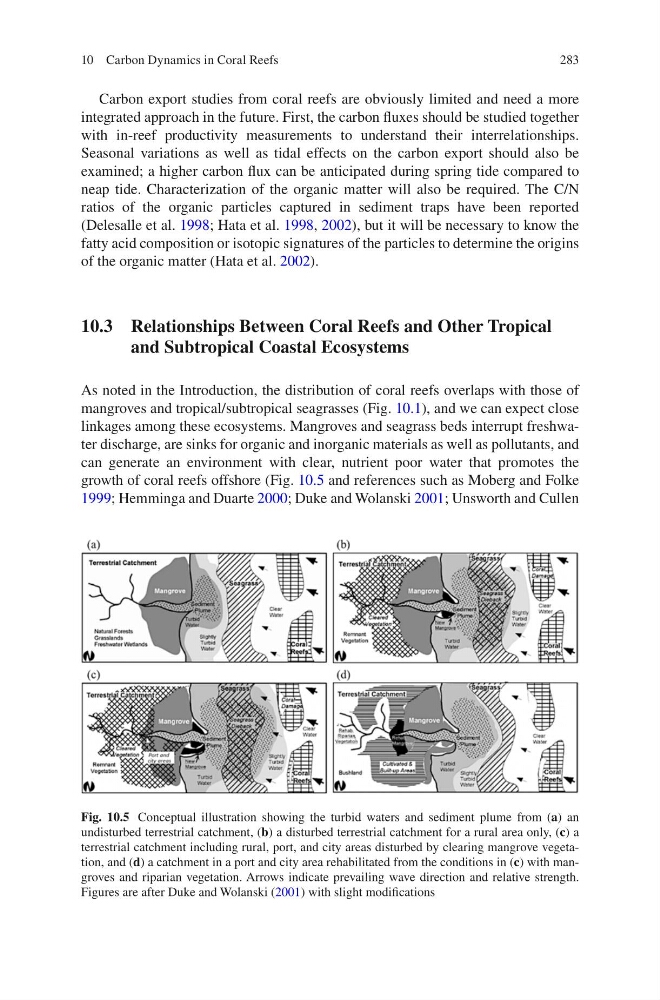
linkages among these ecosystems. Mangroves and seagrass beds interrupt freshwater discharge, are sinks for organic and inorganic materials as well as pollutants, and
can generate an environment with clear, nutrient poor water that promotes the
growth of coral reefs offshore (Fig. 10.5 and references such as Moberg and Folke
1999; Hemminga and Duarte 2000; Duke and Wolanski 2001; Unsworth and Cullen
Fig. 10.5 Conceptual illustration showing the turbid waters and sediment plume from (a) an
undisturbed terrestrial catchment, (b) a disturbed terrestrial catchment for a rural area only, (c) a
terrestrial catchment including rural, port, and city areas disturbed by clearing mangrove vegetation, and (d) a catchment in a port and city area rehabilitated from the conditions in (c) with mangroves and riparian vegetation. Arrows indicate prevailing wave direction and relative strength.
Figures are after Duke and Wolanski (2001) with slight modifications
10 Carbon Dynamics in Coral Reefs
Carbon export studies from coral reefs are obviously limited and need a more
integrated approach in the future. First, the carbon fluxes should be studied together
with in-reef productivity measurements to understand their interrelationships.
Seasonal variations as well as tidal effects on the carbon export should also be
examined; a higher carbon flux can be anticipated during spring tide compared to
neap tide. Characterization of the organic matter will also be required. The C/N
ratios of the organic particles captured in sediment traps have been reported
(Delesalle et al. 1998; Hata et al. 1998, 2002), but it will be necessary to know the
fatty acid composition or isotopic signatures of the particles to determine the origins
of the organic matter (Hata et al. 2002).
10.3 Relationships Between Coral Reefs and Other Tropical
and Subtropical Coastal Ecosystems
As noted in the Introduction, the distribution of coral reefs overlaps with those of
mangroves and tropical/subtropical seagrasses (Fig. 10.1), and we can expect close
linkages among these ecosystems. Mangroves and seagrass beds interrupt freshwater discharge, are sinks for organic and inorganic materials as well as pollutants, and
can generate an environment with clear, nutrient poor water that promotes the
growth of coral reefs offshore (Fig. 10.5 and references such as Moberg and Folke
1999; Hemminga and Duarte 2000; Duke and Wolanski 2001; Unsworth and Cullen
Fig. 10.5 Conceptual illustration showing the turbid waters and sediment plume from (a) an
undisturbed terrestrial catchment, (b) a disturbed terrestrial catchment for a rural area only, (c) a
terrestrial catchment including rural, port, and city areas disturbed by clearing mangrove vegetation, and (d) a catchment in a port and city area rehabilitated from the conditions in (c) with mangroves and riparian vegetation. Arrows indicate prevailing wave direction and relative strength.
Figures are after Duke and Wolanski (2001) with slight modifications
10 Carbon Dynamics in Coral Reefs