

282
can often be offset by net calcification in coral reefs, which increases pCO 2 . Corals
release the excess primary production as mucus, either as dissolved organic carbon
(DOC) or particulate organic carbon (POC) (Wild et al. 2004; Tanaka et al. 2008).
According to Wild et al. (2004), much of the mucus released into seawater efficiently traps organic matter from the water column, which is rapidly carried to the
lagoon sediment and filtered through the lagoon sands. Mucus transports energy to
the lagoon sediments and then the sediments rapidly recycle the organic matter to
nutrients, thus serving as a mechanism for retaining energy and nutrients within the
reef ecosystem.
Some portion of the excess production can be transported offshore of the reef.
Delesalle et al. (1998) studied the organic carbon and carbonate export for Tiahura
reef, French Polynesia, and reported an offshore transport of about 47% and 21% of
the excess organic and inorganic carbon production, respectively. Hata et al. (1998)
studied the organic carbon flux around a barrier reef in Palau in the western Pacific.
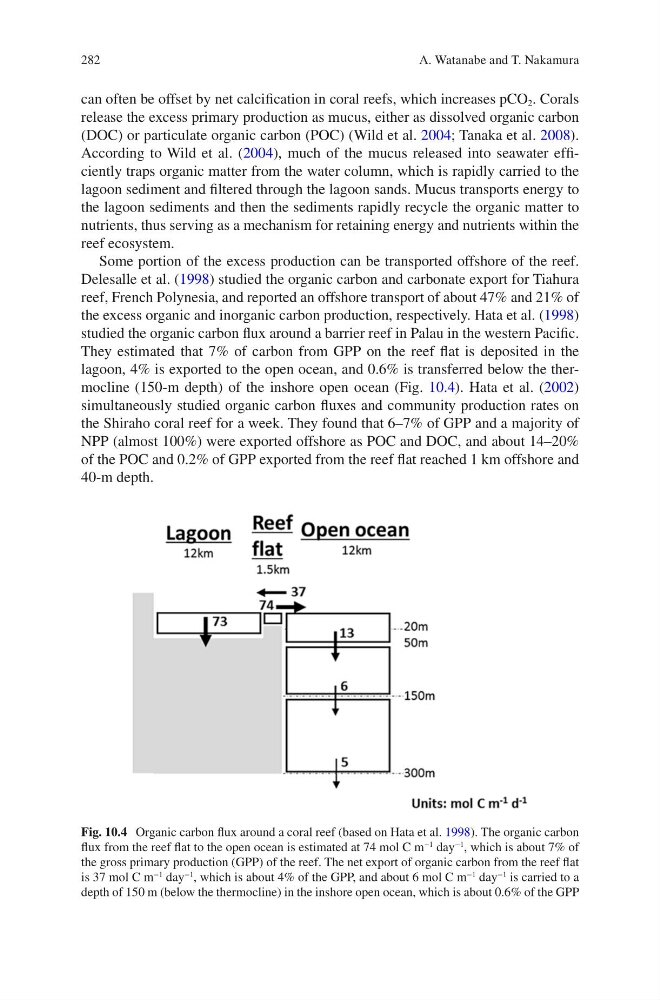
They estimated that 7% of carbon from GPP on the reef flat is deposited in the
lagoon, 4% is exported to the open ocean, and 0.6% is transferred below the thermocline (150-m depth) of the inshore open ocean (Fig. 10.4). Hata et al. (2002)
simultaneously studied organic carbon fluxes and community production rates on
the Shiraho coral reef for a week. They found that 6–7% of GPP and a majority of
NPP (almost 100%) were exported offshore as POC and DOC, and about 14–20%
of the POC and 0.2% of GPP exported from the reef flat reached 1 km offshore and
40-m depth.
Fig. 10.4 Organic carbon flux around a coral reef (based on Hata et al. 1998). The organic carbon
flux from the reef flat to the open ocean is estimated at 74 mol C m
−1 day
−1
, which is about 7% of
the gross primary production (GPP) of the reef. The net export of organic carbon from the reef flat
is 37 mol C m
−1 day
−1 , which is about 4% of the GPP, and about 6 mol C m
−1 day
−1 is carried to a
depth of 150 m (below the thermocline) in the inshore open ocean, which is about 0.6% of the GPP
A. Watanabe and T. Nakamura
can often be offset by net calcification in coral reefs, which increases pCO 2 . Corals
release the excess primary production as mucus, either as dissolved organic carbon
(DOC) or particulate organic carbon (POC) (Wild et al. 2004; Tanaka et al. 2008).
According to Wild et al. (2004), much of the mucus released into seawater efficiently traps organic matter from the water column, which is rapidly carried to the
lagoon sediment and filtered through the lagoon sands. Mucus transports energy to
the lagoon sediments and then the sediments rapidly recycle the organic matter to
nutrients, thus serving as a mechanism for retaining energy and nutrients within the
reef ecosystem.
Some portion of the excess production can be transported offshore of the reef.
Delesalle et al. (1998) studied the organic carbon and carbonate export for Tiahura
reef, French Polynesia, and reported an offshore transport of about 47% and 21% of
the excess organic and inorganic carbon production, respectively. Hata et al. (1998)
studied the organic carbon flux around a barrier reef in Palau in the western Pacific.
They estimated that 7% of carbon from GPP on the reef flat is deposited in the
lagoon, 4% is exported to the open ocean, and 0.6% is transferred below the thermocline (150-m depth) of the inshore open ocean (Fig. 10.4). Hata et al. (2002)
simultaneously studied organic carbon fluxes and community production rates on
the Shiraho coral reef for a week. They found that 6–7% of GPP and a majority of
NPP (almost 100%) were exported offshore as POC and DOC, and about 14–20%
of the POC and 0.2% of GPP exported from the reef flat reached 1 km offshore and
40-m depth.
Fig. 10.4 Organic carbon flux around a coral reef (based on Hata et al. 1998). The organic carbon
flux from the reef flat to the open ocean is estimated at 74 mol C m
−1 day
−1
, which is about 7% of
the gross primary production (GPP) of the reef. The net export of organic carbon from the reef flat
is 37 mol C m
−1 day
−1 , which is about 4% of the GPP, and about 6 mol C m
−1 day
−1 is carried to a
depth of 150 m (below the thermocline) in the inshore open ocean, which is about 0.6% of the GPP
A. Watanabe and T. Nakamura