

280
More studies are needed for the mechanistic understanding of CO 2 dynamics in
coral reefs. It is recommended that future works incorporate following points.
1. Measurements should include reef metabolisms (ecosystem primary production,
respiration, calcification, and carbonate dissolution) and organic-matter flux
along with air–sea CO 2 fluxes.
2. The benthic condition of reef areas of interest should be quantitatively monitored. The biomass balance between corals, macroalgae, and seagrasses can be
especially important.
3. Monitoring should include terrestrial loads such as submarine ground water or
river water inputs to the reefs, their chemistry (e.g. nutrients and carbonate
chemistry), and their advection in the reef, together with hydrodynamic features
of the reefs (e.g. residence time of seawater).
4. The reef as a CO 2 sink or source should be addressed by comparison with the
CO 2 in the open ocean impinging on reefs, and not necessarily directly with
atmospheric CO 2 . The reason is simple: the open ocean is not necessarily in
equilibrium with atmospheric CO 2 , and the capacity of a coral reef as a CO 2 sink
or source should be discussed relative to CO 2 levels in the source water (mainly
open ocean seawater in many cases). This would require adequate monitoring of
conditions offshore of the reefs as well.
Achieving these points will require a combination of hydrodynamic–biogeochemical modeling as well as the appropriate fieldwork to properly constrain the models.
These topics are discussed in more detail in Sect. 10.4.
10.2.4 Carbon Storage in Coral Reefs
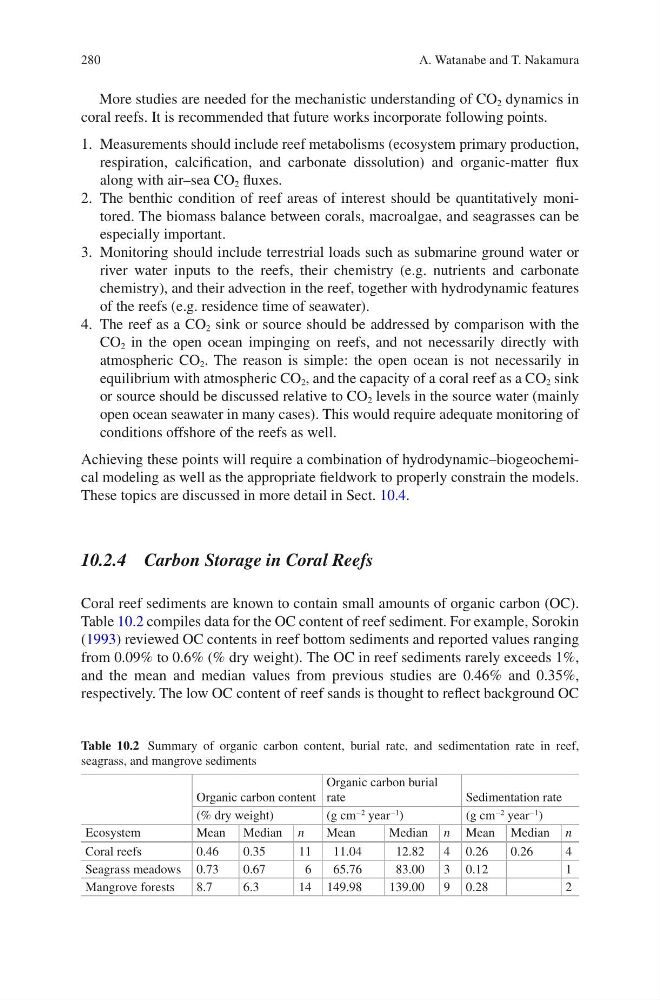
Coral reef sediments are known to contain small amounts of organic carbon (OC).
Table 10.2 compiles data for the OC content of reef sediment. For example, Sorokin
(1993) reviewed OC contents in reef bottom sediments and reported values ranging
from 0.09% to 0.6% (% dry weight). The OC in reef sediments rarely exceeds 1%,
and the mean and median values from previous studies are 0.46% and 0.35%,
respectively. The low OC content of reef sands is thought to reflect background OC
Table 10.2 Summary of organic carbon content, burial rate, and sedimentation rate in reef,
seagrass, and mangrove sediments
Organic carbon content
Organic carbon burial
rate
Sedimentation rate
(% dry weight)
(g cm
−2 year
−1
)
(g cm
−2 year
−1
)
Ecosystem
Mean Median n
Mean
Median n Mean Median n
Coral reefs
0.46
0.35
11
11.04
12.82
4 0.26
0.26
4
Seagrass meadows 0.73
0.67
6
65.76
83.00
3 0.12
1
Mangrove forests
8.7
6.3
14 149.98
139.00
9 0.28
2
A. Watanabe and T. Nakamura
More studies are needed for the mechanistic understanding of CO 2 dynamics in
coral reefs. It is recommended that future works incorporate following points.
1. Measurements should include reef metabolisms (ecosystem primary production,
respiration, calcification, and carbonate dissolution) and organic-matter flux
along with air–sea CO 2 fluxes.
2. The benthic condition of reef areas of interest should be quantitatively monitored. The biomass balance between corals, macroalgae, and seagrasses can be
especially important.
3. Monitoring should include terrestrial loads such as submarine ground water or
river water inputs to the reefs, their chemistry (e.g. nutrients and carbonate
chemistry), and their advection in the reef, together with hydrodynamic features
of the reefs (e.g. residence time of seawater).
4. The reef as a CO 2 sink or source should be addressed by comparison with the
CO 2 in the open ocean impinging on reefs, and not necessarily directly with
atmospheric CO 2 . The reason is simple: the open ocean is not necessarily in
equilibrium with atmospheric CO 2 , and the capacity of a coral reef as a CO 2 sink
or source should be discussed relative to CO 2 levels in the source water (mainly
open ocean seawater in many cases). This would require adequate monitoring of
conditions offshore of the reefs as well.
Achieving these points will require a combination of hydrodynamic–biogeochemical modeling as well as the appropriate fieldwork to properly constrain the models.
These topics are discussed in more detail in Sect. 10.4.
10.2.4 Carbon Storage in Coral Reefs
Coral reef sediments are known to contain small amounts of organic carbon (OC).
Table 10.2 compiles data for the OC content of reef sediment. For example, Sorokin
(1993) reviewed OC contents in reef bottom sediments and reported values ranging
from 0.09% to 0.6% (% dry weight). The OC in reef sediments rarely exceeds 1%,
and the mean and median values from previous studies are 0.46% and 0.35%,
respectively. The low OC content of reef sands is thought to reflect background OC
Table 10.2 Summary of organic carbon content, burial rate, and sedimentation rate in reef,
seagrass, and mangrove sediments
Organic carbon content
Organic carbon burial
rate
Sedimentation rate
(% dry weight)
(g cm
−2 year
−1
)
(g cm
−2 year
−1
)
Ecosystem
Mean Median n
Mean
Median n Mean Median n
Coral reefs
0.46
0.35
11
11.04
12.82
4 0.26
0.26
4
Seagrass meadows 0.73
0.67
6
65.76
83.00
3 0.12
1
Mangrove forests
8.7
6.3
14 149.98
139.00
9 0.28
2
A. Watanabe and T. Nakamura