

260
of dead material derived from them. Eelgrass absorbs inorganic nutrients in sea
water and in pore water from the muddy bottom by the aboveground and belowground parts, respectively. In the aboveground part, carbon dioxide is absorbed and
energy is obtained by photosynthesis using the nutrients in the grass body. Nitrogen
uptake, photosynthesis, and respiration rates of the eelgrass are determined by solar
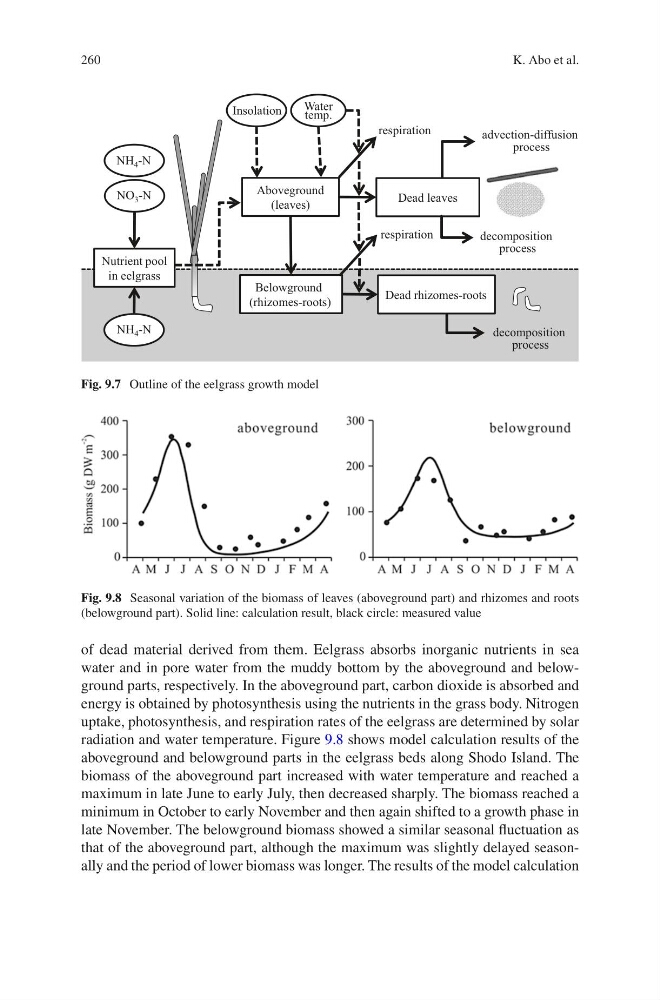
radiation and water temperature. Figure 9.8 shows model calculation results of the
aboveground and belowground parts in the eelgrass beds along Shodo Island. The
biomass of the aboveground part increased with water temperature and reached a
maximum in late June to early July, then decreased sharply. The biomass reached a
minimum in October to early November and then again shifted to a growth phase in
late November. The belowground biomass showed a similar seasonal fluctuation as
that of the aboveground part, although the maximum was slightly delayed seasonally and the period of lower biomass was longer. The results of the model calculation
Aboveground
(leaves)
Belowground
(rhizomes-roots)
Nutrient pool
in eelgrass
Dead leaves
Dead rhizomes-roots
respiration
decomposition
process
Insolation
Water
temp.
NH 4 -N
NH 4 -N
NO 3 -N
respiration
decomposition
process
advection-diffusion
process
Fig. 9.7 Outline of the eelgrass growth model
Fig. 9.8 Seasonal variation of the biomass of leaves (aboveground part) and rhizomes and roots
(belowground part). Solid line: calculation result, black circle: measured value
K. Abo et al.
of dead material derived from them. Eelgrass absorbs inorganic nutrients in sea
water and in pore water from the muddy bottom by the aboveground and belowground parts, respectively. In the aboveground part, carbon dioxide is absorbed and
energy is obtained by photosynthesis using the nutrients in the grass body. Nitrogen
uptake, photosynthesis, and respiration rates of the eelgrass are determined by solar
radiation and water temperature. Figure 9.8 shows model calculation results of the
aboveground and belowground parts in the eelgrass beds along Shodo Island. The
biomass of the aboveground part increased with water temperature and reached a
maximum in late June to early July, then decreased sharply. The biomass reached a
minimum in October to early November and then again shifted to a growth phase in
late November. The belowground biomass showed a similar seasonal fluctuation as
that of the aboveground part, although the maximum was slightly delayed seasonally and the period of lower biomass was longer. The results of the model calculation
Aboveground
(leaves)
Belowground
(rhizomes-roots)
Nutrient pool
in eelgrass
Dead leaves
Dead rhizomes-roots
respiration
decomposition
process
Insolation
Water
temp.
NH 4 -N
NH 4 -N
NO 3 -N
respiration
decomposition
process
advection-diffusion
process
Fig. 9.7 Outline of the eelgrass growth model
Fig. 9.8 Seasonal variation of the biomass of leaves (aboveground part) and rhizomes and roots
(belowground part). Solid line: calculation result, black circle: measured value
K. Abo et al.