

258
9.3 Outflow of the Leaves and Eelgrass-Derived Organic
Matter
To understand the size of the eelgrass-derived organic carbon stock, it is necessary
to follow the ways in which organic carbon compounds in eelgrass decompose and
disperse. Mature eelgrass leaves eventually wither and settle on the bottom in the
eelgrass bed, settle in the eelgrass bed after floating for a while, or float and drift out
of the eelgrass bed and settle at a distant location (drifting leaves). The leaves that
settle in the eelgrass bed are fragmented and decomposed into fine particles, which
can become resuspended in the water column due to turbulence and flow out of the
eelgrass bed as particulate organic matter.
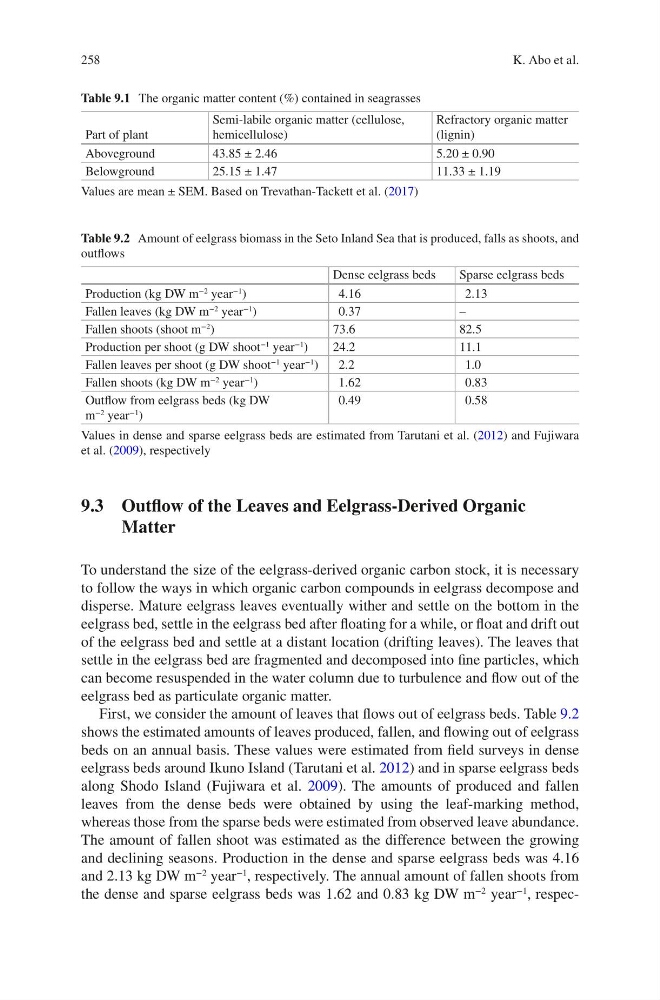
First, we consider the amount of leaves that flows out of eelgrass beds. Table 9.2
shows the estimated amounts of leaves produced, fallen, and flowing out of eelgrass
beds on an annual basis. These values were estimated from field surveys in dense
eelgrass beds around Ikuno Island (Tarutani et al. 2012) and in sparse eelgrass beds
along Shodo Island (Fujiwara et al. 2009). The amounts of produced and fallen
leaves from the dense beds were obtained by using the leaf-marking method,
whereas those from the sparse beds were estimated from observed leave abundance.
The amount of fallen shoot was estimated as the difference between the growing
and declining seasons. Production in the dense and sparse eelgrass beds was 4.16
and 2.13 kg DW m
−2
year
−1
, respectively. The annual amount of fallen shoots from
the dense and sparse eelgrass beds was 1.62 and 0.83 kg DW m
−2
year
−1
, respecTable 9.1 The organic matter content (%) contained in seagrasses
Part of plant
Semi-labile organic matter (cellulose,
hemicellulose)
Refractory organic matter
(lignin)
Aboveground
43.85 ± 2.46
5.20 ± 0.90
Belowground
25.15 ± 1.47
11.33 ± 1.19
Values are mean ± SEM. Based on Trevathan-Tackett et al. (2017)
Table 9.2 Amount of eelgrass biomass in the Seto Inland Sea that is produced, falls as shoots, and
outflows
Dense eelgrass beds
Sparse eelgrass beds
Production (kg DW m
−2 year
−1 )
4.16
2.13
Fallen leaves (kg DW m
−2 year
−1 )
0.37
–
Fallen shoots (shoot m
−2 )
73.6
82.5
Production per shoot (g DW shoot
−1 year
−1 )
24.2
11.1
Fallen leaves per shoot (g DW shoot
−1 year
−1 )
2.2
1.0
Fallen shoots (kg DW m
−2
year
−1 )
1.62
0.83
Outflow from eelgrass beds (kg DW
m
−2 year
−1 )
0.49
0.58
Values in dense and sparse eelgrass beds are estimated from Tarutani et al. (2012) and Fujiwara
et al. (2009), respectively
K. Abo et al.
9.3 Outflow of the Leaves and Eelgrass-Derived Organic
Matter
To understand the size of the eelgrass-derived organic carbon stock, it is necessary
to follow the ways in which organic carbon compounds in eelgrass decompose and
disperse. Mature eelgrass leaves eventually wither and settle on the bottom in the
eelgrass bed, settle in the eelgrass bed after floating for a while, or float and drift out
of the eelgrass bed and settle at a distant location (drifting leaves). The leaves that
settle in the eelgrass bed are fragmented and decomposed into fine particles, which
can become resuspended in the water column due to turbulence and flow out of the
eelgrass bed as particulate organic matter.
First, we consider the amount of leaves that flows out of eelgrass beds. Table 9.2
shows the estimated amounts of leaves produced, fallen, and flowing out of eelgrass
beds on an annual basis. These values were estimated from field surveys in dense
eelgrass beds around Ikuno Island (Tarutani et al. 2012) and in sparse eelgrass beds
along Shodo Island (Fujiwara et al. 2009). The amounts of produced and fallen
leaves from the dense beds were obtained by using the leaf-marking method,
whereas those from the sparse beds were estimated from observed leave abundance.
The amount of fallen shoot was estimated as the difference between the growing
and declining seasons. Production in the dense and sparse eelgrass beds was 4.16
and 2.13 kg DW m
−2
year
−1
, respectively. The annual amount of fallen shoots from
the dense and sparse eelgrass beds was 1.62 and 0.83 kg DW m
−2
year
−1
, respecTable 9.1 The organic matter content (%) contained in seagrasses
Part of plant
Semi-labile organic matter (cellulose,
hemicellulose)
Refractory organic matter
(lignin)
Aboveground
43.85 ± 2.46
5.20 ± 0.90
Belowground
25.15 ± 1.47
11.33 ± 1.19
Values are mean ± SEM. Based on Trevathan-Tackett et al. (2017)
Table 9.2 Amount of eelgrass biomass in the Seto Inland Sea that is produced, falls as shoots, and
outflows
Dense eelgrass beds
Sparse eelgrass beds
Production (kg DW m
−2 year
−1 )
4.16
2.13
Fallen leaves (kg DW m
−2 year
−1 )
0.37
–
Fallen shoots (shoot m
−2 )
73.6
82.5
Production per shoot (g DW shoot
−1 year
−1 )
24.2
11.1
Fallen leaves per shoot (g DW shoot
−1 year
−1 )
2.2
1.0
Fallen shoots (kg DW m
−2
year
−1 )
1.62
0.83
Outflow from eelgrass beds (kg DW
m
−2 year
−1 )
0.49
0.58
Values in dense and sparse eelgrass beds are estimated from Tarutani et al. (2012) and Fujiwara
et al. (2009), respectively
K. Abo et al.