

180
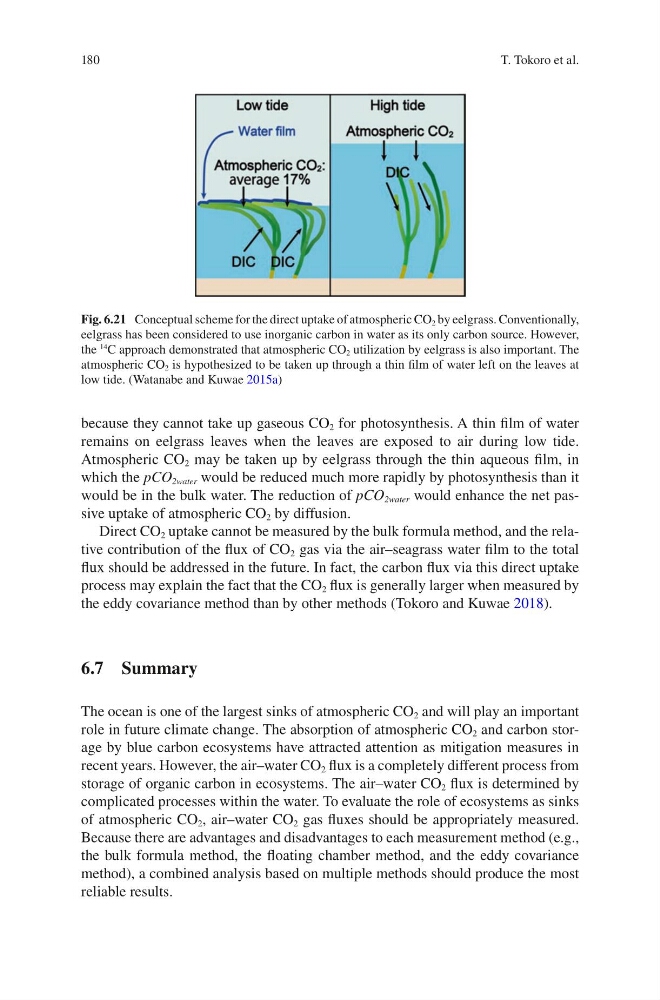
because they cannot take up gaseous CO 2 for photosynthesis. A thin film of water
remains on eelgrass leaves when the leaves are exposed to air during low tide.
Atmospheric CO 2 may be taken up by eelgrass through the thin aqueous film, in
which the pCO 2water would be reduced much more rapidly by photosynthesis than it
would be in the bulk water. The reduction of pCO 2water would enhance the net passive uptake of atmospheric CO 2 by diffusion.
Direct CO 2 uptake cannot be measured by the bulk formula method, and the relative contribution of the flux of CO 2 gas via the air–seagrass water film to the total
flux should be addressed in the future. In fact, the carbon flux via this direct uptake
process may explain the fact that the CO 2 flux is generally larger when measured by
the eddy covariance method than by other methods (Tokoro and Kuwae 2018).
6.7 Summary
The ocean is one of the largest sinks of atmospheric CO 2 and will play an important
role in future climate change. The absorption of atmospheric CO 2 and carbon storage by blue carbon ecosystems have attracted attention as mitigation measures in
recent years. However, the air–water CO 2 flux is a completely different process from
storage of organic carbon in ecosystems. The air–water CO 2 flux is determined by
complicated processes within the water. To evaluate the role of ecosystems as sinks
of atmospheric CO 2 , air–water CO 2 gas fluxes should be appropriately measured.
Because there are advantages and disadvantages to each measurement method (e.g.,
the bulk formula method, the floating chamber method, and the eddy covariance
method), a combined analysis based on multiple methods should produce the most
reliable results.
Fig. 6.21 Conceptual scheme for the direct uptake of atmospheric CO 2 by eelgrass. Conventionally,
eelgrass has been considered to use inorganic carbon in water as its only carbon source. However,
the
14
C approach demonstrated that atmospheric CO 2 utilization by eelgrass is also important. The
atmospheric CO 2 is hypothesized to be taken up through a thin film of water left on the leaves at
low tide. (Watanabe and Kuwae 2015a)
T. Tokoro et al.
because they cannot take up gaseous CO 2 for photosynthesis. A thin film of water
remains on eelgrass leaves when the leaves are exposed to air during low tide.
Atmospheric CO 2 may be taken up by eelgrass through the thin aqueous film, in
which the pCO 2water would be reduced much more rapidly by photosynthesis than it
would be in the bulk water. The reduction of pCO 2water would enhance the net passive uptake of atmospheric CO 2 by diffusion.
Direct CO 2 uptake cannot be measured by the bulk formula method, and the relative contribution of the flux of CO 2 gas via the air–seagrass water film to the total
flux should be addressed in the future. In fact, the carbon flux via this direct uptake
process may explain the fact that the CO 2 flux is generally larger when measured by
the eddy covariance method than by other methods (Tokoro and Kuwae 2018).
6.7 Summary
The ocean is one of the largest sinks of atmospheric CO 2 and will play an important
role in future climate change. The absorption of atmospheric CO 2 and carbon storage by blue carbon ecosystems have attracted attention as mitigation measures in
recent years. However, the air–water CO 2 flux is a completely different process from
storage of organic carbon in ecosystems. The air–water CO 2 flux is determined by
complicated processes within the water. To evaluate the role of ecosystems as sinks
of atmospheric CO 2 , air–water CO 2 gas fluxes should be appropriately measured.
Because there are advantages and disadvantages to each measurement method (e.g.,
the bulk formula method, the floating chamber method, and the eddy covariance
method), a combined analysis based on multiple methods should produce the most
reliable results.
Fig. 6.21 Conceptual scheme for the direct uptake of atmospheric CO 2 by eelgrass. Conventionally,
eelgrass has been considered to use inorganic carbon in water as its only carbon source. However,
the
14
C approach demonstrated that atmospheric CO 2 utilization by eelgrass is also important. The
atmospheric CO 2 is hypothesized to be taken up through a thin film of water left on the leaves at
low tide. (Watanabe and Kuwae 2015a)
T. Tokoro et al.