

157
F
D
C
z
D
C
C
D S pCO
pCO
k
water
top
bottom
air
w ater
= -


= -
-
(
) = -
-
(
)
= -
d
d
2
2
S S pCO
pCO
k S pCO
pCO
air
w ater
water
a ir
2
2
2
2
-
(
) =
-
(
)
(6.3)
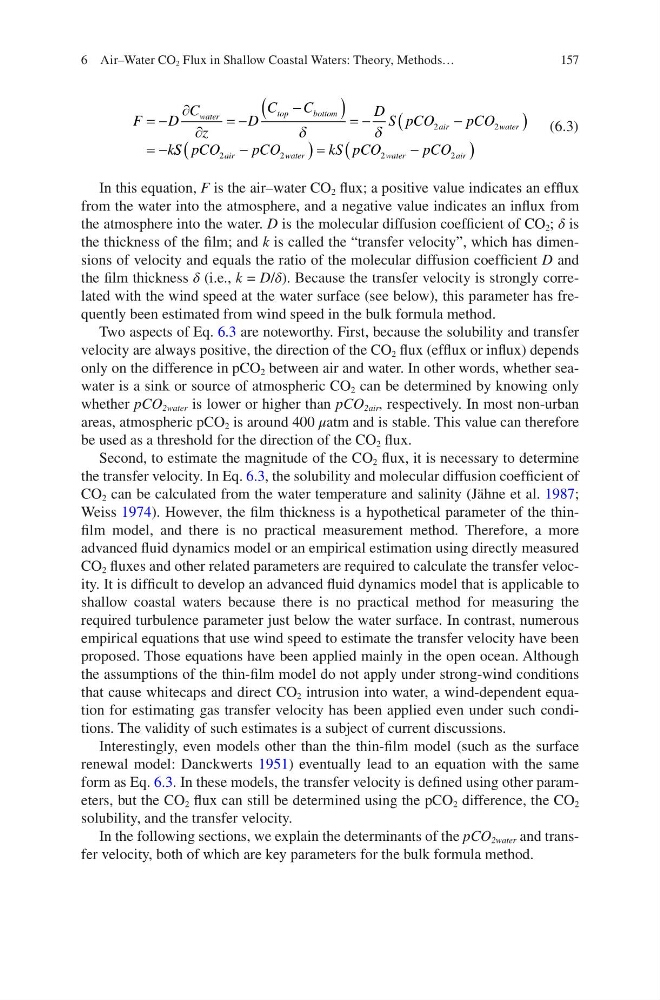
In this equation, F is the air–water CO 2 flux; a positive value indicates an efflux
from the water into the atmosphere, and a negative value indicates an influx from
the atmosphere into the water. D is the molecular diffusion coefficient of CO 2 ; δ is
the thickness of the film; and k is called the “transfer velocity”, which has dimensions of velocity and equals the ratio of the molecular diffusion coefficient D and
the film thickness δ (i.e., k = D/δ). Because the transfer velocity is strongly correlated with the wind speed at the water surface (see below), this parameter has frequently been estimated from wind speed in the bulk formula method.
Two aspects of Eq. 6.3 are noteworthy. First, because the solubility and transfer
velocity are always positive, the direction of the CO 2 flux (efflux or influx) depends
only on the difference in pCO 2 between air and water. In other words, whether seawater is a sink or source of atmospheric CO 2 can be determined by knowing only
whether pCO 2water is lower or higher than pCO 2air , respectively. In most non-urban
areas, atmospheric pCO 2 is around 400 μatm and is stable. This value can therefore
be used as a threshold for the direction of the CO 2 flux.
Second, to estimate the magnitude of the CO 2 flux, it is necessary to determine
the transfer velocity. In Eq. 6.3, the solubility and molecular diffusion coefficient of
CO 2 can be calculated from the water temperature and salinity (Jähne et al. 1987;
Weiss 1974). However, the film thickness is a hypothetical parameter of the thinfilm model, and there is no practical measurement method. Therefore, a more
advanced fluid dynamics model or an empirical estimation using directly measured
CO 2 fluxes and other related parameters are required to calculate the transfer velocity. It is difficult to develop an advanced fluid dynamics model that is applicable to
shallow coastal waters because there is no practical method for measuring the
required turbulence parameter just below the water surface. In contrast, numerous
empirical equations that use wind speed to estimate the transfer velocity have been
proposed. Those equations have been applied mainly in the open ocean. Although
the assumptions of the thin-film model do not apply under strong-wind conditions
that cause whitecaps and direct CO 2 intrusion into water, a wind-dependent equation for estimating gas transfer velocity has been applied even under such conditions. The validity of such estimates is a subject of current discussions.
Interestingly, even models other than the thin-film model (such as the surface
renewal model: Danckwerts 1951) eventually lead to an equation with the same
form as Eq. 6.3. In these models, the transfer velocity is defined using other parameters, but the CO 2 flux can still be determined using the pCO 2 difference, the CO 2
solubility, and the transfer velocity.
In the following sections, we explain the determinants of the pCO 2water and transfer velocity, both of which are key parameters for the bulk formula method.
6 Air–Water CO 2 Flux in Shallow Coastal Waters: Theory, Methods…
F
D
C
z
D
C
C
D S pCO
pCO
k
water
top
bottom
air
w ater
= -


= -
-
(
) = -
-
(
)
= -
d
d
2
2
S S pCO
pCO
k S pCO
pCO
air
w ater
water
a ir
2
2
2
2
-
(
) =
-
(
)
(6.3)
In this equation, F is the air–water CO 2 flux; a positive value indicates an efflux
from the water into the atmosphere, and a negative value indicates an influx from
the atmosphere into the water. D is the molecular diffusion coefficient of CO 2 ; δ is
the thickness of the film; and k is called the “transfer velocity”, which has dimensions of velocity and equals the ratio of the molecular diffusion coefficient D and
the film thickness δ (i.e., k = D/δ). Because the transfer velocity is strongly correlated with the wind speed at the water surface (see below), this parameter has frequently been estimated from wind speed in the bulk formula method.
Two aspects of Eq. 6.3 are noteworthy. First, because the solubility and transfer
velocity are always positive, the direction of the CO 2 flux (efflux or influx) depends
only on the difference in pCO 2 between air and water. In other words, whether seawater is a sink or source of atmospheric CO 2 can be determined by knowing only
whether pCO 2water is lower or higher than pCO 2air , respectively. In most non-urban
areas, atmospheric pCO 2 is around 400 μatm and is stable. This value can therefore
be used as a threshold for the direction of the CO 2 flux.
Second, to estimate the magnitude of the CO 2 flux, it is necessary to determine
the transfer velocity. In Eq. 6.3, the solubility and molecular diffusion coefficient of
CO 2 can be calculated from the water temperature and salinity (Jähne et al. 1987;
Weiss 1974). However, the film thickness is a hypothetical parameter of the thinfilm model, and there is no practical measurement method. Therefore, a more
advanced fluid dynamics model or an empirical estimation using directly measured
CO 2 fluxes and other related parameters are required to calculate the transfer velocity. It is difficult to develop an advanced fluid dynamics model that is applicable to
shallow coastal waters because there is no practical method for measuring the
required turbulence parameter just below the water surface. In contrast, numerous
empirical equations that use wind speed to estimate the transfer velocity have been
proposed. Those equations have been applied mainly in the open ocean. Although
the assumptions of the thin-film model do not apply under strong-wind conditions
that cause whitecaps and direct CO 2 intrusion into water, a wind-dependent equation for estimating gas transfer velocity has been applied even under such conditions. The validity of such estimates is a subject of current discussions.
Interestingly, even models other than the thin-film model (such as the surface
renewal model: Danckwerts 1951) eventually lead to an equation with the same
form as Eq. 6.3. In these models, the transfer velocity is defined using other parameters, but the CO 2 flux can still be determined using the pCO 2 difference, the CO 2
solubility, and the transfer velocity.
In the following sections, we explain the determinants of the pCO 2water and transfer velocity, both of which are key parameters for the bulk formula method.
6 Air–Water CO 2 Flux in Shallow Coastal Waters: Theory, Methods…