

119
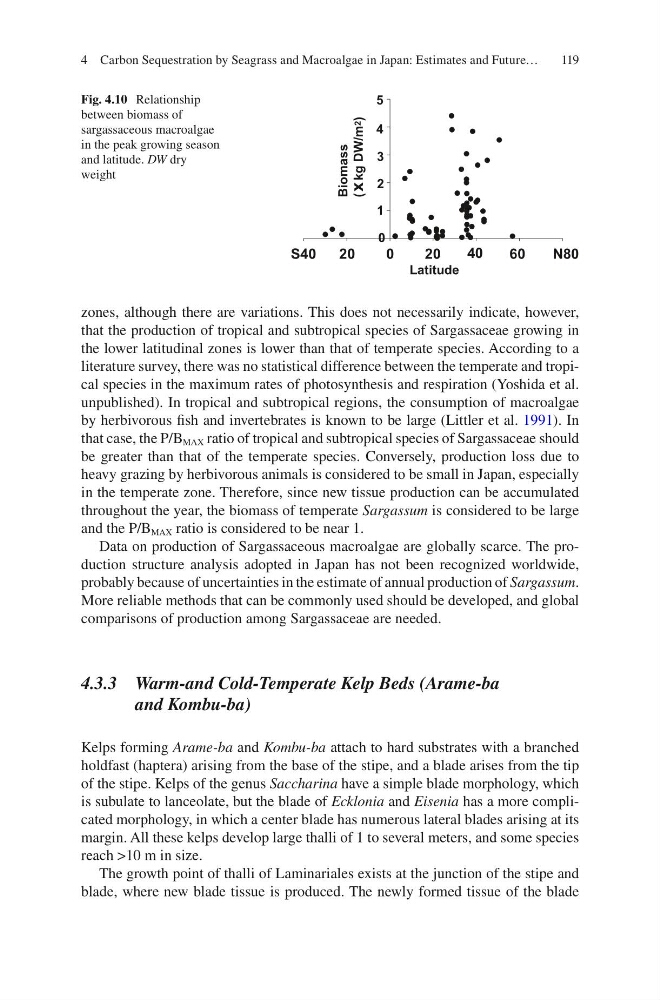
zones, although there are variations. This does not necessarily indicate, however,
that the production of tropical and subtropical species of Sargassaceae growing in
the lower latitudinal zones is lower than that of temperate species. According to a
literature survey, there was no statistical difference between the temperate and tropical species in the maximum rates of photosynthesis and respiration (Yoshida et al.
unpublished). In tropical and subtropical regions, the consumption of macroalgae
by herbivorous fish and invertebrates is known to be large (Littler et al. 1991). In
that case, the P/B MAX ratio of tropical and subtropical species of Sargassaceae should
be greater than that of the temperate species. Conversely, production loss due to
heavy grazing by herbivorous animals is considered to be small in Japan, especially
in the temperate zone. Therefore, since new tissue production can be accumulated
throughout the year, the biomass of temperate Sargassum is considered to be large
and the P/B MAX ratio is considered to be near 1.
Data on production of Sargassaceous macroalgae are globally scarce. The production structure analysis adopted in Japan has not been recognized worldwide,
probably because of uncertainties in the estimate of annual production of Sargassum.
More reliable methods that can be commonly used should be developed, and global
comparisons of production among Sargassaceae are needed.
4.3.3 Warm-and Cold-Temperate Kelp Beds (Arame-ba
and Kombu-ba)
Kelps forming Arame-ba and Kombu-ba attach to hard substrates with a branched
holdfast (haptera) arising from the base of the stipe, and a blade arises from the tip
of the stipe. Kelps of the genus Saccharina have a simple blade morphology, which
is subulate to lanceolate, but the blade of Ecklonia and Eisenia has a more complicated morphology, in which a center blade has numerous lateral blades arising at its
margin. All these kelps develop large thalli of 1 to several meters, and some species
reach >10 m in size.
The growth point of thalli of Laminariales exists at the junction of the stipe and
blade, where new blade tissue is produced. The newly formed tissue of the blade
0
20
40
60
N80
20
S40
0
1
2
3
4
5
Biomass
(
x kg DW/m 2
)
Latitude
Fig. 4.10 Relationship
between biomass of
sargassaceous macroalgae
in the peak growing season
and latitude. DW dry
weight
4 Carbon Sequestration by Seagrass and Macroalgae in Japan: Estimates and Future…
zones, although there are variations. This does not necessarily indicate, however,
that the production of tropical and subtropical species of Sargassaceae growing in
the lower latitudinal zones is lower than that of temperate species. According to a
literature survey, there was no statistical difference between the temperate and tropical species in the maximum rates of photosynthesis and respiration (Yoshida et al.
unpublished). In tropical and subtropical regions, the consumption of macroalgae
by herbivorous fish and invertebrates is known to be large (Littler et al. 1991). In
that case, the P/B MAX ratio of tropical and subtropical species of Sargassaceae should
be greater than that of the temperate species. Conversely, production loss due to
heavy grazing by herbivorous animals is considered to be small in Japan, especially
in the temperate zone. Therefore, since new tissue production can be accumulated
throughout the year, the biomass of temperate Sargassum is considered to be large
and the P/B MAX ratio is considered to be near 1.
Data on production of Sargassaceous macroalgae are globally scarce. The production structure analysis adopted in Japan has not been recognized worldwide,
probably because of uncertainties in the estimate of annual production of Sargassum.
More reliable methods that can be commonly used should be developed, and global
comparisons of production among Sargassaceae are needed.
4.3.3 Warm-and Cold-Temperate Kelp Beds (Arame-ba
and Kombu-ba)
Kelps forming Arame-ba and Kombu-ba attach to hard substrates with a branched
holdfast (haptera) arising from the base of the stipe, and a blade arises from the tip
of the stipe. Kelps of the genus Saccharina have a simple blade morphology, which
is subulate to lanceolate, but the blade of Ecklonia and Eisenia has a more complicated morphology, in which a center blade has numerous lateral blades arising at its
margin. All these kelps develop large thalli of 1 to several meters, and some species
reach >10 m in size.
The growth point of thalli of Laminariales exists at the junction of the stipe and
blade, where new blade tissue is produced. The newly formed tissue of the blade
0
20
40
60
N80
20
S40
0
1
2
3
4
5
Biomass
(
x kg DW/m 2
)
Latitude
Fig. 4.10 Relationship
between biomass of
sargassaceous macroalgae
in the peak growing season
and latitude. DW dry
weight
4 Carbon Sequestration by Seagrass and Macroalgae in Japan: Estimates and Future…