

118
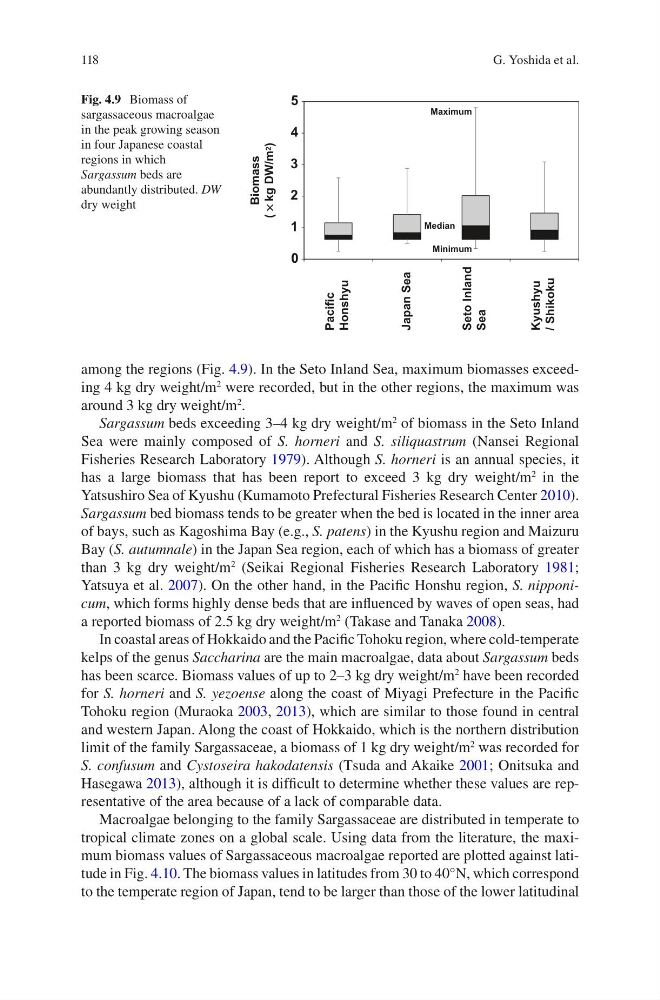
among the regions (Fig. 4.9). In the Seto Inland Sea, maximum biomasses exceeding 4 kg dry weight/m
2
were recorded, but in the other regions, the maximum was
around 3 kg dry weight/m
2
.
Sargassum beds exceeding 3–4 kg dry weight/m
2
of biomass in the Seto Inland
Sea were mainly composed of S. horneri and S. siliquastrum (Nansei Regional
Fisheries Research Laboratory 1979). Although S. horneri is an annual species, it
has a large biomass that has been report to exceed 3 kg dry weight/m
2
in the
Yatsushiro Sea of Kyushu (Kumamoto Prefectural Fisheries Research Center 2010).
Sargassum bed biomass tends to be greater when the bed is located in the inner area
of bays, such as Kagoshima Bay (e.g., S. patens) in the Kyushu region and Maizuru
Bay (S. autumnale) in the Japan Sea region, each of which has a biomass of greater
than 3 kg dry weight/m
2
(Seikai Regional Fisheries Research Laboratory 1981;
Yatsuya et al. 2007). On the other hand, in the Pacific Honshu region, S. nipponicum, which forms highly dense beds that are influenced by waves of open seas, had
a reported biomass of 2.5 kg dry weight/m
2
(Takase and Tanaka 2008).
In coastal areas of Hokkaido and the Pacific Tohoku region, where cold- temperate
kelps of the genus Saccharina are the main macroalgae, data about Sargassum beds
has been scarce. Biomass values of up to 2–3 kg dry weight/m
2
have been recorded
for S. horneri and S. yezoense along the coast of Miyagi Prefecture in the Pacific
Tohoku region (Muraoka 2003, 2013), which are similar to those found in central
and western Japan. Along the coast of Hokkaido, which is the northern distribution
limit of the family Sargassaceae, a biomass of 1 kg dry weight/m
2
was recorded for
S. confusum and Cystoseira hakodatensis (Tsuda and Akaike 2001; Onitsuka and
Hasegawa 2013), although it is difficult to determine whether these values are representative of the area because of a lack of comparable data.
Macroalgae belonging to the family Sargassaceae are distributed in temperate to
tropical climate zones on a global scale. Using data from the literature, the maximum biomass values of Sargassaceous macroalgae reported are plotted against latitude in Fig. 4.10. The biomass values in latitudes from 30 to 40°N, which correspond
to the temperate region of Japan, tend to be larger than those of the lower latitudinal
0
1
2
3
4
5
Biomass
( ¥
kg DW/m 2
)
Japan Sea
Pacific
Honshyu
Seto Inland
Sea
Kyushyu
/ Shikoku
Maximum
Minimum
Median
Fig. 4.9 Biomass of
sargassaceous macroalgae
in the peak growing season
in four Japanese coastal
regions in which
Sargassum beds are
abundantly distributed. DW
dry weight
G. Yoshida et al.
among the regions (Fig. 4.9). In the Seto Inland Sea, maximum biomasses exceeding 4 kg dry weight/m
2
were recorded, but in the other regions, the maximum was
around 3 kg dry weight/m
2
.
Sargassum beds exceeding 3–4 kg dry weight/m
2
of biomass in the Seto Inland
Sea were mainly composed of S. horneri and S. siliquastrum (Nansei Regional
Fisheries Research Laboratory 1979). Although S. horneri is an annual species, it
has a large biomass that has been report to exceed 3 kg dry weight/m
2
in the
Yatsushiro Sea of Kyushu (Kumamoto Prefectural Fisheries Research Center 2010).
Sargassum bed biomass tends to be greater when the bed is located in the inner area
of bays, such as Kagoshima Bay (e.g., S. patens) in the Kyushu region and Maizuru
Bay (S. autumnale) in the Japan Sea region, each of which has a biomass of greater
than 3 kg dry weight/m
2
(Seikai Regional Fisheries Research Laboratory 1981;
Yatsuya et al. 2007). On the other hand, in the Pacific Honshu region, S. nipponicum, which forms highly dense beds that are influenced by waves of open seas, had
a reported biomass of 2.5 kg dry weight/m
2
(Takase and Tanaka 2008).
In coastal areas of Hokkaido and the Pacific Tohoku region, where cold- temperate
kelps of the genus Saccharina are the main macroalgae, data about Sargassum beds
has been scarce. Biomass values of up to 2–3 kg dry weight/m
2
have been recorded
for S. horneri and S. yezoense along the coast of Miyagi Prefecture in the Pacific
Tohoku region (Muraoka 2003, 2013), which are similar to those found in central
and western Japan. Along the coast of Hokkaido, which is the northern distribution
limit of the family Sargassaceae, a biomass of 1 kg dry weight/m
2
was recorded for
S. confusum and Cystoseira hakodatensis (Tsuda and Akaike 2001; Onitsuka and
Hasegawa 2013), although it is difficult to determine whether these values are representative of the area because of a lack of comparable data.
Macroalgae belonging to the family Sargassaceae are distributed in temperate to
tropical climate zones on a global scale. Using data from the literature, the maximum biomass values of Sargassaceous macroalgae reported are plotted against latitude in Fig. 4.10. The biomass values in latitudes from 30 to 40°N, which correspond
to the temperate region of Japan, tend to be larger than those of the lower latitudinal
0
1
2
3
4
5
Biomass
( ¥
kg DW/m 2
)
Japan Sea
Pacific
Honshyu
Seto Inland
Sea
Kyushyu
/ Shikoku
Maximum
Minimum
Median
Fig. 4.9 Biomass of
sargassaceous macroalgae
in the peak growing season
in four Japanese coastal
regions in which
Sargassum beds are
abundantly distributed. DW
dry weight
G. Yoshida et al.