

70
Wang et al. 2016). This is to be taken into account that there are no framed standard
protocols and platforms either for collecting lipidomic data or preprocessing strategies. It basically involves peak detection, peak quantification/normalization, peak
grouping, imputation of missing peaks, visualization, isotope correction, and compound identification (Harkewicz and Dennis 2011; Rolim et al. 2015; Vaz et al.
2015; Yetukuri et al. 2008), described briefly in Table 4.3. There are various commercial and open-source software tools as well as a few databases for preprocessing
of lipidomic datasets such as LipidBlast, Lipid Data Analyzer, Lipid MS prediction
tool, LipidQA, LIMSA, LipidPro, and others enlisted in Table 4.4. In addition,
Lipid Profiler (Ejsing et al. 2006) and LipidInspector (Schwudke et al. 2005) are
compatible with the lipidomic data acquired using hybrid quadrupole/time-of-flight
instruments that can perform multiple precursor ion scans in a single experiment.
Fatty acid analysis tool (FAAT) (Leavell and Leary 2006) is useful for the analysis
of data coming from Fourier transform mass spectrometry The main functionalities
of FAAT include identification of overlapping saturated and unsaturated lipids,
assignment of known ions from a user-defined library, and handling of isotopic
shifts from stable isotope labeling experiments. The commercial softwares can be
efficiently integrated with the machine of the vendor, have advanced graphical interfaces, and are usually well documented. However, the analysis and interpretation of
lipidomic data is still challenging, as most of the softwares are usually custom
designed for a certain mass spectrometer or data acquisition procedures (Maciel
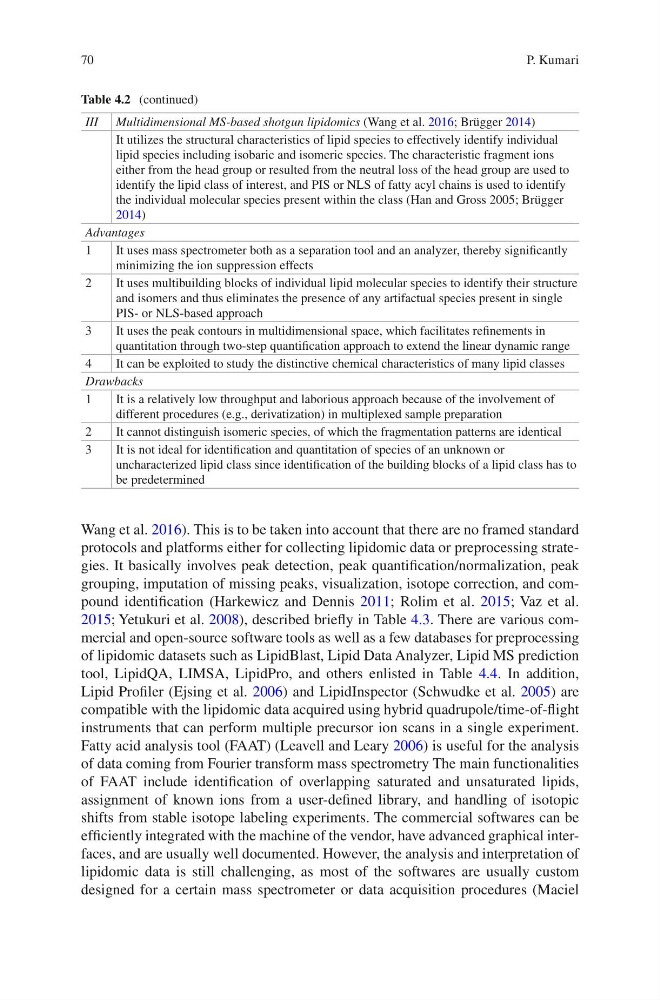
Table 4.2 (continued)
III Multidimensional MS-based shotgun lipidomics (Wang et al. 2016; Brügger 2014)
It utilizes the structural characteristics of lipid species to effectively identify individual
lipid species including isobaric and isomeric species. The characteristic fragment ions
either from the head group or resulted from the neutral loss of the head group are used to
identify the lipid class of interest, and PIS or NLS of fatty acyl chains is used to identify
the individual molecular species present within the class (Han and Gross 2005; Brügger
2014)
Advantages
1
It uses mass spectrometer both as a separation tool and an analyzer, thereby significantly
minimizing the ion suppression effects
2
It uses multibuilding blocks of individual lipid molecular species to identify their structure
and isomers and thus eliminates the presence of any artifactual species present in single
PIS- or NLS-based approach
3
It uses the peak contours in multidimensional space, which facilitates refinements in
quantitation through two-step quantification approach to extend the linear dynamic range
4
It can be exploited to study the distinctive chemical characteristics of many lipid classes
Drawbacks
1
It is a relatively low throughput and laborious approach because of the involvement of
different procedures (e.g., derivatization) in multiplexed sample preparation
2
It cannot distinguish isomeric species, of which the fragmentation patterns are identical
3
It is not ideal for identification and quantitation of species of an unknown or
uncharacterized lipid class since identification of the building blocks of a lipid class has to
be predetermined
P. Kumari
Wang et al. 2016). This is to be taken into account that there are no framed standard
protocols and platforms either for collecting lipidomic data or preprocessing strategies. It basically involves peak detection, peak quantification/normalization, peak
grouping, imputation of missing peaks, visualization, isotope correction, and compound identification (Harkewicz and Dennis 2011; Rolim et al. 2015; Vaz et al.
2015; Yetukuri et al. 2008), described briefly in Table 4.3. There are various commercial and open-source software tools as well as a few databases for preprocessing
of lipidomic datasets such as LipidBlast, Lipid Data Analyzer, Lipid MS prediction
tool, LipidQA, LIMSA, LipidPro, and others enlisted in Table 4.4. In addition,
Lipid Profiler (Ejsing et al. 2006) and LipidInspector (Schwudke et al. 2005) are
compatible with the lipidomic data acquired using hybrid quadrupole/time-of-flight
instruments that can perform multiple precursor ion scans in a single experiment.
Fatty acid analysis tool (FAAT) (Leavell and Leary 2006) is useful for the analysis
of data coming from Fourier transform mass spectrometry The main functionalities
of FAAT include identification of overlapping saturated and unsaturated lipids,
assignment of known ions from a user-defined library, and handling of isotopic
shifts from stable isotope labeling experiments. The commercial softwares can be
efficiently integrated with the machine of the vendor, have advanced graphical interfaces, and are usually well documented. However, the analysis and interpretation of
lipidomic data is still challenging, as most of the softwares are usually custom
designed for a certain mass spectrometer or data acquisition procedures (Maciel
Table 4.2 (continued)
III Multidimensional MS-based shotgun lipidomics (Wang et al. 2016; Brügger 2014)
It utilizes the structural characteristics of lipid species to effectively identify individual
lipid species including isobaric and isomeric species. The characteristic fragment ions
either from the head group or resulted from the neutral loss of the head group are used to
identify the lipid class of interest, and PIS or NLS of fatty acyl chains is used to identify
the individual molecular species present within the class (Han and Gross 2005; Brügger
2014)
Advantages
1
It uses mass spectrometer both as a separation tool and an analyzer, thereby significantly
minimizing the ion suppression effects
2
It uses multibuilding blocks of individual lipid molecular species to identify their structure
and isomers and thus eliminates the presence of any artifactual species present in single
PIS- or NLS-based approach
3
It uses the peak contours in multidimensional space, which facilitates refinements in
quantitation through two-step quantification approach to extend the linear dynamic range
4
It can be exploited to study the distinctive chemical characteristics of many lipid classes
Drawbacks
1
It is a relatively low throughput and laborious approach because of the involvement of
different procedures (e.g., derivatization) in multiplexed sample preparation
2
It cannot distinguish isomeric species, of which the fragmentation patterns are identical
3
It is not ideal for identification and quantitation of species of an unknown or
uncharacterized lipid class since identification of the building blocks of a lipid class has to
be predetermined
P. Kumari