

69
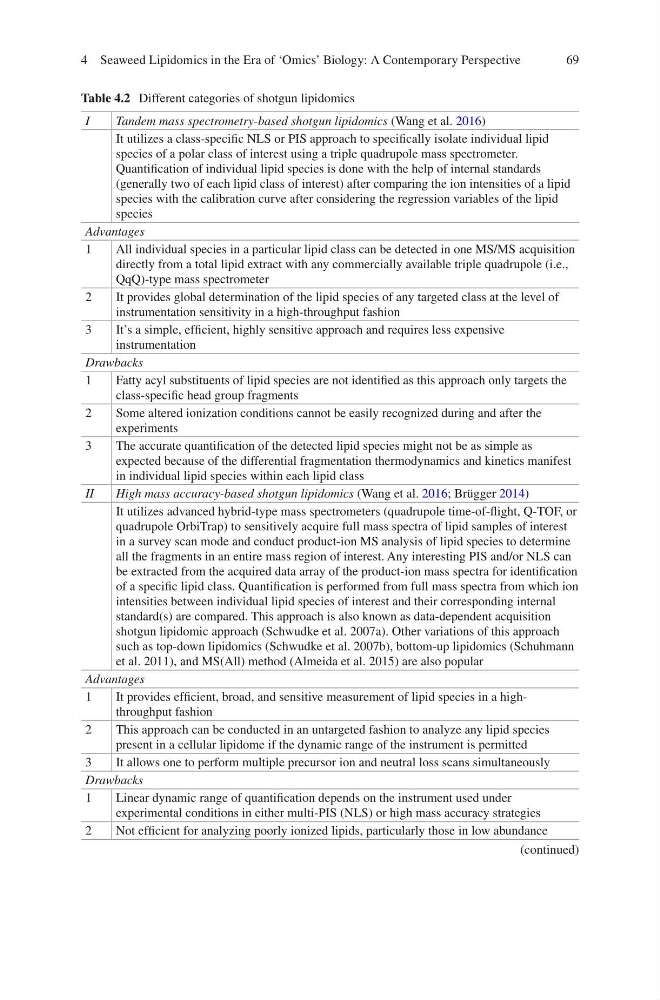
Table 4.2 Different categories of shotgun lipidomics
I
Tandem mass spectrometry-based shotgun lipidomics (Wang et al. 2016)
It utilizes a class-specific NLS or PIS approach to specifically isolate individual lipid
species of a polar class of interest using a triple quadrupole mass spectrometer.
Quantification of individual lipid species is done with the help of internal standards
(generally two of each lipid class of interest) after comparing the ion intensities of a lipid
species with the calibration curve after considering the regression variables of the lipid
species
Advantages
1
All individual species in a particular lipid class can be detected in one MS/MS acquisition
directly from a total lipid extract with any commercially available triple quadrupole (i.e.,
QqQ)-type mass spectrometer
2
It provides global determination of the lipid species of any targeted class at the level of
instrumentation sensitivity in a high-throughput fashion
3
It’s a simple, efficient, highly sensitive approach and requires less expensive
instrumentation
Drawbacks
1
Fatty acyl substituents of lipid species are not identified as this approach only targets the
class-specific head group fragments
2
Some altered ionization conditions cannot be easily recognized during and after the
experiments
3
The accurate quantification of the detected lipid species might not be as simple as
expected because of the differential fragmentation thermodynamics and kinetics manifest
in individual lipid species within each lipid class
II
High mass accuracy-based shotgun lipidomics (Wang et al. 2016; Brügger 2014)
It utilizes advanced hybrid-type mass spectrometers (quadrupole time-of-flight, Q-TOF, or
quadrupole OrbiTrap) to sensitively acquire full mass spectra of lipid samples of interest
in a survey scan mode and conduct product-ion MS analysis of lipid species to determine
all the fragments in an entire mass region of interest. Any interesting PIS and/or NLS can
be extracted from the acquired data array of the product-ion mass spectra for identification
of a specific lipid class. Quantification is performed from full mass spectra from which ion
intensities between individual lipid species of interest and their corresponding internal
standard(s) are compared. This approach is also known as data-dependent acquisition
shotgun lipidomic approach (Schwudke et al. 2007a). Other variations of this approach
such as top-down lipidomics (Schwudke et al. 2007b), bottom-up lipidomics (Schuhmann
et al. 2011), and MS(All) method (Almeida et al. 2015) are also popular
Advantages
1
It provides efficient, broad, and sensitive measurement of lipid species in a highthroughput fashion
2
This approach can be conducted in an untargeted fashion to analyze any lipid species
present in a cellular lipidome if the dynamic range of the instrument is permitted
3
It allows one to perform multiple precursor ion and neutral loss scans simultaneously
Drawbacks
1
Linear dynamic range of quantification depends on the instrument used under
experimental conditions in either multi-PIS (NLS) or high mass accuracy strategies
2
Not efficient for analyzing poorly ionized lipids, particularly those in low abundance
(continued)
4 Seaweed Lipidomics in the Era of ‘Omics’ Biology: A Contemporary Perspective
Table 4.2 Different categories of shotgun lipidomics
I
Tandem mass spectrometry-based shotgun lipidomics (Wang et al. 2016)
It utilizes a class-specific NLS or PIS approach to specifically isolate individual lipid
species of a polar class of interest using a triple quadrupole mass spectrometer.
Quantification of individual lipid species is done with the help of internal standards
(generally two of each lipid class of interest) after comparing the ion intensities of a lipid
species with the calibration curve after considering the regression variables of the lipid
species
Advantages
1
All individual species in a particular lipid class can be detected in one MS/MS acquisition
directly from a total lipid extract with any commercially available triple quadrupole (i.e.,
QqQ)-type mass spectrometer
2
It provides global determination of the lipid species of any targeted class at the level of
instrumentation sensitivity in a high-throughput fashion
3
It’s a simple, efficient, highly sensitive approach and requires less expensive
instrumentation
Drawbacks
1
Fatty acyl substituents of lipid species are not identified as this approach only targets the
class-specific head group fragments
2
Some altered ionization conditions cannot be easily recognized during and after the
experiments
3
The accurate quantification of the detected lipid species might not be as simple as
expected because of the differential fragmentation thermodynamics and kinetics manifest
in individual lipid species within each lipid class
II
High mass accuracy-based shotgun lipidomics (Wang et al. 2016; Brügger 2014)
It utilizes advanced hybrid-type mass spectrometers (quadrupole time-of-flight, Q-TOF, or
quadrupole OrbiTrap) to sensitively acquire full mass spectra of lipid samples of interest
in a survey scan mode and conduct product-ion MS analysis of lipid species to determine
all the fragments in an entire mass region of interest. Any interesting PIS and/or NLS can
be extracted from the acquired data array of the product-ion mass spectra for identification
of a specific lipid class. Quantification is performed from full mass spectra from which ion
intensities between individual lipid species of interest and their corresponding internal
standard(s) are compared. This approach is also known as data-dependent acquisition
shotgun lipidomic approach (Schwudke et al. 2007a). Other variations of this approach
such as top-down lipidomics (Schwudke et al. 2007b), bottom-up lipidomics (Schuhmann
et al. 2011), and MS(All) method (Almeida et al. 2015) are also popular
Advantages
1
It provides efficient, broad, and sensitive measurement of lipid species in a highthroughput fashion
2
This approach can be conducted in an untargeted fashion to analyze any lipid species
present in a cellular lipidome if the dynamic range of the instrument is permitted
3
It allows one to perform multiple precursor ion and neutral loss scans simultaneously
Drawbacks
1
Linear dynamic range of quantification depends on the instrument used under
experimental conditions in either multi-PIS (NLS) or high mass accuracy strategies
2
Not efficient for analyzing poorly ionized lipids, particularly those in low abundance
(continued)
4 Seaweed Lipidomics in the Era of ‘Omics’ Biology: A Contemporary Perspective