

332
homogenous fluorescence signal, depending on the concentration and localization
of ribosomes inside the cell. It represents a new and useful approach to identify living cells possessing an active metabolism. In coral bacteriology, FISH technology
allows spatial and temporal analysis of bacterial community and their variability
(Bouvier and del Giorgio 2003). For example, Ainsworth et al. (2006) combined
FISH and spectral imaging to study coral-associated bacteria to overcome the extensive autofluorescence of coral tissues and endosymbionts for the identification of
the coral-associated bacterial communities.
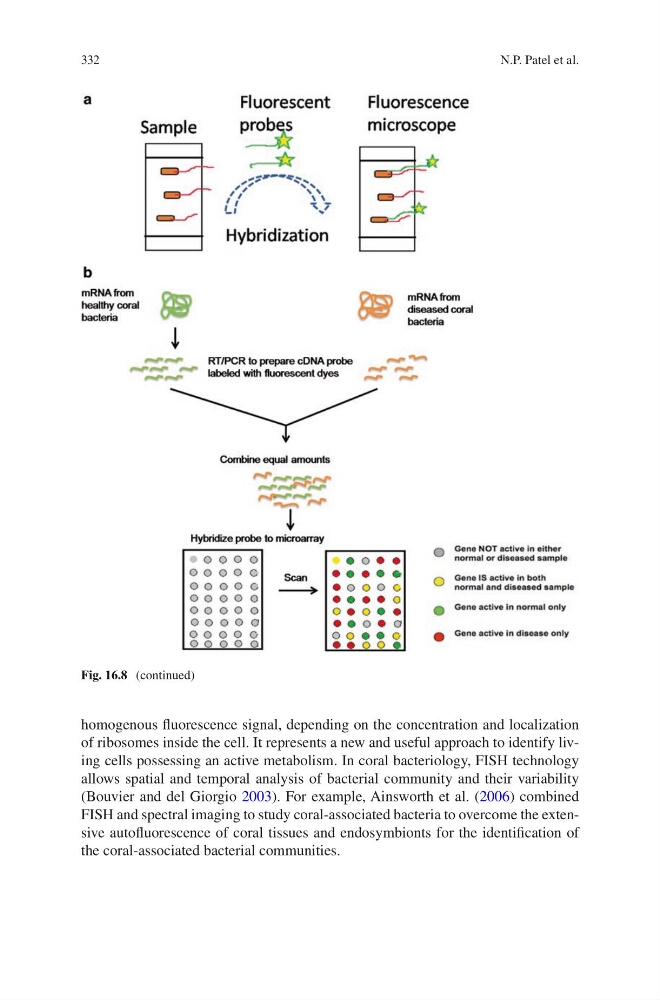
Fig. 16.8 (continued)
N.P. Patel et al.
homogenous fluorescence signal, depending on the concentration and localization
of ribosomes inside the cell. It represents a new and useful approach to identify living cells possessing an active metabolism. In coral bacteriology, FISH technology
allows spatial and temporal analysis of bacterial community and their variability
(Bouvier and del Giorgio 2003). For example, Ainsworth et al. (2006) combined
FISH and spectral imaging to study coral-associated bacteria to overcome the extensive autofluorescence of coral tissues and endosymbionts for the identification of
the coral-associated bacterial communities.
Fig. 16.8 (continued)
N.P. Patel et al.