

331
16.5.2 Nucleic Acid Hybridization-Based Techniques
Nucleic acid hybridization-based techniques are popularly used in coral-bacterial
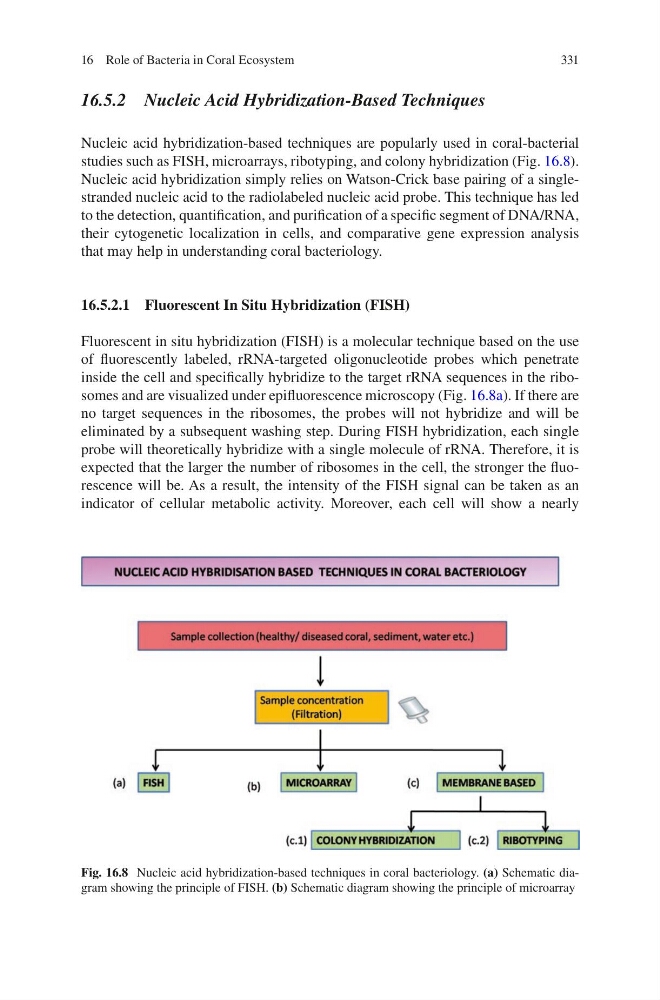
studies such as FISH, microarrays, ribotyping, and colony hybridization (Fig. 16.8).
Nucleic acid hybridization simply relies on Watson-Crick base pairing of a singlestranded nucleic acid to the radiolabeled nucleic acid probe. This technique has led
to the detection, quantification, and purification of a specific segment of DNA/RNA,
their cytogenetic localization in cells, and comparative gene expression analysis
that may help in understanding coral bacteriology.
16.5.2.1 Fluorescent In Situ Hybridization (FISH)
Fluorescent in situ hybridization (FISH) is a molecular technique based on the use
of fluorescently labeled, rRNA-targeted oligonucleotide probes which penetrate
inside the cell and specifically hybridize to the target rRNA sequences in the ribosomes and are visualized under epifluorescence microscopy (Fig. 16.8a). If there are
no target sequences in the ribosomes, the probes will not hybridize and will be
eliminated by a subsequent washing step. During FISH hybridization, each single
probe will theoretically hybridize with a single molecule of rRNA. Therefore, it is
expected that the larger the number of ribosomes in the cell, the stronger the fluorescence will be. As a result, the intensity of the FISH signal can be taken as an
indicator of cellular metabolic activity. Moreover, each cell will show a nearly
Fig. 16.8 Nucleic acid hybridization-based techniques in coral bacteriology. (a) Schematic diagram showing the principle of FISH. (b) Schematic diagram showing the principle of microarray
16 Role of Bacteria in Coral Ecosystem
16.5.2 Nucleic Acid Hybridization-Based Techniques
Nucleic acid hybridization-based techniques are popularly used in coral-bacterial
studies such as FISH, microarrays, ribotyping, and colony hybridization (Fig. 16.8).
Nucleic acid hybridization simply relies on Watson-Crick base pairing of a singlestranded nucleic acid to the radiolabeled nucleic acid probe. This technique has led
to the detection, quantification, and purification of a specific segment of DNA/RNA,
their cytogenetic localization in cells, and comparative gene expression analysis
that may help in understanding coral bacteriology.
16.5.2.1 Fluorescent In Situ Hybridization (FISH)
Fluorescent in situ hybridization (FISH) is a molecular technique based on the use
of fluorescently labeled, rRNA-targeted oligonucleotide probes which penetrate
inside the cell and specifically hybridize to the target rRNA sequences in the ribosomes and are visualized under epifluorescence microscopy (Fig. 16.8a). If there are
no target sequences in the ribosomes, the probes will not hybridize and will be
eliminated by a subsequent washing step. During FISH hybridization, each single
probe will theoretically hybridize with a single molecule of rRNA. Therefore, it is
expected that the larger the number of ribosomes in the cell, the stronger the fluorescence will be. As a result, the intensity of the FISH signal can be taken as an
indicator of cellular metabolic activity. Moreover, each cell will show a nearly
Fig. 16.8 Nucleic acid hybridization-based techniques in coral bacteriology. (a) Schematic diagram showing the principle of FISH. (b) Schematic diagram showing the principle of microarray
16 Role of Bacteria in Coral Ecosystem