

320
but very little is known about the role of bacteria associated with the coral holobiont. For this reason, the chapter aims to review the recent advancement in understanding the coral-bacterial interactions and their possible roles in coral holobiont.
We are also discussing the recent biotechnological tools used in the study of coralassociated bacterial diversity and their role in structuring coral ecosystem.
16.2 Coral and Its Structure
The coral reef ecosystem consists of diverse species that interact with each other and
the surrounding environment. They are estimated to cover 284,300 km
2
(109,800 sq.
mi) (Spalding et al. 2001) just under 0.1% of the oceans’ surface area. The IndoPacific region that include the Red Sea, Indian Ocean, Southeast Asia, and the Pacific)
accounts for 91.9%, Southeast Asia accounts for 32.3%, and the Pacific including
Australia accounts for 40.8%, while Atlantic and Caribbean coral reefs account for
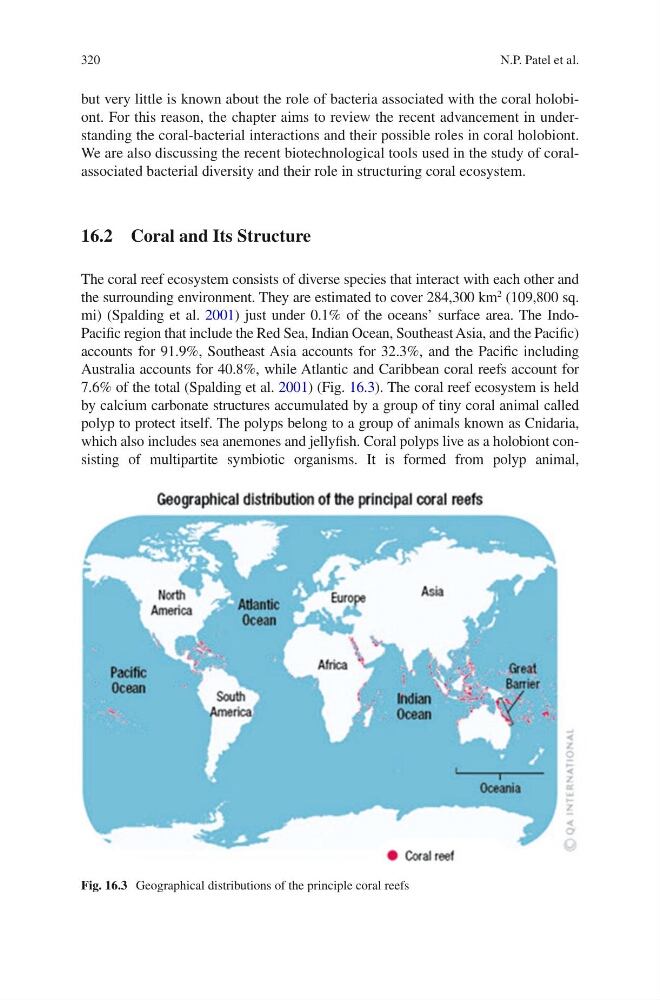
7.6% of the total (Spalding et al. 2001) (Fig. 16.3). The coral reef ecosystem is held
by calcium carbonate structures accumulated by a group of tiny coral animal called
polyp to protect itself. The polyps belong to a group of animals known as Cnidaria,
which also includes sea anemones and jellyfish. Coral polyps live as a holobiont consisting of multipartite symbiotic organisms. It is formed from polyp animal,
Fig. 16.3 Geographical distributions of the principle coral reefs
N.P. Patel et al.
but very little is known about the role of bacteria associated with the coral holobiont. For this reason, the chapter aims to review the recent advancement in understanding the coral-bacterial interactions and their possible roles in coral holobiont.
We are also discussing the recent biotechnological tools used in the study of coralassociated bacterial diversity and their role in structuring coral ecosystem.
16.2 Coral and Its Structure
The coral reef ecosystem consists of diverse species that interact with each other and
the surrounding environment. They are estimated to cover 284,300 km
2
(109,800 sq.
mi) (Spalding et al. 2001) just under 0.1% of the oceans’ surface area. The IndoPacific region that include the Red Sea, Indian Ocean, Southeast Asia, and the Pacific)
accounts for 91.9%, Southeast Asia accounts for 32.3%, and the Pacific including
Australia accounts for 40.8%, while Atlantic and Caribbean coral reefs account for
7.6% of the total (Spalding et al. 2001) (Fig. 16.3). The coral reef ecosystem is held
by calcium carbonate structures accumulated by a group of tiny coral animal called
polyp to protect itself. The polyps belong to a group of animals known as Cnidaria,
which also includes sea anemones and jellyfish. Coral polyps live as a holobiont consisting of multipartite symbiotic organisms. It is formed from polyp animal,
Fig. 16.3 Geographical distributions of the principle coral reefs
N.P. Patel et al.