

246
photochemical efficiency (Chen and Gao 2011). As for the coupling of UV-A and OA,
this alga appeared to raise its photochemical efficiency (Y′) and lower non-photochemical quenching (NPQ) under moderate levels of solar radiation (cloudy days). On
sunny days, there was no significant effect on Y′ while it significantly raised the NPQ
(Chen and Gao 2011). Regardless of sunny or cloudy days, the combined effects of
OA and UV-B lowered the algal Y′ and increased its NPQ only on sunny days (Chen
and Gao 2011). Under fluctuating irradiances, OA was shown to counteract the
enhancement of photosynthetic carbon fixation by UV-A, while decreasing the photochemical inhibition associated with UV-B (Jin et al. 2013).
Studies show that OA and UV have a synergistic effect on calcified algae. OA
lowers the calcification in coccolithophorids and coralline algae. It thins the calcified
layer, enhancing the transmission of UV so as to intensify the damage of UV to
impair cellular functions (Gao et al. 2009; Gao and Zheng 2010; Xu and Gao 2014).
Under OA conditions, coralline algae calcify less, their photosynthetic pigments are
highly reduced, but UV-screening compounds (mainly mycosprine-like amino acids)
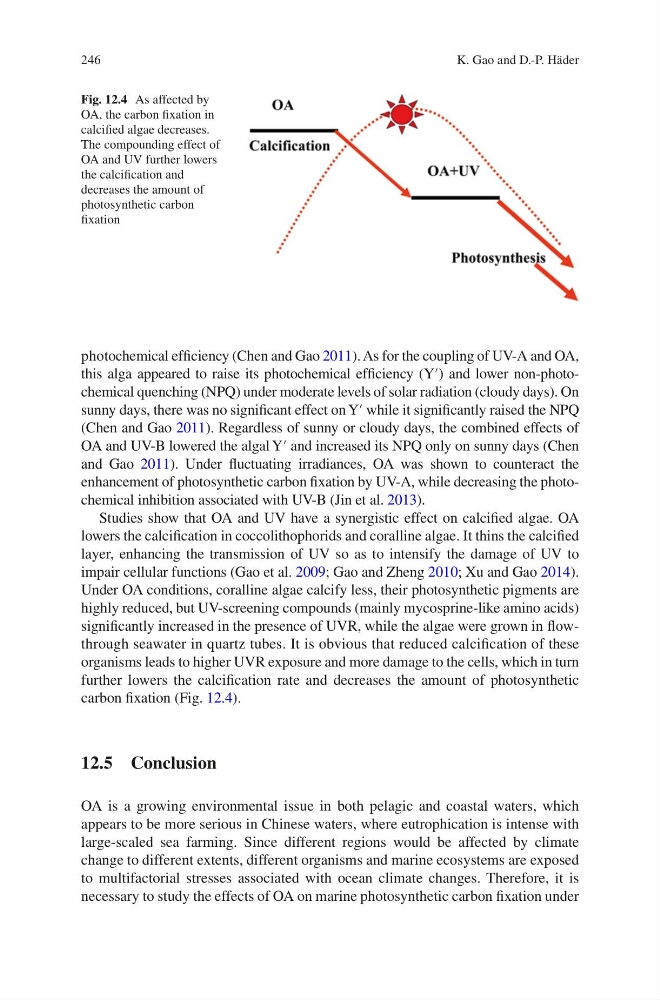
significantly increased in the presence of UVR, while the algae were grown in flowthrough seawater in quartz tubes. It is obvious that reduced calcification of these
organisms leads to higher UVR exposure and more damage to the cells, which in turn
further lowers the calcification rate and decreases the amount of photosynthetic
carbon fixation (Fig. 12.4).
12.5 Conclusion
OA is a growing environmental issue in both pelagic and coastal waters, which
appears to be more serious in Chinese waters, where eutrophication is intense with
large-scaled sea farming. Since different regions would be affected by climate
change to different extents, different organisms and marine ecosystems are exposed
to multifactorial stresses associated with ocean climate changes. Therefore, it is
necessary to study the effects of OA on marine photosynthetic carbon fixation under
Fig. 12.4 As affected by
OA, the carbon fixation in
calcified algae decreases.
The compounding effect of
OA and UV further lowers
the calcification and
decreases the amount of
photosynthetic carbon
fixation
K. Gao and D.-P. Häder
photochemical efficiency (Chen and Gao 2011). As for the coupling of UV-A and OA,
this alga appeared to raise its photochemical efficiency (Y′) and lower non-photochemical quenching (NPQ) under moderate levels of solar radiation (cloudy days). On
sunny days, there was no significant effect on Y′ while it significantly raised the NPQ
(Chen and Gao 2011). Regardless of sunny or cloudy days, the combined effects of
OA and UV-B lowered the algal Y′ and increased its NPQ only on sunny days (Chen
and Gao 2011). Under fluctuating irradiances, OA was shown to counteract the
enhancement of photosynthetic carbon fixation by UV-A, while decreasing the photochemical inhibition associated with UV-B (Jin et al. 2013).
Studies show that OA and UV have a synergistic effect on calcified algae. OA
lowers the calcification in coccolithophorids and coralline algae. It thins the calcified
layer, enhancing the transmission of UV so as to intensify the damage of UV to
impair cellular functions (Gao et al. 2009; Gao and Zheng 2010; Xu and Gao 2014).
Under OA conditions, coralline algae calcify less, their photosynthetic pigments are
highly reduced, but UV-screening compounds (mainly mycosprine-like amino acids)
significantly increased in the presence of UVR, while the algae were grown in flowthrough seawater in quartz tubes. It is obvious that reduced calcification of these
organisms leads to higher UVR exposure and more damage to the cells, which in turn
further lowers the calcification rate and decreases the amount of photosynthetic
carbon fixation (Fig. 12.4).
12.5 Conclusion
OA is a growing environmental issue in both pelagic and coastal waters, which
appears to be more serious in Chinese waters, where eutrophication is intense with
large-scaled sea farming. Since different regions would be affected by climate
change to different extents, different organisms and marine ecosystems are exposed
to multifactorial stresses associated with ocean climate changes. Therefore, it is
necessary to study the effects of OA on marine photosynthetic carbon fixation under
Fig. 12.4 As affected by
OA, the carbon fixation in
calcified algae decreases.
The compounding effect of
OA and UV further lowers
the calcification and
decreases the amount of
photosynthetic carbon
fixation
K. Gao and D.-P. Häder