

179
8.3.2 Interactions with Other Organisms
Seagrasses interact with a diverse array of epiphytic microorganisms, macroalgae,
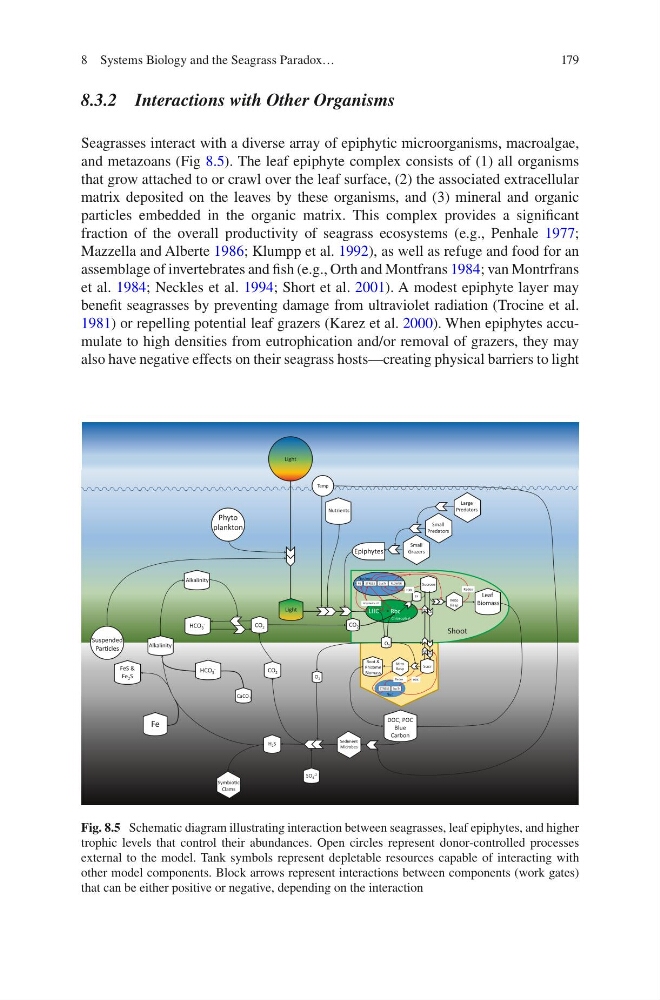
and metazoans (Fig 8.5). The leaf epiphyte complex consists of (1) all organisms
that grow attached to or crawl over the leaf surface, (2) the associated extracellular
matrix deposited on the leaves by these organisms, and (3) mineral and organic
particles embedded in the organic matrix. This complex provides a significant
fraction of the overall productivity of seagrass ecosystems (e.g., Penhale 1977;
Mazzella and Alberte 1986; Klumpp et al. 1992), as well as refuge and food for an
assemblage of invertebrates and fish (e.g., Orth and Montfrans 1984; van Montrfrans
et al. 1984; Neckles et al. 1994; Short et al. 2001). A modest epiphyte layer may
benefit seagrasses by preventing damage from ultraviolet radiation (Trocine et al.
1981) or repelling potential leaf grazers (Karez et al. 2000). When epiphytes accumulate to high densities from eutrophication and/or removal of grazers, they may
also have negative effects on their seagrass hosts—creating physical barriers to light
Nutrients
Suspended
ParƟcles
Phyto
plankton
Sucrose
Sucr
O2
Leaf
Biomass
Root &
Rhizome
Biomass
LHC
Rbc
Chloroplast
Nucleus
PS STRESS
FLOWER
SucTr
TP
Mito
Resp
CO 2
ROS Redox ET
HXK
Inv
Sus
Inv Sus
STRESS SucTr
Nuc
HXK
Mito
Resp
Redox
Redox
Shoot
O2
SymbioƟc
Clams
DOC, POC
Blue
Carbon
SO4 -2
HCO 3
-
Alkalinity
CO 2
Light
CaCO3
CO 2
FeS &
Fe 2 S
Alkalinity
Fe
Sediment
Microbes
H2S
HCO 3
-
Light
Small
Grazers
Small
Predators
Temp
Epiphytes
Large
Predators
Nutrients
Fig. 8.5 Schematic diagram illustrating interaction between seagrasses, leaf epiphytes, and higher
trophic levels that control their abundances. Open circles represent donor-controlled processes
external to the model. Tank symbols represent depletable resources capable of interacting with
other model components. Block arrows represent interactions between components (work gates)
that can be either positive or negative, depending on the interaction
8 Systems Biology and the Seagrass Paradox…
8.3.2 Interactions with Other Organisms
Seagrasses interact with a diverse array of epiphytic microorganisms, macroalgae,
and metazoans (Fig 8.5). The leaf epiphyte complex consists of (1) all organisms
that grow attached to or crawl over the leaf surface, (2) the associated extracellular
matrix deposited on the leaves by these organisms, and (3) mineral and organic
particles embedded in the organic matrix. This complex provides a significant
fraction of the overall productivity of seagrass ecosystems (e.g., Penhale 1977;
Mazzella and Alberte 1986; Klumpp et al. 1992), as well as refuge and food for an
assemblage of invertebrates and fish (e.g., Orth and Montfrans 1984; van Montrfrans
et al. 1984; Neckles et al. 1994; Short et al. 2001). A modest epiphyte layer may
benefit seagrasses by preventing damage from ultraviolet radiation (Trocine et al.
1981) or repelling potential leaf grazers (Karez et al. 2000). When epiphytes accumulate to high densities from eutrophication and/or removal of grazers, they may
also have negative effects on their seagrass hosts—creating physical barriers to light
Nutrients
Suspended
ParƟcles
Phyto
plankton
Sucrose
Sucr
O2
Leaf
Biomass
Root &
Rhizome
Biomass
LHC
Rbc
Chloroplast
Nucleus
PS STRESS
FLOWER
SucTr
TP
Mito
Resp
CO 2
ROS Redox ET
HXK
Inv
Sus
Inv Sus
STRESS SucTr
Nuc
HXK
Mito
Resp
Redox
Redox
Shoot
O2
SymbioƟc
Clams
DOC, POC
Blue
Carbon
SO4 -2
HCO 3
-
Alkalinity
CO 2
Light
CaCO3
CO 2
FeS &
Fe 2 S
Alkalinity
Fe
Sediment
Microbes
H2S
HCO 3
-
Light
Small
Grazers
Small
Predators
Temp
Epiphytes
Large
Predators
Nutrients
Fig. 8.5 Schematic diagram illustrating interaction between seagrasses, leaf epiphytes, and higher
trophic levels that control their abundances. Open circles represent donor-controlled processes
external to the model. Tank symbols represent depletable resources capable of interacting with
other model components. Block arrows represent interactions between components (work gates)
that can be either positive or negative, depending on the interaction
8 Systems Biology and the Seagrass Paradox…