

xviii
a general committee member of ASPAB. He is also an invited reviewer for a number
of international scientific journals including New Phytologist, Scientific Reports,
Algal Research, Frontiers in Plant Science, and research grant proposals including
ARC-DECRA and ARC-Discovery.
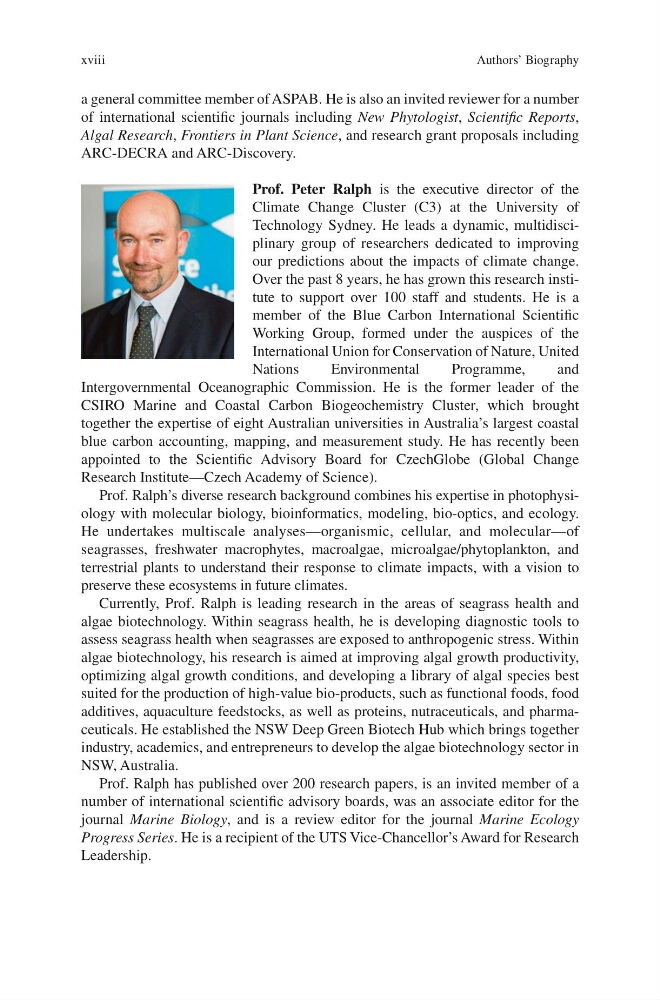
Prof. Peter Ralph is the executive director of the
Climate Change Cluster (C3) at the University of
Technology Sydney. He leads a dynamic, multidisciplinary group of researchers dedicated to improving
our predictions about the impacts of climate change.
Over the past 8 years, he has grown this research institute to support over 100 staff and students. He is a
member of the Blue Carbon International Scientific
Working Group, formed under the auspices of the
International Union for Conservation of Nature, United
Nations
Environmental
Programme,
and
Intergovernmental Oceanographic Commission. He is the former leader of the
CSIRO Marine and Coastal Carbon Biogeochemistry Cluster, which brought
together the expertise of eight Australian universities in Australia’s largest coastal
blue carbon accounting, mapping, and measurement study. He has recently been
appointed to the Scientific Advisory Board for CzechGlobe (Global Change
Research Institute—Czech Academy of Science).
Prof. Ralph’s diverse research background combines his expertise in photophysiology with molecular biology, bioinformatics, modeling, bio-optics, and ecology.
He undertakes multiscale analyses—organismic, cellular, and molecular—of
seagrasses, freshwater macrophytes, macroalgae, microalgae/phytoplankton, and
terrestrial plants to understand their response to climate impacts, with a vision to
preserve these ecosystems in future climates.
Currently, Prof. Ralph is leading research in the areas of seagrass health and
algae biotechnology. Within seagrass health, he is developing diagnostic tools to
assess seagrass health when seagrasses are exposed to anthropogenic stress. Within
algae biotechnology, his research is aimed at improving algal growth productivity,
optimizing algal growth conditions, and developing a library of algal species best
suited for the production of high-value bio-products, such as functional foods, food
additives, aquaculture feedstocks, as well as proteins, nutraceuticals, and pharmaceuticals. He established the NSW Deep Green Biotech Hub which brings together
industry, academics, and entrepreneurs to develop the algae biotechnology sector in
NSW, Australia.
Prof. Ralph has published over 200 research papers, is an invited member of a
number of international scientific advisory boards, was an associate editor for the
journal Marine Biology, and is a review editor for the journal Marine Ecology
Progress Series. He is a recipient of the UTS Vice-Chancellor’s Award for Research
Leadership.
Authors’ Biography
a general committee member of ASPAB. He is also an invited reviewer for a number
of international scientific journals including New Phytologist, Scientific Reports,
Algal Research, Frontiers in Plant Science, and research grant proposals including
ARC-DECRA and ARC-Discovery.
Prof. Peter Ralph is the executive director of the
Climate Change Cluster (C3) at the University of
Technology Sydney. He leads a dynamic, multidisciplinary group of researchers dedicated to improving
our predictions about the impacts of climate change.
Over the past 8 years, he has grown this research institute to support over 100 staff and students. He is a
member of the Blue Carbon International Scientific
Working Group, formed under the auspices of the
International Union for Conservation of Nature, United
Nations
Environmental
Programme,
and
Intergovernmental Oceanographic Commission. He is the former leader of the
CSIRO Marine and Coastal Carbon Biogeochemistry Cluster, which brought
together the expertise of eight Australian universities in Australia’s largest coastal
blue carbon accounting, mapping, and measurement study. He has recently been
appointed to the Scientific Advisory Board for CzechGlobe (Global Change
Research Institute—Czech Academy of Science).
Prof. Ralph’s diverse research background combines his expertise in photophysiology with molecular biology, bioinformatics, modeling, bio-optics, and ecology.
He undertakes multiscale analyses—organismic, cellular, and molecular—of
seagrasses, freshwater macrophytes, macroalgae, microalgae/phytoplankton, and
terrestrial plants to understand their response to climate impacts, with a vision to
preserve these ecosystems in future climates.
Currently, Prof. Ralph is leading research in the areas of seagrass health and
algae biotechnology. Within seagrass health, he is developing diagnostic tools to
assess seagrass health when seagrasses are exposed to anthropogenic stress. Within
algae biotechnology, his research is aimed at improving algal growth productivity,
optimizing algal growth conditions, and developing a library of algal species best
suited for the production of high-value bio-products, such as functional foods, food
additives, aquaculture feedstocks, as well as proteins, nutraceuticals, and pharmaceuticals. He established the NSW Deep Green Biotech Hub which brings together
industry, academics, and entrepreneurs to develop the algae biotechnology sector in
NSW, Australia.
Prof. Ralph has published over 200 research papers, is an invited member of a
number of international scientific advisory boards, was an associate editor for the
journal Marine Biology, and is a review editor for the journal Marine Ecology
Progress Series. He is a recipient of the UTS Vice-Chancellor’s Award for Research
Leadership.
Authors’ Biography