

xvii
Authors’ Biography
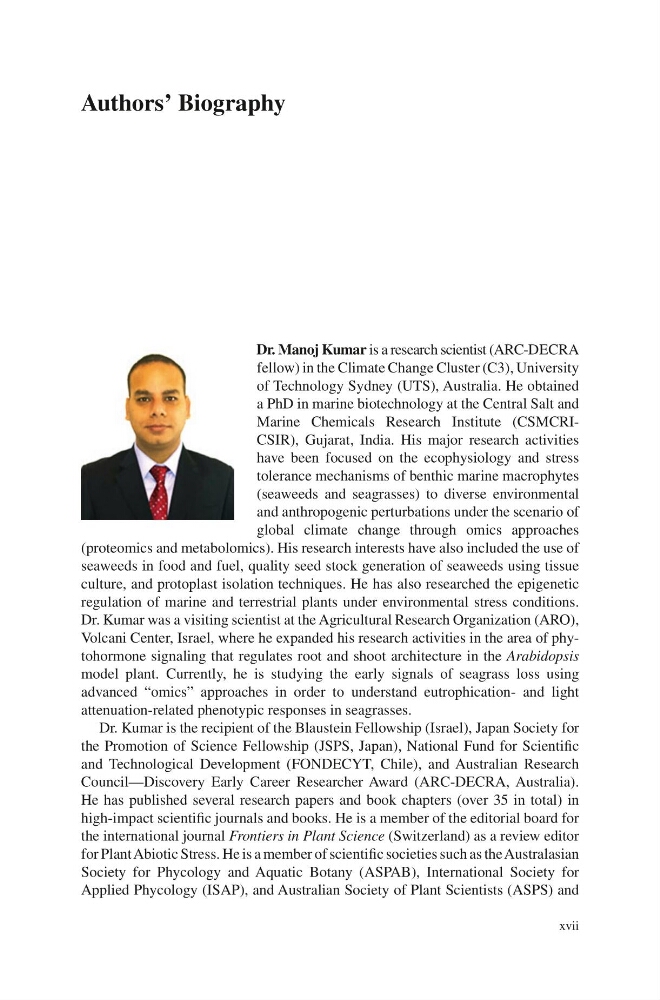
Dr. Manoj Kumar is a research scientist (ARC-DECRA
fellow) in the Climate Change Cluster (C3), University
of Technology Sydney (UTS), Australia. He obtained
a PhD in marine biotechnology at the Central Salt and
Marine Chemicals Research Institute (CSMCRICSIR), Gujarat, India. His major research activities
have been focused on the ecophysiology and stress
tolerance mechanisms of benthic marine macrophytes
(seaweeds and seagrasses) to diverse environmental
and anthropogenic perturbations under the scenario of
global climate change through omics approaches
(proteomics and metabolomics). His research interests have also included the use of
seaweeds in food and fuel, quality seed stock generation of seaweeds using tissue
culture, and protoplast isolation techniques. He has also researched the epigenetic
regulation of marine and terrestrial plants under environmental stress conditions.
Dr. Kumar was a visiting scientist at the Agricultural Research Organization (ARO),
Volcani Center, Israel, where he expanded his research activities in the area of phytohormone signaling that regulates root and shoot architecture in the Arabidopsis
model plant. Currently, he is studying the early signals of seagrass loss using
advanced “omics” approaches in order to understand eutrophication- and light
attenuation-related phenotypic responses in seagrasses.
Dr. Kumar is the recipient of the Blaustein Fellowship (Israel), Japan Society for
the Promotion of Science Fellowship (JSPS, Japan), National Fund for Scientific
and Technological Development (FONDECYT, Chile), and Australian Research
Council—Discovery Early Career Researcher Award (ARC-DECRA, Australia).
He has published several research papers and book chapters (over 35 in total) in
high-impact scientific journals and books. He is a member of the editorial board for
the international journal Frontiers in Plant Science (Switzerland) as a review editor
for Plant Abiotic Stress. He is a member of scientific societies such as the Australasian
Society for Phycology and Aquatic Botany (ASPAB), International Society for
Applied Phycology (ISAP), and Australian Society of Plant Scientists (ASPS) and
Authors’ Biography
Dr. Manoj Kumar is a research scientist (ARC-DECRA
fellow) in the Climate Change Cluster (C3), University
of Technology Sydney (UTS), Australia. He obtained
a PhD in marine biotechnology at the Central Salt and
Marine Chemicals Research Institute (CSMCRICSIR), Gujarat, India. His major research activities
have been focused on the ecophysiology and stress
tolerance mechanisms of benthic marine macrophytes
(seaweeds and seagrasses) to diverse environmental
and anthropogenic perturbations under the scenario of
global climate change through omics approaches
(proteomics and metabolomics). His research interests have also included the use of
seaweeds in food and fuel, quality seed stock generation of seaweeds using tissue
culture, and protoplast isolation techniques. He has also researched the epigenetic
regulation of marine and terrestrial plants under environmental stress conditions.
Dr. Kumar was a visiting scientist at the Agricultural Research Organization (ARO),
Volcani Center, Israel, where he expanded his research activities in the area of phytohormone signaling that regulates root and shoot architecture in the Arabidopsis
model plant. Currently, he is studying the early signals of seagrass loss using
advanced “omics” approaches in order to understand eutrophication- and light
attenuation-related phenotypic responses in seagrasses.
Dr. Kumar is the recipient of the Blaustein Fellowship (Israel), Japan Society for
the Promotion of Science Fellowship (JSPS, Japan), National Fund for Scientific
and Technological Development (FONDECYT, Chile), and Australian Research
Council—Discovery Early Career Researcher Award (ARC-DECRA, Australia).
He has published several research papers and book chapters (over 35 in total) in
high-impact scientific journals and books. He is a member of the editorial board for
the international journal Frontiers in Plant Science (Switzerland) as a review editor
for Plant Abiotic Stress. He is a member of scientific societies such as the Australasian
Society for Phycology and Aquatic Botany (ASPAB), International Society for
Applied Phycology (ISAP), and Australian Society of Plant Scientists (ASPS) and