

110
complexities have emerged at a molecular level. Firstly, if the response is related to
chemical stimuli, as volatiles are, the sensing model will comprise a molecule—a
chemical ligand—which will bind to a specific receptor. Secondly, the presence of
a type of receptor does not mean that its nucleotide sequences are uniform in all
organisms and/or development stages, and moreover, these sequences can likely be
identified. This situation is recurrent in seaweeds since it is not feasible to compare
gene sequences from red algae with those from green algae and plants or unicellular
versus multicellular algae either. Furthermore, the existence of multiple nonannotated protein sequences in algae and the presence of nonhomologous genes in
other organisms hinder the sequence comparison.
With this scenario, and even more so given the scarcity of genes in public database and genes related to reproduction events, a major gene repertoire for the red
seaweed Grateloupia imbricata was developed with the aim of uncovering potential
genomic mechanisms related to different physiological events (GenBank sequences
record with BioProject record PRJNA309128 and BioSample record
SAMN04420758).
In particular, the focus of the genetic research in this seaweed has turned to identifying genes related to important traits of development such as carposporogenesis
in G. imbricata. This approach revealed a set of genes that are closely associated
with the synthesis of ethylene and methyl jasmonate. Furthermore, Grateloupia
transcriptome revealed a number of sequences encoding proteins that target ethylene synthesis and different kinases which could involve response to ethylene signalling and that the perception of stimuli, such as gaseous hormones, could activate
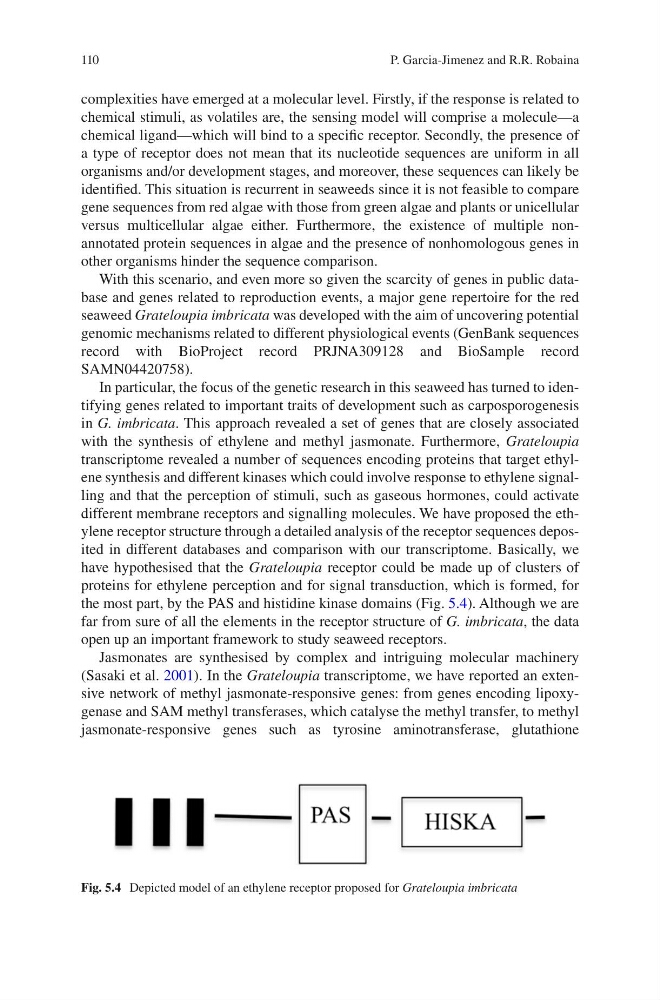
different membrane receptors and signalling molecules. We have proposed the ethylene receptor structure through a detailed analysis of the receptor sequences deposited in different databases and comparison with our transcriptome. Basically, we
have hypothesised that the Grateloupia receptor could be made up of clusters of
proteins for ethylene perception and for signal transduction, which is formed, for
the most part, by the PAS and histidine kinase domains (Fig. 5.4). Although we are
far from sure of all the elements in the receptor structure of G. imbricata, the data
open up an important framework to study seaweed receptors.
Jasmonates are synthesised by complex and intriguing molecular machinery
(Sasaki et al. 2001). In the Grateloupia transcriptome, we have reported an extensive network of methyl jasmonate-responsive genes: from genes encoding lipoxygenase and SAM methyl transferases, which catalyse the methyl transfer, to methyl
jasmonate-responsive genes such as tyrosine aminotransferase, glutathione
Fig. 5.4 Depicted model of an ethylene receptor proposed for Grateloupia imbricata
P. Garcia-Jimenez and R.R. Robaina
complexities have emerged at a molecular level. Firstly, if the response is related to
chemical stimuli, as volatiles are, the sensing model will comprise a molecule—a
chemical ligand—which will bind to a specific receptor. Secondly, the presence of
a type of receptor does not mean that its nucleotide sequences are uniform in all
organisms and/or development stages, and moreover, these sequences can likely be
identified. This situation is recurrent in seaweeds since it is not feasible to compare
gene sequences from red algae with those from green algae and plants or unicellular
versus multicellular algae either. Furthermore, the existence of multiple nonannotated protein sequences in algae and the presence of nonhomologous genes in
other organisms hinder the sequence comparison.
With this scenario, and even more so given the scarcity of genes in public database and genes related to reproduction events, a major gene repertoire for the red
seaweed Grateloupia imbricata was developed with the aim of uncovering potential
genomic mechanisms related to different physiological events (GenBank sequences
record with BioProject record PRJNA309128 and BioSample record
SAMN04420758).
In particular, the focus of the genetic research in this seaweed has turned to identifying genes related to important traits of development such as carposporogenesis
in G. imbricata. This approach revealed a set of genes that are closely associated
with the synthesis of ethylene and methyl jasmonate. Furthermore, Grateloupia
transcriptome revealed a number of sequences encoding proteins that target ethylene synthesis and different kinases which could involve response to ethylene signalling and that the perception of stimuli, such as gaseous hormones, could activate
different membrane receptors and signalling molecules. We have proposed the ethylene receptor structure through a detailed analysis of the receptor sequences deposited in different databases and comparison with our transcriptome. Basically, we
have hypothesised that the Grateloupia receptor could be made up of clusters of
proteins for ethylene perception and for signal transduction, which is formed, for
the most part, by the PAS and histidine kinase domains (Fig. 5.4). Although we are
far from sure of all the elements in the receptor structure of G. imbricata, the data
open up an important framework to study seaweed receptors.
Jasmonates are synthesised by complex and intriguing molecular machinery
(Sasaki et al. 2001). In the Grateloupia transcriptome, we have reported an extensive network of methyl jasmonate-responsive genes: from genes encoding lipoxygenase and SAM methyl transferases, which catalyse the methyl transfer, to methyl
jasmonate-responsive genes such as tyrosine aminotransferase, glutathione
Fig. 5.4 Depicted model of an ethylene receptor proposed for Grateloupia imbricata
P. Garcia-Jimenez and R.R. Robaina