

106
5.5 Ethylene and Methyl Jasmonate as Priming Volatile
Growth Regulators that Affect Reproduction
in Seaweeds
Excitingly, red seaweeds also produce and perceive ethylene and methyl jasmonate
with major physiological implications, such as reproduction. Depending on the ethylene biosynthetic route, the enzyme activities of ACC synthase and ACC oxidase
are reported, and ethylene production has been correlated with these enzyme activities (Garcia-Jimenez and Robaina 2012). Ethylene affects the in vitro development
of tetrasporangial branches in the red seaweed Pterocladiella capillacea (Fig. 5.2a)
and the incremental number of cystocarps in G. imbricata (Garcia-Jimenez and
Robaina 2012), while the application of an inhibitor of the perception of ethylene,
such as silver thiosulphate (STS), eliminates this ethylene response.
The increment in the number of tetrasporangial branches in P. capillacea is also
dependent on the duration of ethylene exposure, increasing nearly 200-fold in thalli
treated with ethylene for 30 min compared to untreated thalli. In vitro, the increase
in ethylene production after an initial exposure to exogenous ethylene suggests an
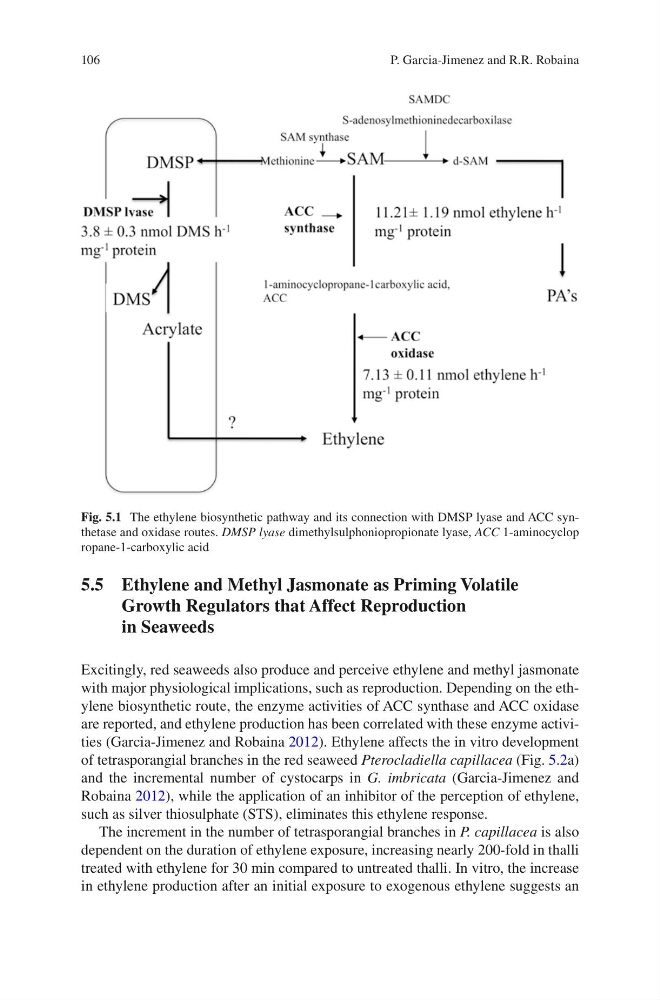
Fig. 5.1 The ethylene biosynthetic pathway and its connection with DMSP lyase and ACC synthetase and oxidase routes. DMSP lyase dimethylsulphoniopropionate lyase, ACC 1- aminocyclop
ropane- 1-carboxylic acid
P. Garcia-Jimenez and R.R. Robaina
5.5 Ethylene and Methyl Jasmonate as Priming Volatile
Growth Regulators that Affect Reproduction
in Seaweeds
Excitingly, red seaweeds also produce and perceive ethylene and methyl jasmonate
with major physiological implications, such as reproduction. Depending on the ethylene biosynthetic route, the enzyme activities of ACC synthase and ACC oxidase
are reported, and ethylene production has been correlated with these enzyme activities (Garcia-Jimenez and Robaina 2012). Ethylene affects the in vitro development
of tetrasporangial branches in the red seaweed Pterocladiella capillacea (Fig. 5.2a)
and the incremental number of cystocarps in G. imbricata (Garcia-Jimenez and
Robaina 2012), while the application of an inhibitor of the perception of ethylene,
such as silver thiosulphate (STS), eliminates this ethylene response.
The increment in the number of tetrasporangial branches in P. capillacea is also
dependent on the duration of ethylene exposure, increasing nearly 200-fold in thalli
treated with ethylene for 30 min compared to untreated thalli. In vitro, the increase
in ethylene production after an initial exposure to exogenous ethylene suggests an
Fig. 5.1 The ethylene biosynthetic pathway and its connection with DMSP lyase and ACC synthetase and oxidase routes. DMSP lyase dimethylsulphoniopropionate lyase, ACC 1- aminocyclop
ropane- 1-carboxylic acid
P. Garcia-Jimenez and R.R. Robaina