

284
A.M. Zink and J. K1icka
C/)
(])
0)
ttl
(])
c
:::i
'(])
.0
E
::l
Z
C
-.J
100~-----------------------------.
10
Song Sparrow Control Region
Sequence Data
Time
o
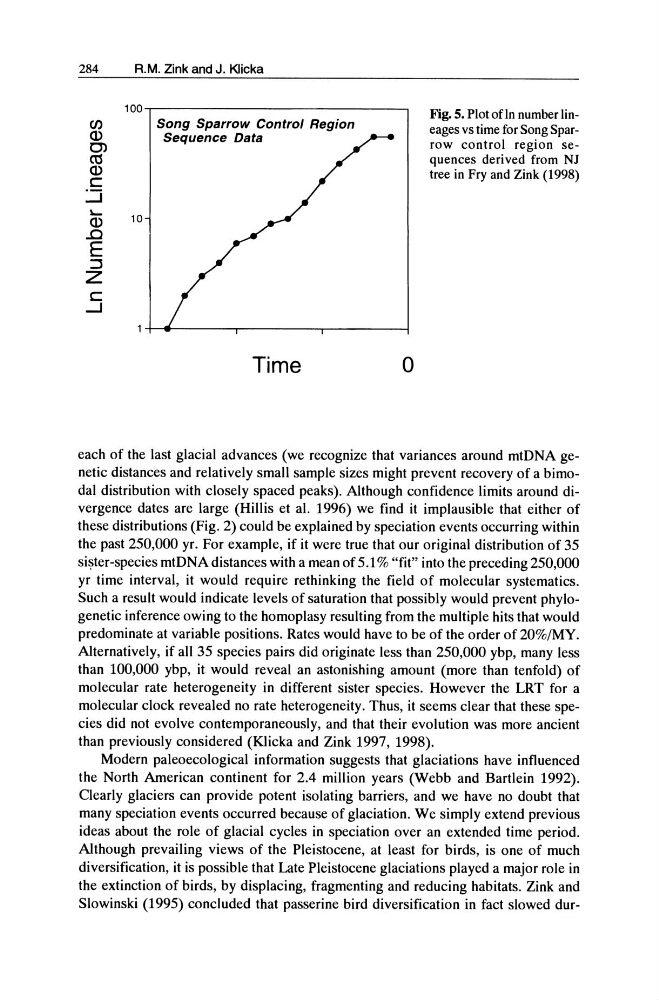
Fig. 5. Plot of In number lineages vs time for Song Sparrow control region sequences derived from NJ
tree in Fry and Zink (1998)
each of the last glacial advances (we recognize that variances around mtDNA genetic distances and relatively small sample sizes might prevent recovery of a bimodal distribution with closely spaced peaks). Although confidence limits around divergence dates are large (Hillis et al. 1996) we find it implausible that either of
these distributions (Fig. 2) could be explained by speciation events occurring within
the past 250,000 yr. For example, if it were true that our original distribution of 35
si~ter-species mtDNA distances with a mean of 5.1 % "fit" into the preceding 250,000
yr time interval, it would require rethinking the field of molecular systematics.
Such a result would indicate levels of saturation that possibly would prevent phylogenetic inference owing to the homoplasy resulting from the multiple hits that would
predominate at variable positions. Rates would have to be of the order of20%/MY.
Alternatively, if all 35 species pairs did originate less than 250,000 ybp, many less
than 100,000 ybp, it would reveal an astonishing amount (more than tenfold) of
molecular rate heterogeneity in different sister species. However the LRT for a
molecular clock revealed no rate heterogeneity. Thus, it seems clear that these species did not evolve contemporaneously, and that their evolution was more ancient
than previously considered (Klicka and Zink 1997, 1998).
Modern paleoecological information suggests that glaciations have influenced
the North American continent for 2.4 million years (Webb and Bartlein 1992).
Clearly glaciers can provide potent isolating barriers, and we have no doubt that
many speciation events occurred because of glaciation. We simply extend previous
ideas about the role of glacial cycles in speciation over an extended time period.
Although prevailing views of the Pleistocene, at least for birds, is one of much
diversification, it is possible that Late Pleistocene glaciations played a major role in
the extinction of birds, by displacing, fragmenting and reducing habitats. Zink and
Slowinski (1995) concluded that passerine bird diversification in fact slowed dur-
A.M. Zink and J. K1icka
C/)
(])
0)
ttl
(])
c
:::i
'(])
.0
E
::l
Z
C
-.J
100~-----------------------------.
10
Song Sparrow Control Region
Sequence Data
Time
o
Fig. 5. Plot of In number lineages vs time for Song Sparrow control region sequences derived from NJ
tree in Fry and Zink (1998)
each of the last glacial advances (we recognize that variances around mtDNA genetic distances and relatively small sample sizes might prevent recovery of a bimodal distribution with closely spaced peaks). Although confidence limits around divergence dates are large (Hillis et al. 1996) we find it implausible that either of
these distributions (Fig. 2) could be explained by speciation events occurring within
the past 250,000 yr. For example, if it were true that our original distribution of 35
si~ter-species mtDNA distances with a mean of 5.1 % "fit" into the preceding 250,000
yr time interval, it would require rethinking the field of molecular systematics.
Such a result would indicate levels of saturation that possibly would prevent phylogenetic inference owing to the homoplasy resulting from the multiple hits that would
predominate at variable positions. Rates would have to be of the order of20%/MY.
Alternatively, if all 35 species pairs did originate less than 250,000 ybp, many less
than 100,000 ybp, it would reveal an astonishing amount (more than tenfold) of
molecular rate heterogeneity in different sister species. However the LRT for a
molecular clock revealed no rate heterogeneity. Thus, it seems clear that these species did not evolve contemporaneously, and that their evolution was more ancient
than previously considered (Klicka and Zink 1997, 1998).
Modern paleoecological information suggests that glaciations have influenced
the North American continent for 2.4 million years (Webb and Bartlein 1992).
Clearly glaciers can provide potent isolating barriers, and we have no doubt that
many speciation events occurred because of glaciation. We simply extend previous
ideas about the role of glacial cycles in speciation over an extended time period.
Although prevailing views of the Pleistocene, at least for birds, is one of much
diversification, it is possible that Late Pleistocene glaciations played a major role in
the extinction of birds, by displacing, fragmenting and reducing habitats. Zink and
Slowinski (1995) concluded that passerine bird diversification in fact slowed dur-