

*
tOO
16. Evolution of Reproductive Organs in Vascular Plants
247
r-....., ..... M..;P_M~:!!D~~~n~:9~~/~:(~~a9c::I~~!ae) •
SL':bttl.!:~~rr~~~~p('SY~~~~'ha~~!ceae) •
..rn..-- FBP6 P.tunla (50Ian.ceae).
AGL1 Arabidopsls (Brassicaceae) •
... ..;:::..._A..;,G..;,LS H:M;gt;fSh~j~~~~~~c(s:~~~!ceae) •
PMADS3 Petunia (50Ianac.ae).
AGAMOUS Arabidops/s (Brasslcaceae).
BAGI Brassiea (Brasslcaceae).
- ..... __ O_s'f:gf'z.~1~~.~:~eO)O
L........:=r--ZmOV23 Zea (Poace.e) 0
ZAG2 Zea (Po.ce •• ) 0
100 RSM:~~: :::'u~7:(~~I~~:;eUa~)~aC8ae).
FBP11 Petunia (Solanaceae).
AGL 11 Arabidopsls (Brassicaceae).
GbMADS2 (Glnkgoaceae).
AG
DAL2 Pinus (Plnaceae). ~":"':"~~~ _ _ _ -.:-:::!
L-----l2lL.:.C::::::::=;;:~'MlD1';bffa1n~fJa(?3ag'::~Tli=~~. -:J AGL 12
98 PMAOS2 Petunia (Solanaceae). ...;..;..._---..
F8P3 Petunia (Solanaceae).
o;~===::'!S~LM~2~S~ile~n~!~~6ifl~Y~~~e"a:Ja~MagnOliaCeae).
L:.;i:r:::~~FBP1 Petunia (Solanaceae).
r __ .l2lt~~~~~~~G~L~O Antirrhlnum (Scrophulariaceae).
PI Arabldopsis (Brassicaceae).
OsMADS2 Oryza (Poaceae) 0
RsMADS7 Ranunculus (Ranunculace •• ).
100 RS:::;:, R:':;~~f:'rs"OI~R:a~~~~i';·a;;;e):.::.:.... _ _ _ "I
DEF AntJrrhlnum (Scrophulariaceae).
PI
[
~~~~~~~~~ SLM3 Silene (Caryophyllaceae) •
AP3 Arabidopsls (Brass;c.ceae) •
.... ----.....
RS:::lgs~a~~~~~~:'u~R(~~~~~~a~:::~~.
RSM~g~:fWan'"Z~~~f~~ (~~~nn~~'~~::~)\ -----~
AP3
RsMADS12 Ranunculus (Ranunculaceae).
Jr CRM3
1 ~~~~~~~~~~~M~P~M;~!g2;~D~JlG~~k9~~~~:!I.ea.).
AG L 15
GpMADS4 Gnetum (Gnetaceae).
rAGL 15 Arabfd~;~~6{~:!':~c~~~:~r.ris (Pteridaceae) 0
I
100
OEFH1~~Ll~ti::~;~i~:(~~r~~~~~~:~:::~:
• AG L 17
51
98
CPCRM4 Ceratopteris (Pt.r;dac ... )D~----,
61
CerMADS1 Ceratopteris (Pterldaceae)D
CMADS3lCRC;;;cg::;t;;,~;::.!~~tt{~~IJ~~~:fD.) 0
CMADS2 Ceratopterls (pteridaceae) 0
[======~;;;:;;;-;-;i=='~~~=~~;;;~=~;'CPCRM2 Ceratopteris (Pteridaceae)D
CMADS4 Ceratopterls (Pterldaceae)O _ _ _ _ _ __
PpMADS1 Physcomitrella (Funariaceae)
100
CRM1
0.1
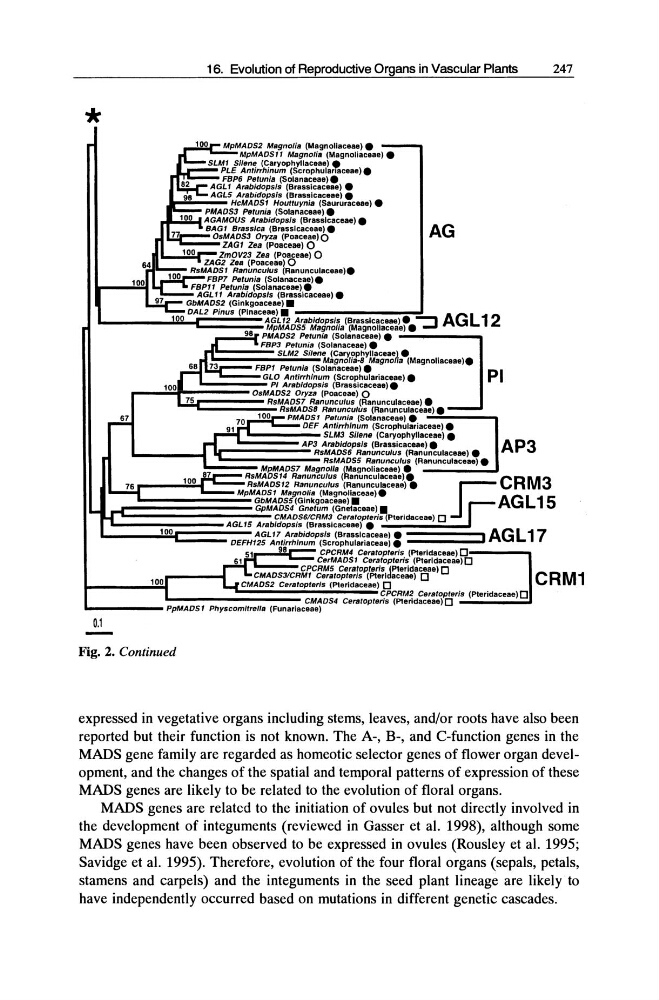
Fig. 2. Continued
expressed in vegetative organs including stems, leaves, and/or roots have also been
reported but their function is not known. The A-, B-, and C-function genes in the
MADS gene family are regarded as homeotic selector genes of flower organ development, and the changes of the spatial and temporal patterns of expression of these
MADS genes are likely to be related to the evolution of floral organs.
MADS genes are related to the initiation of ovules but not directly involved in
the development of integuments (reviewed in Gasser et al. 1998), although some
MADS genes have been observed to be expressed in ovules (Rousley et al. 1995;
Savidge et al. 1995). Therefore, evolution of the four floral organs (sepals, petals,
stamens and carpels) and the integuments in the seed plant lineage are likely to
have independently occurred based on mutations in different genetic cascades.
tOO
16. Evolution of Reproductive Organs in Vascular Plants
247
r-....., ..... M..;P_M~:!!D~~~n~:9~~/~:(~~a9c::I~~!ae) •
SL':bttl.!:~~rr~~~~p('SY~~~~'ha~~!ceae) •
..rn..-- FBP6 P.tunla (50Ian.ceae).
AGL1 Arabidopsls (Brassicaceae) •
... ..;:::..._A..;,G..;,LS H:M;gt;fSh~j~~~~~~c(s:~~~!ceae) •
PMADS3 Petunia (50Ianac.ae).
AGAMOUS Arabidops/s (Brasslcaceae).
BAGI Brassiea (Brasslcaceae).
- ..... __ O_s'f:gf'z.~1~~.~:~eO)O
L........:=r--ZmOV23 Zea (Poace.e) 0
ZAG2 Zea (Po.ce •• ) 0
100 RSM:~~: :::'u~7:(~~I~~:;eUa~)~aC8ae).
FBP11 Petunia (Solanaceae).
AGL 11 Arabidopsls (Brassicaceae).
GbMADS2 (Glnkgoaceae).
AG
DAL2 Pinus (Plnaceae). ~":"':"~~~ _ _ _ -.:-:::!
L-----l2lL.:.C::::::::=;;:~'MlD1';bffa1n~fJa(?3ag'::~Tli=~~. -:J AGL 12
98 PMAOS2 Petunia (Solanaceae). ...;..;..._---..
F8P3 Petunia (Solanaceae).
o;~===::'!S~LM~2~S~ile~n~!~~6ifl~Y~~~e"a:Ja~MagnOliaCeae).
L:.;i:r:::~~FBP1 Petunia (Solanaceae).
r __ .l2lt~~~~~~~G~L~O Antirrhlnum (Scrophulariaceae).
PI Arabldopsis (Brassicaceae).
OsMADS2 Oryza (Poaceae) 0
RsMADS7 Ranunculus (Ranunculace •• ).
100 RS:::;:, R:':;~~f:'rs"OI~R:a~~~~i';·a;;;e):.::.:.... _ _ _ "I
DEF AntJrrhlnum (Scrophulariaceae).
PI
[
~~~~~~~~~ SLM3 Silene (Caryophyllaceae) •
AP3 Arabidopsls (Brass;c.ceae) •
.... ----.....
RS:::lgs~a~~~~~~:'u~R(~~~~~~a~:::~~.
RSM~g~:fWan'"Z~~~f~~ (~~~nn~~'~~::~)\ -----~
AP3
RsMADS12 Ranunculus (Ranunculaceae).
Jr CRM3
1 ~~~~~~~~~~~M~P~M;~!g2;~D~JlG~~k9~~~~:!I.ea.).
AG L 15
GpMADS4 Gnetum (Gnetaceae).
rAGL 15 Arabfd~;~~6{~:!':~c~~~:~r.ris (Pteridaceae) 0
I
100
OEFH1~~Ll~ti::~;~i~:(~~r~~~~~~:~:::~:
• AG L 17
51
98
CPCRM4 Ceratopteris (Pt.r;dac ... )D~----,
61
CerMADS1 Ceratopteris (Pterldaceae)D
CMADS3lCRC;;;cg::;t;;,~;::.!~~tt{~~IJ~~~:fD.) 0
CMADS2 Ceratopterls (pteridaceae) 0
[======~;;;:;;;-;-;i=='~~~=~~;;;~=~;'CPCRM2 Ceratopteris (Pteridaceae)D
CMADS4 Ceratopterls (Pterldaceae)O _ _ _ _ _ __
PpMADS1 Physcomitrella (Funariaceae)
100
CRM1
0.1
Fig. 2. Continued
expressed in vegetative organs including stems, leaves, and/or roots have also been
reported but their function is not known. The A-, B-, and C-function genes in the
MADS gene family are regarded as homeotic selector genes of flower organ development, and the changes of the spatial and temporal patterns of expression of these
MADS genes are likely to be related to the evolution of floral organs.
MADS genes are related to the initiation of ovules but not directly involved in
the development of integuments (reviewed in Gasser et al. 1998), although some
MADS genes have been observed to be expressed in ovules (Rousley et al. 1995;
Savidge et al. 1995). Therefore, evolution of the four floral organs (sepals, petals,
stamens and carpels) and the integuments in the seed plant lineage are likely to
have independently occurred based on mutations in different genetic cascades.