

15. The Regulation of Dorsiventral Symmetry in Plants
229
c
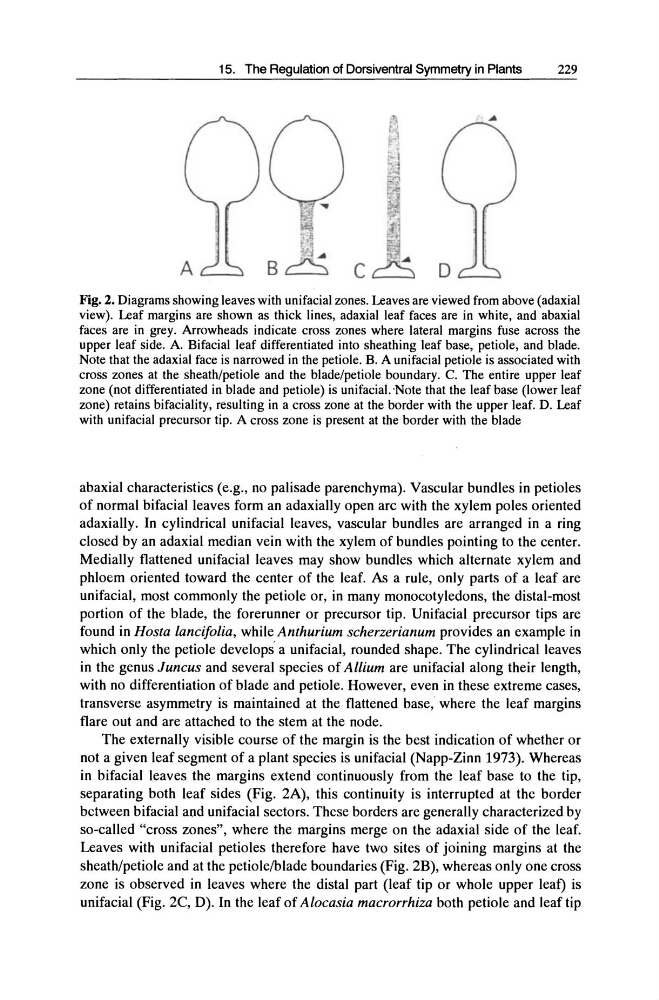
Fig. 2. Diagrams showing leaves with unifacial zones. Leaves are viewed from above (adaxial
view). Leaf margins are shown as thick lines, adaxial leaf faces are in white, and abaxial
faces are in grey. Arrowheads indicate cross zones where lateral margins fuse across the
upper leaf side. A. Bifacial leaf differentiated into sheathing leaf base, petiole, and blade.
Note that the adaxial face is narrowed in the petiole. B. A unifacial petiole is associated with
cross zones at the sheath/petiole and the blade/petiole boundary. C. The entire upper leaf
zone (not differentiated in blade and petiole) is unifacial. 'Note that the leaf base (lower leaf
zone) retains bifaciality, resulting in a cross zone at the border with the upper leaf. D. Leaf
with unifacial precursor tip. A cross zone is present at the border with the blade
abaxial characteristics (e.g., no palisade parenchyma). Vascular bundles in petioles
of normal bifacial leaves form an adaxially open arc with the xylem poles oriented
adaxially. In cylindrical unifacial leaves, vascular bundles are arranged in a ring
closed by an adaxial median vein with the xylem of bundles pointing to the center.
Medially flattened unifacial leaves may show bundles which alternate xylem and
phloem oriented toward the center of the leaf. As a rule, only parts of a leaf are
unifacial, most commonly the petiole or, in many monocotyledons, the distal-most
portion of the blade, the forerunner or precursor tip. Unifacial precursor tips are
found in Hosta lancifolia, while Anthurium scherzerianum provides an example in
which only the petiole develops' a unifacial, rounded shape. The cylindrical leaves
in the genus funcus and several species of Allium are unifacial along their length,
with no differentiation of blade and petiole. However, even in these extreme cases,
transverse asymmetry is maintained at the flattened base, where the leaf margins
flare out and are attached to the stem at the node.
The externally visible course of the margin is the best indication of whether or
not a given leaf segment of a plant species is unifacial (Napp-Zinn 1973). Whereas
in bifacial leaves the margins extend continuously from the leaf base to the tip,
separating both leaf sides (Fig. 2A), this continuity is interrupted at the border
between bifacial and unifacial sectors. Thcse borders are generally characterized by
so-called "cross zones", where the margins merge on the adaxial side of the leaf.
Leaves with unifacial petioles therefore have two sites of joining margins at the
sheath/petiole and at the petiole/blade boundaries (Fig. 2B), whereas only one cross
zone is observed in leaves where the distal part (leaf tip or whole upper leaf) is
unifacial (Fig. 2e, D). In the leaf of Alocasia macrorrhiza both petiole and leaf tip
229
c
Fig. 2. Diagrams showing leaves with unifacial zones. Leaves are viewed from above (adaxial
view). Leaf margins are shown as thick lines, adaxial leaf faces are in white, and abaxial
faces are in grey. Arrowheads indicate cross zones where lateral margins fuse across the
upper leaf side. A. Bifacial leaf differentiated into sheathing leaf base, petiole, and blade.
Note that the adaxial face is narrowed in the petiole. B. A unifacial petiole is associated with
cross zones at the sheath/petiole and the blade/petiole boundary. C. The entire upper leaf
zone (not differentiated in blade and petiole) is unifacial. 'Note that the leaf base (lower leaf
zone) retains bifaciality, resulting in a cross zone at the border with the upper leaf. D. Leaf
with unifacial precursor tip. A cross zone is present at the border with the blade
abaxial characteristics (e.g., no palisade parenchyma). Vascular bundles in petioles
of normal bifacial leaves form an adaxially open arc with the xylem poles oriented
adaxially. In cylindrical unifacial leaves, vascular bundles are arranged in a ring
closed by an adaxial median vein with the xylem of bundles pointing to the center.
Medially flattened unifacial leaves may show bundles which alternate xylem and
phloem oriented toward the center of the leaf. As a rule, only parts of a leaf are
unifacial, most commonly the petiole or, in many monocotyledons, the distal-most
portion of the blade, the forerunner or precursor tip. Unifacial precursor tips are
found in Hosta lancifolia, while Anthurium scherzerianum provides an example in
which only the petiole develops' a unifacial, rounded shape. The cylindrical leaves
in the genus funcus and several species of Allium are unifacial along their length,
with no differentiation of blade and petiole. However, even in these extreme cases,
transverse asymmetry is maintained at the flattened base, where the leaf margins
flare out and are attached to the stem at the node.
The externally visible course of the margin is the best indication of whether or
not a given leaf segment of a plant species is unifacial (Napp-Zinn 1973). Whereas
in bifacial leaves the margins extend continuously from the leaf base to the tip,
separating both leaf sides (Fig. 2A), this continuity is interrupted at the border
between bifacial and unifacial sectors. Thcse borders are generally characterized by
so-called "cross zones", where the margins merge on the adaxial side of the leaf.
Leaves with unifacial petioles therefore have two sites of joining margins at the
sheath/petiole and at the petiole/blade boundaries (Fig. 2B), whereas only one cross
zone is observed in leaves where the distal part (leaf tip or whole upper leaf) is
unifacial (Fig. 2e, D). In the leaf of Alocasia macrorrhiza both petiole and leaf tip