

228
S. Gleissberg et al.
LPyb) LPI
SAM
A
00
phantastica
leafbladeless
B
phabulosa
c
- -
rough sheath2
Adaxial identity
Abaxial identity
KNOX 1 expression
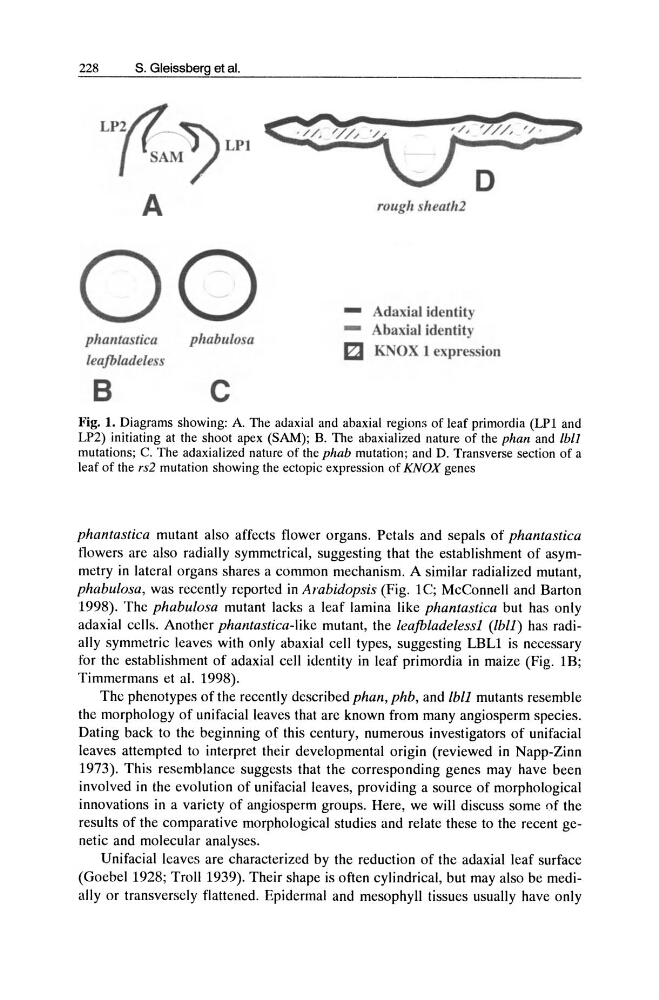
Fig. 1. Diagrams showing: A. The adaxial and abaxial regions of leaf primordia (LP1 and
LP2) initiating at the shoot apex (SAM); B. The abaxialized nature of the phan and lbll
mutations; C. The adaxialized nature of the phab mutation; and D. Transverse section of a
leaf of the rs2 mutation showing the ectopic expression of KNOX genes
phantastica mutant also affects flower organs. Petals and sepals of phantastica
flowers are also radially symmetrical, suggesting that the establishment of asymmetry in lateral organs shares a common mechanism. A similar radialized mutant,
phabuiosa, was recently reported in Al'abidopsis (Fig. lC; McConnell and Barton
1998). The phabu/osa mutant lacks a leaf lamina like phantastica but has only
adaxial cells. Another phantastica-like mutant, the ieafbiadeiessl (ibll) has radially symmetric leaves with only abaxial cell types, suggesting LBLI is necessary
for the establishment of adaxial cell identity in leaf primordia in maize (Fig. IB;
Timmermans et aI. 1998).
The phenotypes of the recently described phan, phb, and ibll mutants resemble
the morphology of unifacialleaves that are known from many angiosperm species.
Dating back to the beginning of this century, numerous investigators of unifacial
leaves attempted to interpret their developmental origin (reviewed in Napp-Zinn
1973). This resemblance suggests that the corresponding genes may have been
involved in the evolution of unifacial leaves, providing a source of morphological
innovations in a variety of angiosperm groups. Here, we will discuss some of the
results of the comparative morphological studies and relate these to the recent genetic and molecular analyses.
Unifacial leaves arc characterized by the reduction of the adaxial leaf surface
(Goebel 1928; Troll 1939). Their shape is often cylindrical, but may also be medially or transversely flattened. Epidermal and mesophyll tissues usually have only
S. Gleissberg et al.
LPyb) LPI
SAM
A
00
phantastica
leafbladeless
B
phabulosa
c
- -
rough sheath2
Adaxial identity
Abaxial identity
KNOX 1 expression
Fig. 1. Diagrams showing: A. The adaxial and abaxial regions of leaf primordia (LP1 and
LP2) initiating at the shoot apex (SAM); B. The abaxialized nature of the phan and lbll
mutations; C. The adaxialized nature of the phab mutation; and D. Transverse section of a
leaf of the rs2 mutation showing the ectopic expression of KNOX genes
phantastica mutant also affects flower organs. Petals and sepals of phantastica
flowers are also radially symmetrical, suggesting that the establishment of asymmetry in lateral organs shares a common mechanism. A similar radialized mutant,
phabuiosa, was recently reported in Al'abidopsis (Fig. lC; McConnell and Barton
1998). The phabu/osa mutant lacks a leaf lamina like phantastica but has only
adaxial cells. Another phantastica-like mutant, the ieafbiadeiessl (ibll) has radially symmetric leaves with only abaxial cell types, suggesting LBLI is necessary
for the establishment of adaxial cell identity in leaf primordia in maize (Fig. IB;
Timmermans et aI. 1998).
The phenotypes of the recently described phan, phb, and ibll mutants resemble
the morphology of unifacialleaves that are known from many angiosperm species.
Dating back to the beginning of this century, numerous investigators of unifacial
leaves attempted to interpret their developmental origin (reviewed in Napp-Zinn
1973). This resemblance suggests that the corresponding genes may have been
involved in the evolution of unifacial leaves, providing a source of morphological
innovations in a variety of angiosperm groups. Here, we will discuss some of the
results of the comparative morphological studies and relate these to the recent genetic and molecular analyses.
Unifacial leaves arc characterized by the reduction of the adaxial leaf surface
(Goebel 1928; Troll 1939). Their shape is often cylindrical, but may also be medially or transversely flattened. Epidermal and mesophyll tissues usually have only