

12
K. Sawamura
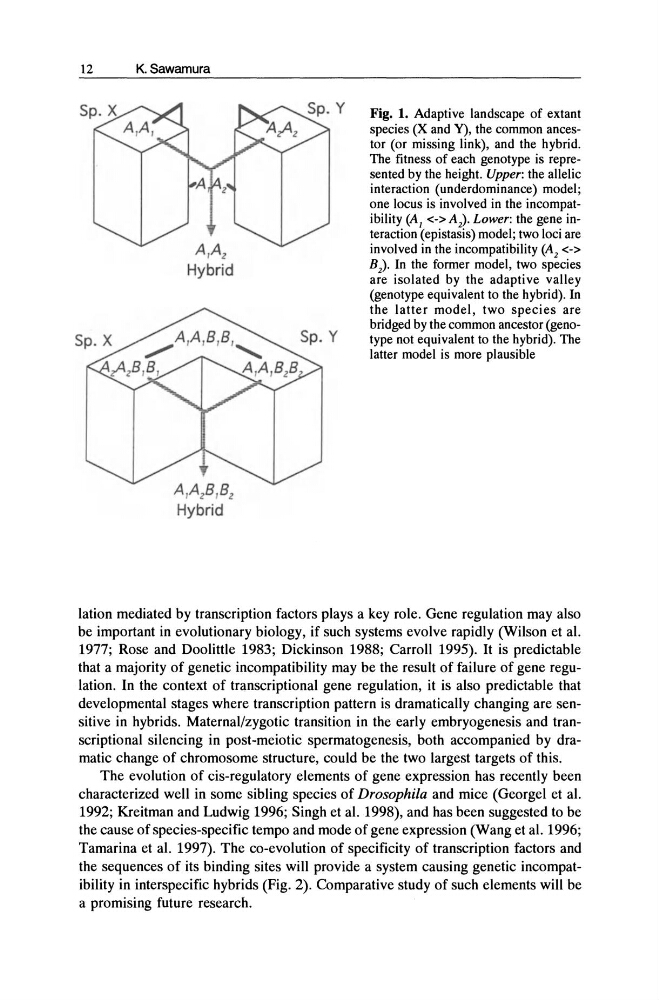
Fig. 1. Adaptive landscape of extant
species (X and Y), the common ancestor (or missing link), and the hybrid.
The fitness of each genotype is represented by the height. Upper: the allelic
interaction (underdominance) model;
one locus is involved in the incompatibility (Aj <->A). Lower: the gene interaction (epistasis) model; two loci are
involved in the incompatibility (A2 <->
8 2 ), In the former model, two species
are isolated by the adaptive valley
(genotype equivalent to the hybrid). In
the latter model, two species are
bridged by the common ancestor (genotype not equivalent to the hybrid). The
latter model is more plausible
lation mediated by transcription factors plays a key role. Gene regulation may also
be important in evolutionary biology, if such systems evolve rapidly (Wilson et al.
1977; Rose and Doolittle 1983; Dickinson 1988; Carroll 1995). It is predictable
that a majority of genetic incompatibility may be the result of failure of gene regulation. In the context of transcriptional gene regulation, it is also predictable that
developmental stages where transcription pattern is dramatically changing are sensitive in hybrids. Maternal/zygotic transition in the early embryogenesis and transcriptional silencing in post-meiotic spermatogenesis, both accompanied by dramatic change of chromosome structure, could be the two largest targets of this.
The evolution of cis-regulatory elements of gene expression has recently been
characterized well in some sibling species of Drosophila and mice (George I et al.
1992; Kreitman and Ludwig 1996; Singh et al. 1998), and has been suggested to be
the cause of species-specific tempo and mode of gene expression (Wang et al. 1996;
Tamarina et al. 1997). The co-evolution of specificity of transcription factors and
the sequences of its binding sites will provide a system causing genetic incompatibility in interspecific hybrids (Fig. 2). Comparative study of such elements will be
a promising future research.
K. Sawamura
Fig. 1. Adaptive landscape of extant
species (X and Y), the common ancestor (or missing link), and the hybrid.
The fitness of each genotype is represented by the height. Upper: the allelic
interaction (underdominance) model;
one locus is involved in the incompatibility (Aj <->A). Lower: the gene interaction (epistasis) model; two loci are
involved in the incompatibility (A2 <->
8 2 ), In the former model, two species
are isolated by the adaptive valley
(genotype equivalent to the hybrid). In
the latter model, two species are
bridged by the common ancestor (genotype not equivalent to the hybrid). The
latter model is more plausible
lation mediated by transcription factors plays a key role. Gene regulation may also
be important in evolutionary biology, if such systems evolve rapidly (Wilson et al.
1977; Rose and Doolittle 1983; Dickinson 1988; Carroll 1995). It is predictable
that a majority of genetic incompatibility may be the result of failure of gene regulation. In the context of transcriptional gene regulation, it is also predictable that
developmental stages where transcription pattern is dramatically changing are sensitive in hybrids. Maternal/zygotic transition in the early embryogenesis and transcriptional silencing in post-meiotic spermatogenesis, both accompanied by dramatic change of chromosome structure, could be the two largest targets of this.
The evolution of cis-regulatory elements of gene expression has recently been
characterized well in some sibling species of Drosophila and mice (George I et al.
1992; Kreitman and Ludwig 1996; Singh et al. 1998), and has been suggested to be
the cause of species-specific tempo and mode of gene expression (Wang et al. 1996;
Tamarina et al. 1997). The co-evolution of specificity of transcription factors and
the sequences of its binding sites will provide a system causing genetic incompatibility in interspecific hybrids (Fig. 2). Comparative study of such elements will be
a promising future research.