

140
I. Washitani
$.0
1.0
ilJ
~ 0.8
0
= $.0 0.6
ilJ
Q..
***
**
**
- 0.4
ilJ
III
"C
o 0 0
ilJ
0.2
ilJ
rJJ.
0
Monoclonal
Multiclonal
Populations
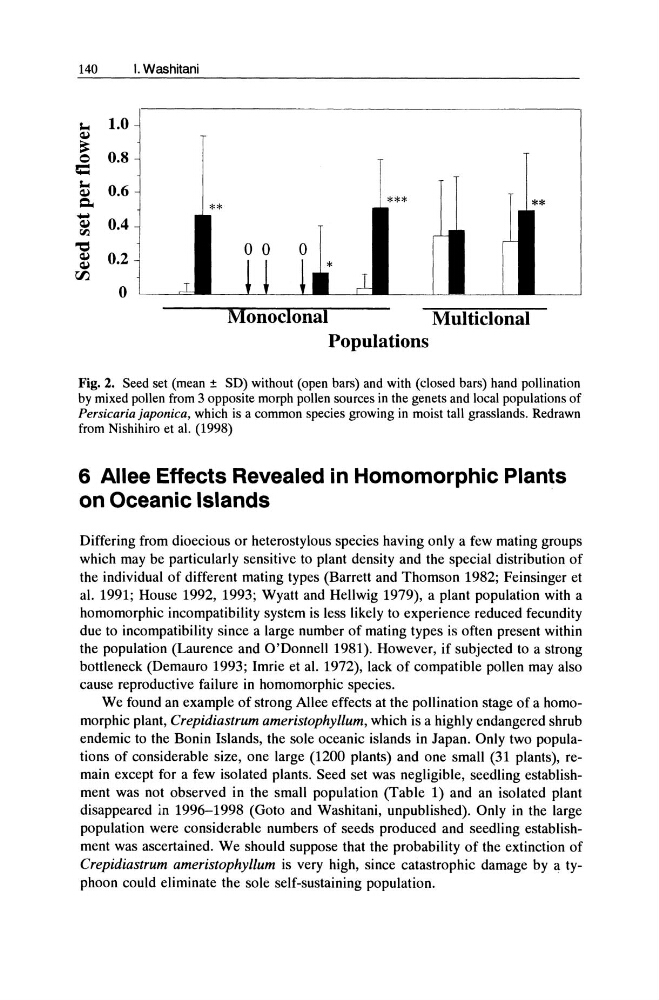
Fig. 2. Seed set (mean ± SD) without (open bars) and with (closed bars) hand pollination
by mixed pollen from 3 opposite morph pollen sources in the genets and local populations of
Persicaria japonica, which is a common species growing in moist tall grasslands. Redrawn
from Nishihiro et al. (1998)
6 Allee Effects Revealed in Homomorphic Plants
on Oceanic Islands
Differing from dioecious or heterostylous species having only a few mating groups
which may be particularly sensitive to plant density and the special distribution of
the individual of different mating types (Barrett and Thomson 1982; Feinsinger et
at. 1991; House 1992, 1993; Wyatt and Hellwig 1979), a plant population with a
homomorphic incompatibility system is less likely to experience reduced fecundity
due to incompatibility since a large number of mating types is often present within
the population (Laurence and O'Donnell 1981). However, if subjected to a strong
bottleneck (Demauro 1993; Imrie et al. 1972), lack of compatible pollen may also
cause reproductive failure in homomorphic species.
We found an example of strong Allee effects at the pollination stage of a homomorphic plant, Crepidiastrum ameristophyllum, which is a highly endangered shrub
endemic to the Bonin Islands, the sole oceanic islands in Japan. Only two populations of considerable size, one large (1200 plants) and one small (31 plants), remain except for a few isolated plants. Seed set was negligible, seedling establishment was not observed in the small population (Table 1) and an isolated plant
disappeared in 1996-1998 (Goto and Washitani, unpublished). Only in the large
population were considerable numbers of seeds produced and seedling establishment was ascertained. We should suppose that the probability of the extinction of
Crepidiastrum ameristophyllum is very high, since catastrophic damage by a typhoon could eliminate the sole self-sustaining population.
I. Washitani
$.0
1.0
ilJ
~ 0.8
0
= $.0 0.6
ilJ
Q..
***
**
**
- 0.4
ilJ
III
"C
o 0 0
ilJ
0.2
ilJ
rJJ.
0
Monoclonal
Multiclonal
Populations
Fig. 2. Seed set (mean ± SD) without (open bars) and with (closed bars) hand pollination
by mixed pollen from 3 opposite morph pollen sources in the genets and local populations of
Persicaria japonica, which is a common species growing in moist tall grasslands. Redrawn
from Nishihiro et al. (1998)
6 Allee Effects Revealed in Homomorphic Plants
on Oceanic Islands
Differing from dioecious or heterostylous species having only a few mating groups
which may be particularly sensitive to plant density and the special distribution of
the individual of different mating types (Barrett and Thomson 1982; Feinsinger et
at. 1991; House 1992, 1993; Wyatt and Hellwig 1979), a plant population with a
homomorphic incompatibility system is less likely to experience reduced fecundity
due to incompatibility since a large number of mating types is often present within
the population (Laurence and O'Donnell 1981). However, if subjected to a strong
bottleneck (Demauro 1993; Imrie et al. 1972), lack of compatible pollen may also
cause reproductive failure in homomorphic species.
We found an example of strong Allee effects at the pollination stage of a homomorphic plant, Crepidiastrum ameristophyllum, which is a highly endangered shrub
endemic to the Bonin Islands, the sole oceanic islands in Japan. Only two populations of considerable size, one large (1200 plants) and one small (31 plants), remain except for a few isolated plants. Seed set was negligible, seedling establishment was not observed in the small population (Table 1) and an isolated plant
disappeared in 1996-1998 (Goto and Washitani, unpublished). Only in the large
population were considerable numbers of seeds produced and seedling establishment was ascertained. We should suppose that the probability of the extinction of
Crepidiastrum ameristophyllum is very high, since catastrophic damage by a typhoon could eliminate the sole self-sustaining population.