

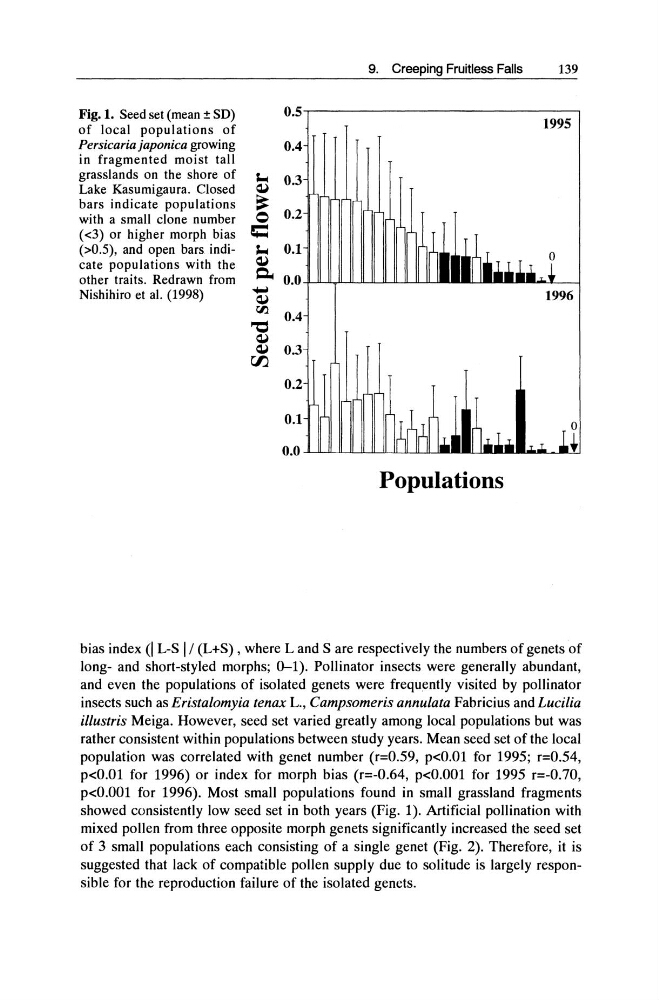
Fig. 1. Seed set (mean ± SD)
of local populations of
Persicaria japonica growing
in fragmented moist tall
grasslands on the shore of
Lake Kasumigaura. Closed
bars indicate populations
with a small clone number
«3) or higher morph bias
(>0.5), and open bars indicate populations with the
other traits. Redrawn from
Nishihiro et al. (1998)
9. Creeping Fruitless Falls
139
1995
Populations
bias index (I L-S 1/ (L+S) , where Land S are respectively the numbers of genets of
long- and short-styled morphs; 0-1). Pollinator insects were generally abundant,
and even the populations of isolated genets were frequently visited by pollinator
insects such as Eristalomyia tenax L., Campsomeris annulata Fabricius and Lucilia
illustris Meiga. However, seed set varied greatly among local populations but was
rather consistent within populations between study years. Mean seed set of the local
population was correlated with genet number (r=0.59, p
p
p
mixed pollen from three opposite morph genets significantly increased the seed set
of 3 small populations each consisting of a single genet (Fig. 2). Therefore, it is
suggested that lack of compatible pollen supply due to solitude is largely responsible for the reproduction failure of the isolated genets.
of local populations of
Persicaria japonica growing
in fragmented moist tall
grasslands on the shore of
Lake Kasumigaura. Closed
bars indicate populations
with a small clone number
«3) or higher morph bias
(>0.5), and open bars indicate populations with the
other traits. Redrawn from
Nishihiro et al. (1998)
9. Creeping Fruitless Falls
139
1995
Populations
bias index (I L-S 1/ (L+S) , where Land S are respectively the numbers of genets of
long- and short-styled morphs; 0-1). Pollinator insects were generally abundant,
and even the populations of isolated genets were frequently visited by pollinator
insects such as Eristalomyia tenax L., Campsomeris annulata Fabricius and Lucilia
illustris Meiga. However, seed set varied greatly among local populations but was
rather consistent within populations between study years. Mean seed set of the local
population was correlated with genet number (r=0.59, p
mixed pollen from three opposite morph genets significantly increased the seed set
of 3 small populations each consisting of a single genet (Fig. 2). Therefore, it is
suggested that lack of compatible pollen supply due to solitude is largely responsible for the reproduction failure of the isolated genets.