

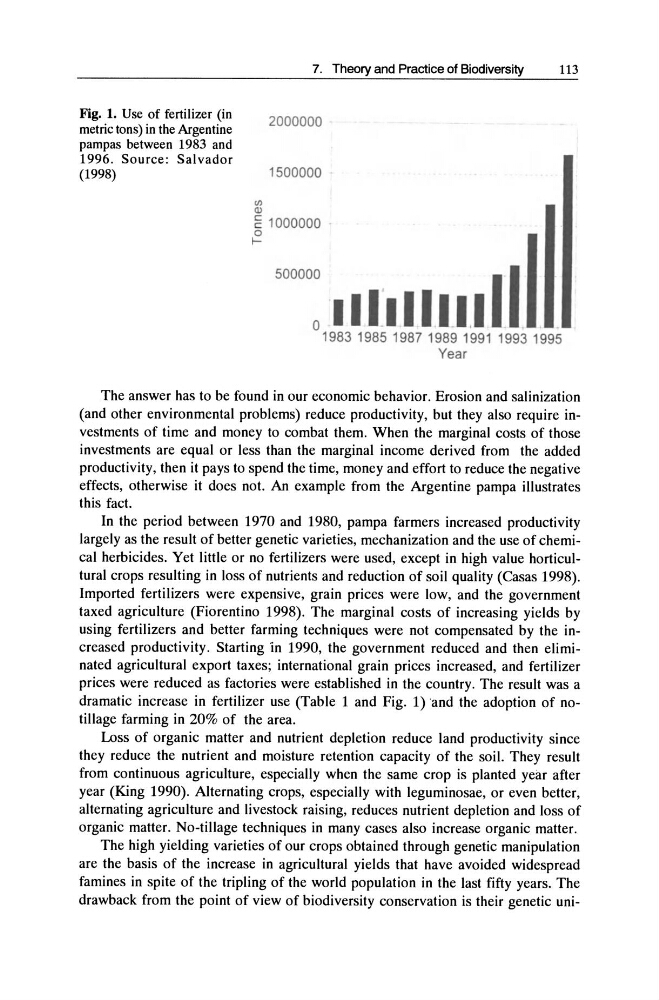
Fig. 1. Use of fertilizer (in
metric tons) in the Argentine
pampas between 1983 and
1996. Source : Salvador
(1998)
til
Q)
7. Theory and Practice of Biodiversity
113
2000000
1500000
§ 1000000
o
I500000
I
o Ilhllnl ... -
1983 1985 198719891991 1993 1995
Year
The answer has to be found in our economic behavior. Erosion and salinization
(and other environmental problems) reduce productivity, but they also require investments of time and money to combat them. When the marginal costs of those
investments are equal or less than the marginal income derived from the added
productivity, then it pays to spend the time, money and effort to reduce the negative
effects, otherwise it does not. An example from the Argentine pampa illustrates
this fact.
In the period between 1970 and 1980, pampa farmers increased productivity
largely as the result of better genetic varieties, mechanization and the use of chemical herbicides. Yet little or no fertilizers were used, except in high value horticultural crops resulting in loss of nutrients and reduction of soil quality (Casas 1998).
Imported fertilizers were expensive, grain prices were low, and the government
taxed agriculture (Fiorentino 1998). The marginal costs of increasing yields by
using fertilizers and better farming techniques were not compensated by the increased productivity. Starting "in 1990, the government reduced and then eliminated agricultural export taxes; international grain prices increased, and fertilizer
prices were reduced as factories were established in the country. The result was a
dramatic increase in fertilizer use (Table 1 and Fig. 1) and the adoption of notillage farming in 20% of the area.
Loss of organic matter and nutrient depletion reduce land productivity since
they reduce the nutrient and moisture retention capacity of the soil. They result
from continuous agriculture, especially when the same crop is planted year after
year (King 1990). Alternating crops, especially with leguminosae, or even better,
alternating agriculture and livestock raising, reduces nutrient depletion and loss of
organic matter. No-tillage techniques in many cases also increase organic matter.
The high yielding varieties of our crops obtained through genetic manipulation
are the basis of the increase in agricultural yields that have avoided widespread
famines in spite of the tripling of the world popUlation in the last fifty years. The
drawback from the point of view of biodiversity conservation is their genetic uni-
metric tons) in the Argentine
pampas between 1983 and
1996. Source : Salvador
(1998)
til
Q)
7. Theory and Practice of Biodiversity
113
2000000
1500000
§ 1000000
o
I500000
I
o Ilhllnl ... -
1983 1985 198719891991 1993 1995
Year
The answer has to be found in our economic behavior. Erosion and salinization
(and other environmental problems) reduce productivity, but they also require investments of time and money to combat them. When the marginal costs of those
investments are equal or less than the marginal income derived from the added
productivity, then it pays to spend the time, money and effort to reduce the negative
effects, otherwise it does not. An example from the Argentine pampa illustrates
this fact.
In the period between 1970 and 1980, pampa farmers increased productivity
largely as the result of better genetic varieties, mechanization and the use of chemical herbicides. Yet little or no fertilizers were used, except in high value horticultural crops resulting in loss of nutrients and reduction of soil quality (Casas 1998).
Imported fertilizers were expensive, grain prices were low, and the government
taxed agriculture (Fiorentino 1998). The marginal costs of increasing yields by
using fertilizers and better farming techniques were not compensated by the increased productivity. Starting "in 1990, the government reduced and then eliminated agricultural export taxes; international grain prices increased, and fertilizer
prices were reduced as factories were established in the country. The result was a
dramatic increase in fertilizer use (Table 1 and Fig. 1) and the adoption of notillage farming in 20% of the area.
Loss of organic matter and nutrient depletion reduce land productivity since
they reduce the nutrient and moisture retention capacity of the soil. They result
from continuous agriculture, especially when the same crop is planted year after
year (King 1990). Alternating crops, especially with leguminosae, or even better,
alternating agriculture and livestock raising, reduces nutrient depletion and loss of
organic matter. No-tillage techniques in many cases also increase organic matter.
The high yielding varieties of our crops obtained through genetic manipulation
are the basis of the increase in agricultural yields that have avoided widespread
famines in spite of the tripling of the world popUlation in the last fifty years. The
drawback from the point of view of biodiversity conservation is their genetic uni-