

112
O.T. Solbrig
(but not impossible). The second most serious problem - and in many irrigation
areas more acute these days than erosion - is salinization. According to Norse et
al. (1992) 2000 million hectares of land have been lost to erosion and salinization.
It has been calculated that 35 % of the arable land of the world is affected by some
degree of erosion (Norse et al. 1992). For the United States alone, the costs of
erosion have been calculated at 900 million dollars/year (Pimentel et al. 1995)
although not everybody agrees with these figures. In general, natural scientists tend
to see the problem as very serious and economists tend to dismiss it as secondary.
The difference lies in that natural scientists measure the changes that are occurring
in the soil itself, while economists look at the production from these same soils.
Production has not decreased in the same measure as erosion, and in mildly eroded
soils it has actually increased due to the introduction of new varieties and increased
use of fertilizers. The unresolved question is whether soil losses can be replaced for
ever by technological improvements in agronomic technologies, or whether eventually a point is reached at which the soil loses its capacity to sustain agriculture.
All indications (National Academy of Science 1989) are that the latter is true, and
prudence calls for a careful approach. New minimum tillage and no tillage techniques can reduce soil erosion by at least an order of magnitude and should be
adopted whenever possible. Every effort should be made to reduce erosion and salinization. The knowledge is there, so why are erosion and salinization increasing?
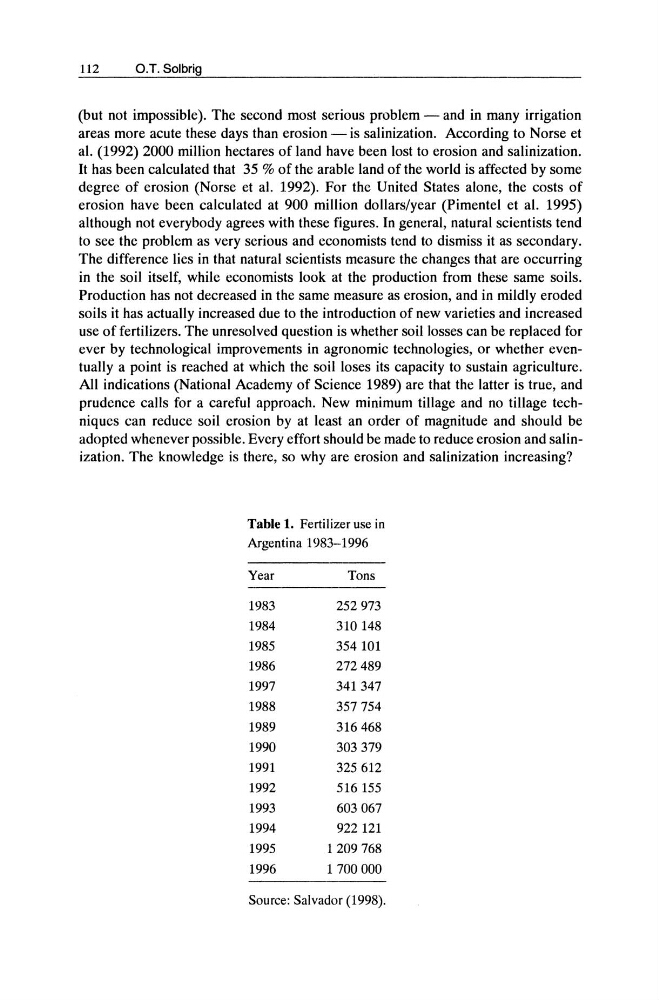
Table 1. Fertilizer use in
Argentina 1983-1996
Year
Tons
1983
252973
1984
310 148
1985
354101
1986
272 489
1997
341347
1988
357754
1989
316468
1990
303 379
1991
325612
1992
516 155
1993
603067
1994
922121
1995
1209768
1996
1 700000
Source: Salvador (1998).
O.T. Solbrig
(but not impossible). The second most serious problem - and in many irrigation
areas more acute these days than erosion - is salinization. According to Norse et
al. (1992) 2000 million hectares of land have been lost to erosion and salinization.
It has been calculated that 35 % of the arable land of the world is affected by some
degree of erosion (Norse et al. 1992). For the United States alone, the costs of
erosion have been calculated at 900 million dollars/year (Pimentel et al. 1995)
although not everybody agrees with these figures. In general, natural scientists tend
to see the problem as very serious and economists tend to dismiss it as secondary.
The difference lies in that natural scientists measure the changes that are occurring
in the soil itself, while economists look at the production from these same soils.
Production has not decreased in the same measure as erosion, and in mildly eroded
soils it has actually increased due to the introduction of new varieties and increased
use of fertilizers. The unresolved question is whether soil losses can be replaced for
ever by technological improvements in agronomic technologies, or whether eventually a point is reached at which the soil loses its capacity to sustain agriculture.
All indications (National Academy of Science 1989) are that the latter is true, and
prudence calls for a careful approach. New minimum tillage and no tillage techniques can reduce soil erosion by at least an order of magnitude and should be
adopted whenever possible. Every effort should be made to reduce erosion and salinization. The knowledge is there, so why are erosion and salinization increasing?
Table 1. Fertilizer use in
Argentina 1983-1996
Year
Tons
1983
252973
1984
310 148
1985
354101
1986
272 489
1997
341347
1988
357754
1989
316468
1990
303 379
1991
325612
1992
516 155
1993
603067
1994
922121
1995
1209768
1996
1 700000
Source: Salvador (1998).