

6. Phylogenetic Analyses of Large Data Sets
95
average in less than two days of computer run time. In contrast, the separate and
pairwise analyses of the data sets did not swap to completion. These results agree
with those of Chase et al. (1993), Rice et al. (1997), Soltis et al. (1997a) and
Savolainen et al. (in press) for large data sets for the individual genes; none of these
searches ever completed. Furthermore, whereas analyses of a 193-taxon data set for
two genes (rbeL + 18S rDNA) for angiosperms did not swap to completion, analyses of somewhat larger (and highly similar data sets in terms of taxon composition)
rbeL + 18S data sets for 228 and 267 taxa did swap to completion (Soltis et al.
1999). The individual data sets for rbeL and 18S rDNA alone for 228 and 267 taxa
did not swap to completion. Thus, simply by adding taxa and sequence this large
phylogenetic problem actually became more tractable.
The results summarized here illustrate a major advantage of combining sequences
(or other characters) and adding taxa in studies of large data sets: the time needed
for parsimony analysis actually decreases with the addition of characters and taxa.
In addition to shorter run times, combined data sets for angiosperms show tremendous improvements in internal support for clades, as well as increased resolution
(Soltis et al. 1998). The number of clades receiving fast bootstrap support of ~ 50%
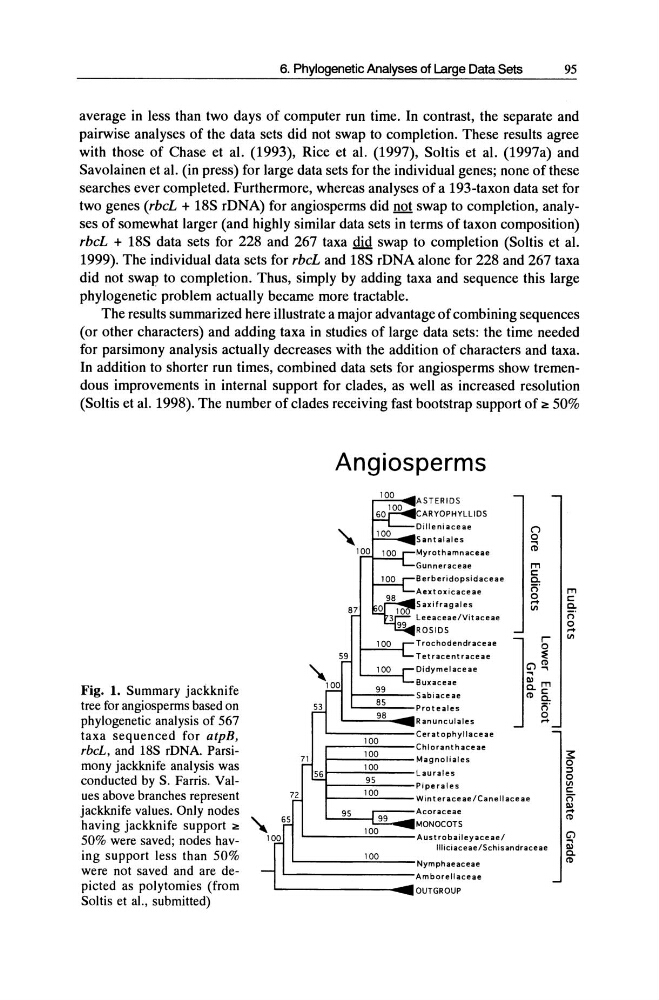
Fig. 1. Summary jackknife
tree for angiosperms based on
phylogenetic analysis of 567
taxa sequenced for atpB,
rbeL, and 18S rONA. Parsimony jackknife analysis was
conducted by S. Farris. Values above branches represent
jackknife values. Only nodes
having jackknife support ..
50% were saved; nodes having support less than 50%
were not saved and are depicted as polytomies (from
Soltis et aI., submitted)
"
100
71
7Z
65
Angiosperms
n
Santalales
0
...,
100 100
Myrothamnaceae
C1>
Gunneraceae
m
Serb e ride psid ac e ae
c::
a.
Aextoxicaceae
r;'
0
Saxifragales
.....
VI
Leeaceae/Vitaceae
ROSIDS
Ji
Trochodendracea@
T et rae e nt racea e
Didymelaceae
Buxaceae
III m
Sabiaceae
a.c::
C1> a.
Proteales
r;'
0
Ranunculales
....
100
59
"
100
100
99
85
98
Ceratophyllaceae
Chloranthaceae
100
100
Magnoliales
Laurales
Piperales
Winteraceae/Canell aeeae
100
S6
95
100
95
Acoraceae
MONOCOTS
Austrobaileyace ae/
IlIiciaceae/Schisandraceae
100
Nymphaeaceae
Amborellaceae
OUT GROUP
m
c::
a.
n' 0
.....
VI
3:
0
::I
0
VI
c::
n III
.... C1>
~
III
a.
C1>
95
average in less than two days of computer run time. In contrast, the separate and
pairwise analyses of the data sets did not swap to completion. These results agree
with those of Chase et al. (1993), Rice et al. (1997), Soltis et al. (1997a) and
Savolainen et al. (in press) for large data sets for the individual genes; none of these
searches ever completed. Furthermore, whereas analyses of a 193-taxon data set for
two genes (rbeL + 18S rDNA) for angiosperms did not swap to completion, analyses of somewhat larger (and highly similar data sets in terms of taxon composition)
rbeL + 18S data sets for 228 and 267 taxa did swap to completion (Soltis et al.
1999). The individual data sets for rbeL and 18S rDNA alone for 228 and 267 taxa
did not swap to completion. Thus, simply by adding taxa and sequence this large
phylogenetic problem actually became more tractable.
The results summarized here illustrate a major advantage of combining sequences
(or other characters) and adding taxa in studies of large data sets: the time needed
for parsimony analysis actually decreases with the addition of characters and taxa.
In addition to shorter run times, combined data sets for angiosperms show tremendous improvements in internal support for clades, as well as increased resolution
(Soltis et al. 1998). The number of clades receiving fast bootstrap support of ~ 50%
Fig. 1. Summary jackknife
tree for angiosperms based on
phylogenetic analysis of 567
taxa sequenced for atpB,
rbeL, and 18S rONA. Parsimony jackknife analysis was
conducted by S. Farris. Values above branches represent
jackknife values. Only nodes
having jackknife support ..
50% were saved; nodes having support less than 50%
were not saved and are depicted as polytomies (from
Soltis et aI., submitted)
"
100
71
7Z
65
Angiosperms
n
Santalales
0
...,
100 100
Myrothamnaceae
C1>
Gunneraceae
m
Serb e ride psid ac e ae
c::
a.
Aextoxicaceae
r;'
0
Saxifragales
.....
VI
Leeaceae/Vitaceae
ROSIDS
Ji
Trochodendracea@
T et rae e nt racea e
Didymelaceae
Buxaceae
III m
Sabiaceae
a.c::
C1> a.
Proteales
r;'
0
Ranunculales
....
100
59
"
100
100
99
85
98
Ceratophyllaceae
Chloranthaceae
100
100
Magnoliales
Laurales
Piperales
Winteraceae/Canell aeeae
100
S6
95
100
95
Acoraceae
MONOCOTS
Austrobaileyace ae/
IlIiciaceae/Schisandraceae
100
Nymphaeaceae
Amborellaceae
OUT GROUP
m
c::
a.
n' 0
.....
VI
3:
0
::I
0
VI
c::
n III
.... C1>
~
III
a.
C1>