

4. Methods of Estimating Belowground Net Primary Production
61
Jordan and Escalante (1980) compared six different ingrowth methods in a tropical rainforest and
found that estimates of biomass accumulation were
similar among methods. Persson (1979, 1983) and
Neill (1992) found that estimates of BNPP by ingrowth cores were similar to those produced by a
biomass method. Limitations of ingrowth methods
include the stimulation or depression of root growth
caused by collecting the initial root core, inability
to deal with simultaneous growth and death or herbivory, and the different conditions associated with
roots growing into root-free soil (Neill 1992).
Isotopes
Although radioactive isotopes have been used in
several ways in root studies, the only isotope that
has been used to estimate BNPP is carbon = 14
e 4 C) (Dahlman and Kucera 1967; Caldwell and
Camp 1974; Milchunas et al. 1985; Milchunas and
Lauenroth 1992). The assumption implicit in this
method is that by exposing the photosynthetically
active tissue of a plant or group of plants to an
atmosphere containing 14C02, a portion of the 14C
that is translocated to the roots will be incorporated
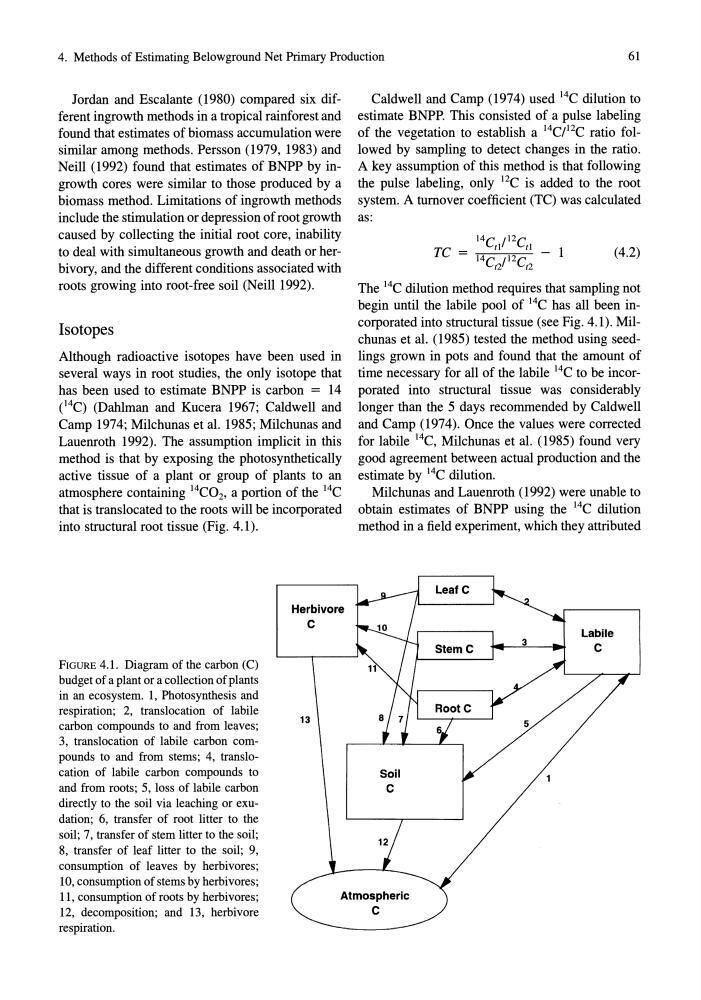
into structural root tissue (Fig. 4.1).
FIGURE 4.1. Diagram of the carbon (C)
budget of a plant or a collection of plants
in an ecosystem. 1, Photosynthesis and
respiration; 2, translocation of labile
carbon compounds to and from leaves;
3, translocation of labile carbon compounds to and from stems; 4, translocation of labile carbon compounds to
and from roots; 5, loss of labile carbon
directly to the soil via leaching or exudation; 6, transfer of root litter to the
soil; 7, transfer of stem litter to the soil;
8, transfer of leaf litter to the soil; 9,
consumption of leaves by herbivores;
10, consumption of stems by herbivores;
11, consumption of roots by herbivores;
12, decomposition; and 13, herbivore
respiration.
Herbivore
C
13
Caldwell and Camp (1974) used 14C dilution to
estimate BNPP. This consisted of a pulse labeling
of the vegetation to establish a 14C/12C ratio followed by sampling to detect changes in the ratio.
A key assumption of this method is that following
the pulse labeling, only 12C is added to the root
system. A turnover coefficient (TC) was calculated
as:
14C / 12 C
TC = tl tl - 1
(4.2)
14Ca/12Ct2
The 14C dilution method requires that sampling not
begin until the labile pool of 14C has all been incorporated into structural tissue (see Fig. 4.1). Milchunas et al. (1985) tested the method using seedlings grown in pots and found that the amount of
time necessary for all of the labile 14C to be incorporated into structural tissue was considerably
longer than the 5 days recommended by Caldwell
and Camp (1974). Once the values were corrected
for labile 14C, Milchunas et al. (1985) found very
good agreement between actual production and the
estimate by 14C dilution.
Milchunas and Lauenroth (1992) were unable to
obtain estimates of BNPP using the 14C dilution
method in a field experiment, which they attributed
Soil
C
Labile
C
61
Jordan and Escalante (1980) compared six different ingrowth methods in a tropical rainforest and
found that estimates of biomass accumulation were
similar among methods. Persson (1979, 1983) and
Neill (1992) found that estimates of BNPP by ingrowth cores were similar to those produced by a
biomass method. Limitations of ingrowth methods
include the stimulation or depression of root growth
caused by collecting the initial root core, inability
to deal with simultaneous growth and death or herbivory, and the different conditions associated with
roots growing into root-free soil (Neill 1992).
Isotopes
Although radioactive isotopes have been used in
several ways in root studies, the only isotope that
has been used to estimate BNPP is carbon = 14
e 4 C) (Dahlman and Kucera 1967; Caldwell and
Camp 1974; Milchunas et al. 1985; Milchunas and
Lauenroth 1992). The assumption implicit in this
method is that by exposing the photosynthetically
active tissue of a plant or group of plants to an
atmosphere containing 14C02, a portion of the 14C
that is translocated to the roots will be incorporated
into structural root tissue (Fig. 4.1).
FIGURE 4.1. Diagram of the carbon (C)
budget of a plant or a collection of plants
in an ecosystem. 1, Photosynthesis and
respiration; 2, translocation of labile
carbon compounds to and from leaves;
3, translocation of labile carbon compounds to and from stems; 4, translocation of labile carbon compounds to
and from roots; 5, loss of labile carbon
directly to the soil via leaching or exudation; 6, transfer of root litter to the
soil; 7, transfer of stem litter to the soil;
8, transfer of leaf litter to the soil; 9,
consumption of leaves by herbivores;
10, consumption of stems by herbivores;
11, consumption of roots by herbivores;
12, decomposition; and 13, herbivore
respiration.
Herbivore
C
13
Caldwell and Camp (1974) used 14C dilution to
estimate BNPP. This consisted of a pulse labeling
of the vegetation to establish a 14C/12C ratio followed by sampling to detect changes in the ratio.
A key assumption of this method is that following
the pulse labeling, only 12C is added to the root
system. A turnover coefficient (TC) was calculated
as:
14C / 12 C
TC = tl tl - 1
(4.2)
14Ca/12Ct2
The 14C dilution method requires that sampling not
begin until the labile pool of 14C has all been incorporated into structural tissue (see Fig. 4.1). Milchunas et al. (1985) tested the method using seedlings grown in pots and found that the amount of
time necessary for all of the labile 14C to be incorporated into structural tissue was considerably
longer than the 5 days recommended by Caldwell
and Camp (1974). Once the values were corrected
for labile 14C, Milchunas et al. (1985) found very
good agreement between actual production and the
estimate by 14C dilution.
Milchunas and Lauenroth (1992) were unable to
obtain estimates of BNPP using the 14C dilution
method in a field experiment, which they attributed
Soil
C
Labile
C