

60
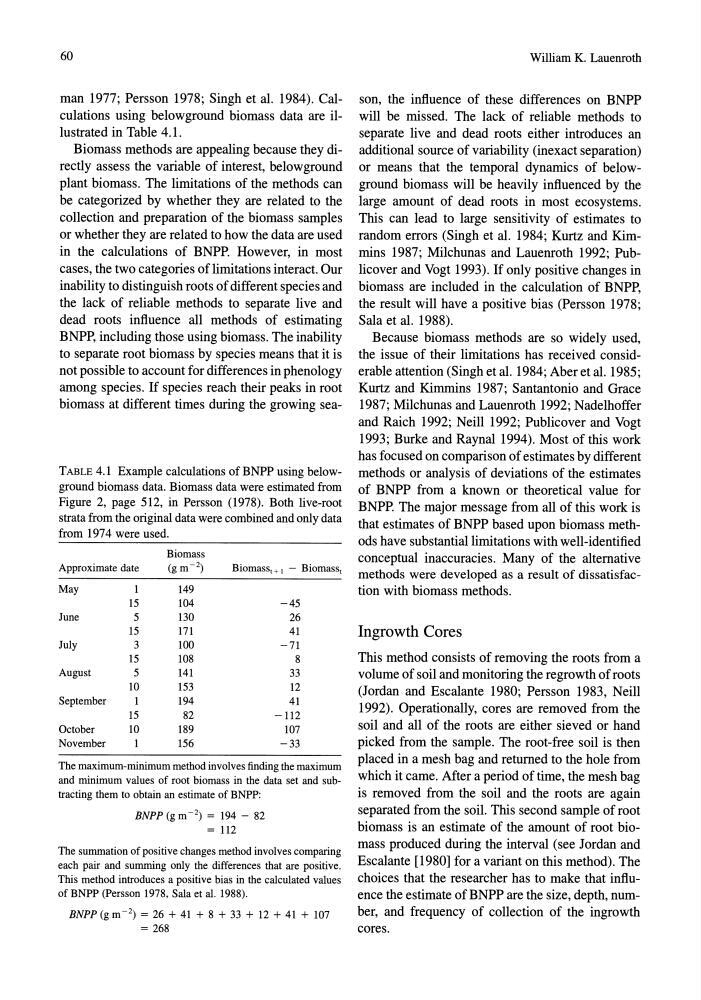
man 1977; Persson 1978; Singh et al. 1984). Calculations using belowground biomass data are illustrated in Table 4.1.
Biomass methods are appealing because they directly assess the variable of interest, belowground
plant biomass. The limitations of the methods can
be categorized by whether they are related to the
collection and preparation of the biomass samples
or whether they are related to how the data are used
in the calculations of BNPP. However, in most
cases, the two categories oflimitations interact. Our
inability to distinguish roots of different species and
the lack of reliable methods to separate live and
dead roots influence all methods of estimating
BNPP, including those using biomass. The inability
to separate root biomass by species means that it is
not possible to account for differences in phenology
among species. If species reach their peaks in root
biomass at different times during the growing seaTABLE 4.1 Example calculations of BNPP using belowground biomass data. Biomass data were estimated from
Figure 2, page 512, in Persson (1978). Both live-root
strata from the original data were combined and only data
from 1974 were used.
Biomass
Approximate date
(gm- 2 )
Biomass'+l - Biomass,
May
149
15
104
-45
June
5
130
26
15
171
41
July
3
100
-71
15
108
8
August
5
141
33
10
153
12
September
1
194
41
15
82
-112
October
10
189
107
November
156
-33
The maximum-minimum method involves finding the maximum
and minimum values of root biomass in the data set and subtracting them to obtain an estimate of BNPP:
BNPP(gm- 2 ) = 194 - 82
= 112
The summation of positive changes method involves comparing
each pair and summing only the differences that are positive.
This method introduces a positive bias in the calculated values
of BNPP (Persson 1978, Sala et al. 1988).
BNPP(gm- 2 ) = 26 + 41 + 8 + 33 + 12 + 41 + 107
= 268
William K. Lauenroth
son, the influence of these differences on BNPP
will be missed. The lack of reliable methods to
separate live and dead roots either introduces an
additional source of variability (inexact separation)
or means that the temporal dynamics of belowground biomass will be heavily influenced by the
large amount of dead roots in most ecosystems.
This can lead to large sensitivity of estimates to
random errors (Singh et al. 1984; Kurtz and Kimmins 1987; Milchunas and Lauenroth 1992; Publicover and Vogt 1993). If only positive changes in
biomass are included in the calculation of BNPP,
the result will have a positive bias (Persson 1978;
Sala et al. 1988).
Because biomass methods are so widely used,
the issue of their limitations has received considerable attention (Singh et al. 1984; Aber et al. 1985;
Kurtz and Kimmins 1987; Santantonio and Grace
1987; Milchunas and Lauenroth 1992; Nadelhoffer
and Raich 1992; Neill 1992; Publicover and Vogt
1993; Burke and RaynalI994). Most of this work
has focused on comparison of estimates by different
methods or analysis of deviations of the estimates
of BNPP from a known or theoretical value for
BNPP. The major message from all of this work is
that estimates of BNPP based upon biomass methods have substantial limitations with well-identified
conceptual inaccuracies. Many of the alternative
methods were developed as a result of dissatisfaction with biomass methods.
Ingrowth Cores
This method consists of removing the roots from a
volume of soil and monitoring the regrowth of roots
(Jordan and Escalante 1980; Persson 1983, Neill
1992). Operationally, cores are removed from the
soil and all of the roots are either sieved or hand
picked from the sample. The root-free soil is then
placed in a mesh bag and returned to the hole from
which it came. After a period of time, the mesh bag
is removed from the soil and the roots are again
separated from the soil. This second sample of root
biomass is an estimate of the amount of root biomass produced during the interval (see Jordan and
Escalante [1980] for a variant on this method). The
choices that the researcher has to make that influence the estimate of BNPP are the size, depth, number, and frequency of collection of the ingrowth
cores.
man 1977; Persson 1978; Singh et al. 1984). Calculations using belowground biomass data are illustrated in Table 4.1.
Biomass methods are appealing because they directly assess the variable of interest, belowground
plant biomass. The limitations of the methods can
be categorized by whether they are related to the
collection and preparation of the biomass samples
or whether they are related to how the data are used
in the calculations of BNPP. However, in most
cases, the two categories oflimitations interact. Our
inability to distinguish roots of different species and
the lack of reliable methods to separate live and
dead roots influence all methods of estimating
BNPP, including those using biomass. The inability
to separate root biomass by species means that it is
not possible to account for differences in phenology
among species. If species reach their peaks in root
biomass at different times during the growing seaTABLE 4.1 Example calculations of BNPP using belowground biomass data. Biomass data were estimated from
Figure 2, page 512, in Persson (1978). Both live-root
strata from the original data were combined and only data
from 1974 were used.
Biomass
Approximate date
(gm- 2 )
Biomass'+l - Biomass,
May
149
15
104
-45
June
5
130
26
15
171
41
July
3
100
-71
15
108
8
August
5
141
33
10
153
12
September
1
194
41
15
82
-112
October
10
189
107
November
156
-33
The maximum-minimum method involves finding the maximum
and minimum values of root biomass in the data set and subtracting them to obtain an estimate of BNPP:
BNPP(gm- 2 ) = 194 - 82
= 112
The summation of positive changes method involves comparing
each pair and summing only the differences that are positive.
This method introduces a positive bias in the calculated values
of BNPP (Persson 1978, Sala et al. 1988).
BNPP(gm- 2 ) = 26 + 41 + 8 + 33 + 12 + 41 + 107
= 268
William K. Lauenroth
son, the influence of these differences on BNPP
will be missed. The lack of reliable methods to
separate live and dead roots either introduces an
additional source of variability (inexact separation)
or means that the temporal dynamics of belowground biomass will be heavily influenced by the
large amount of dead roots in most ecosystems.
This can lead to large sensitivity of estimates to
random errors (Singh et al. 1984; Kurtz and Kimmins 1987; Milchunas and Lauenroth 1992; Publicover and Vogt 1993). If only positive changes in
biomass are included in the calculation of BNPP,
the result will have a positive bias (Persson 1978;
Sala et al. 1988).
Because biomass methods are so widely used,
the issue of their limitations has received considerable attention (Singh et al. 1984; Aber et al. 1985;
Kurtz and Kimmins 1987; Santantonio and Grace
1987; Milchunas and Lauenroth 1992; Nadelhoffer
and Raich 1992; Neill 1992; Publicover and Vogt
1993; Burke and RaynalI994). Most of this work
has focused on comparison of estimates by different
methods or analysis of deviations of the estimates
of BNPP from a known or theoretical value for
BNPP. The major message from all of this work is
that estimates of BNPP based upon biomass methods have substantial limitations with well-identified
conceptual inaccuracies. Many of the alternative
methods were developed as a result of dissatisfaction with biomass methods.
Ingrowth Cores
This method consists of removing the roots from a
volume of soil and monitoring the regrowth of roots
(Jordan and Escalante 1980; Persson 1983, Neill
1992). Operationally, cores are removed from the
soil and all of the roots are either sieved or hand
picked from the sample. The root-free soil is then
placed in a mesh bag and returned to the hole from
which it came. After a period of time, the mesh bag
is removed from the soil and the roots are again
separated from the soil. This second sample of root
biomass is an estimate of the amount of root biomass produced during the interval (see Jordan and
Escalante [1980] for a variant on this method). The
choices that the researcher has to make that influence the estimate of BNPP are the size, depth, number, and frequency of collection of the ingrowth
cores.