

52
Steven W. Running, Peter E. Thornton, Ramakrishna Nemani, and Joseph M. Glassy
ation scalars are simple linear ramp functions of
daily TMIN and VPD. The estimate of maintenance respiration costs for leaves and fine roots is
based on a standard exponential function of daily
average air temperature (Sprugel et al. 1995; Ryan
et al. 1997; Maier et al. 1998), scaled by the biomass of leaves and fine roots. We use the daily
LAI from MODIS to estimate leaf mass, based on
a specific leaf area (SLA) from Table 3.1. Fine
root mass is assumed to be present in a constant
ratio to leaf mass. The following parameters from
Table 3.1 are required for these calculations: SLA,
frooCleaCratio, leaCrnr_base, frooCrnr_base,
qlO_rnr.
Annual Estimation of NP P
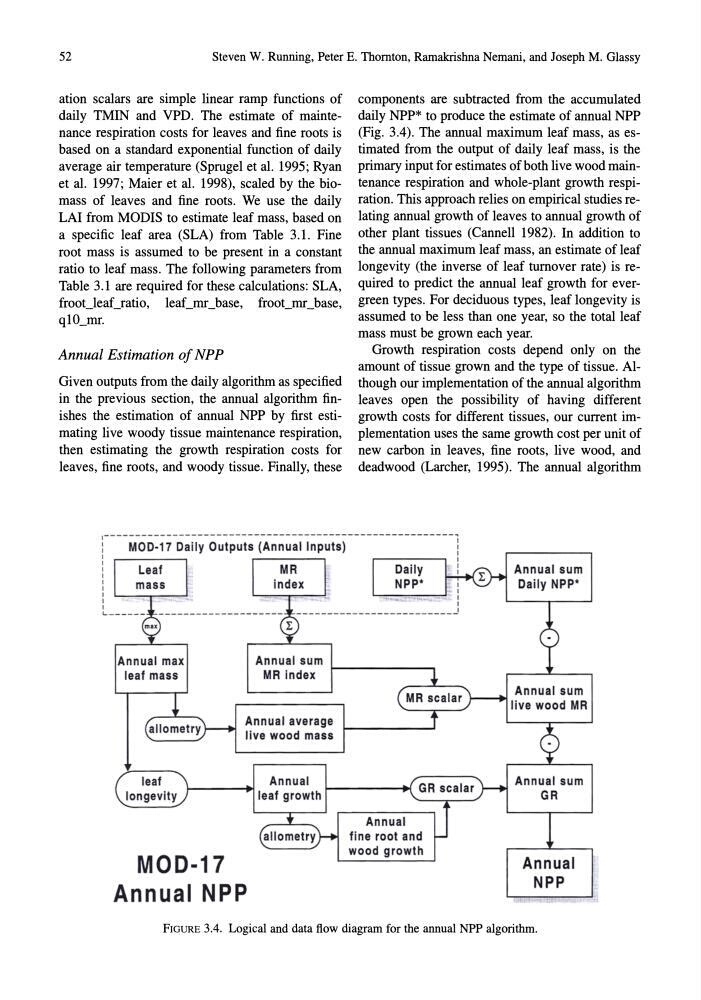
Given outputs from the daily algorithm as specified
in the previous section, the annual algorithm finishes the estimation of annual NPP by first estimating live woody tissue maintenance respiration,
then estimating the growth respiration costs for
leaves, fine roots, and woody tissue. Finally, these
I
I
I
I
I
components are subtracted from the accumulated
daily NPP* to produce the estimate of annual NPP
(Fig. 3.4). The annual maximum leaf mass, as estimated from the output of daily leaf mass, is the
primary input for estimates of both live wood maintenance respiration and whole-plant growth respiration. This approach relies on empirical studies relating annual growth of leaves to annual growth of
other plant tissues (Cannell 1982). In addition to
the annual maximum leaf mass, an estimate of leaf
longevity (the inverse of leaf turnover rate) is required to predict the annual leaf growth for evergreen types. For deciduous types, leaf longevity is
assumed to be less than one year, so the total leaf
mass must be grown each year.
Growth respiration costs depend only on the
amount of tissue grown and the type of tissue. Although our implementation of the annual algorithm
leaves open the possibility of having different
growth costs for different tissues, our current implementation uses the same growth cost per unit of
new carbon in leaves, fine roots, live wood, and
deadwood (Larcher, 1995). The annual algorithm
Annual sum
Daily NPP'
I
I
1
•
I
I
I
L___ ___ _______ ______ __ __ ___ -- - -- - --- - - -------- - - --- -Annual max
leaf mass
Annual sum
MR index
Annual average
live wood mass
MOO-17
Annual NPP
Annual
leaf growth
Annual
fine root and
wood growth
Annual sum
live wood MR
Annual sum
GR
Annual
NPP
FIGURE 3.4. Logical and data flow diagram for the annual NPP algorithm.
Steven W. Running, Peter E. Thornton, Ramakrishna Nemani, and Joseph M. Glassy
ation scalars are simple linear ramp functions of
daily TMIN and VPD. The estimate of maintenance respiration costs for leaves and fine roots is
based on a standard exponential function of daily
average air temperature (Sprugel et al. 1995; Ryan
et al. 1997; Maier et al. 1998), scaled by the biomass of leaves and fine roots. We use the daily
LAI from MODIS to estimate leaf mass, based on
a specific leaf area (SLA) from Table 3.1. Fine
root mass is assumed to be present in a constant
ratio to leaf mass. The following parameters from
Table 3.1 are required for these calculations: SLA,
frooCleaCratio, leaCrnr_base, frooCrnr_base,
qlO_rnr.
Annual Estimation of NP P
Given outputs from the daily algorithm as specified
in the previous section, the annual algorithm finishes the estimation of annual NPP by first estimating live woody tissue maintenance respiration,
then estimating the growth respiration costs for
leaves, fine roots, and woody tissue. Finally, these
I
I
I
I
I
components are subtracted from the accumulated
daily NPP* to produce the estimate of annual NPP
(Fig. 3.4). The annual maximum leaf mass, as estimated from the output of daily leaf mass, is the
primary input for estimates of both live wood maintenance respiration and whole-plant growth respiration. This approach relies on empirical studies relating annual growth of leaves to annual growth of
other plant tissues (Cannell 1982). In addition to
the annual maximum leaf mass, an estimate of leaf
longevity (the inverse of leaf turnover rate) is required to predict the annual leaf growth for evergreen types. For deciduous types, leaf longevity is
assumed to be less than one year, so the total leaf
mass must be grown each year.
Growth respiration costs depend only on the
amount of tissue grown and the type of tissue. Although our implementation of the annual algorithm
leaves open the possibility of having different
growth costs for different tissues, our current implementation uses the same growth cost per unit of
new carbon in leaves, fine roots, live wood, and
deadwood (Larcher, 1995). The annual algorithm
Annual sum
Daily NPP'
I
I
1
•
I
I
I
L___ ___ _______ ______ __ __ ___ -- - -- - --- - - -------- - - --- -Annual max
leaf mass
Annual sum
MR index
Annual average
live wood mass
MOO-17
Annual NPP
Annual
leaf growth
Annual
fine root and
wood growth
Annual sum
live wood MR
Annual sum
GR
Annual
NPP
FIGURE 3.4. Logical and data flow diagram for the annual NPP algorithm.