

Canopy Structure and Light Quality
42.2 meters
4.2 meters
4.1 meters
Scaling up from Leaves to Stands
Westgec
g
=: OJ
CD
i
.:: .,
~
]i
.,
Transect G: Open DouglaS Fir (960725)
70r--------------------,
c ~ ~ ~ ~ ~ ~ ~ ~ ~ d
Dlft'usel(D lIruse.-D irect)
DxN Clone (960728)
12r--------------------,
10
8
6
4
2
0
0
0.1
0.2
0.3
Dlft'us~lft'use+Direct)
TxD Clone (9607291
0.4
12r--------------------,
550nm - -
618nm - -
830nm - -
0 ' - -..... _ ...... ---'-_.&....1
o
0.1
0.2
0.3
0.4
o lITuseI(DIIruse+Dlrect)
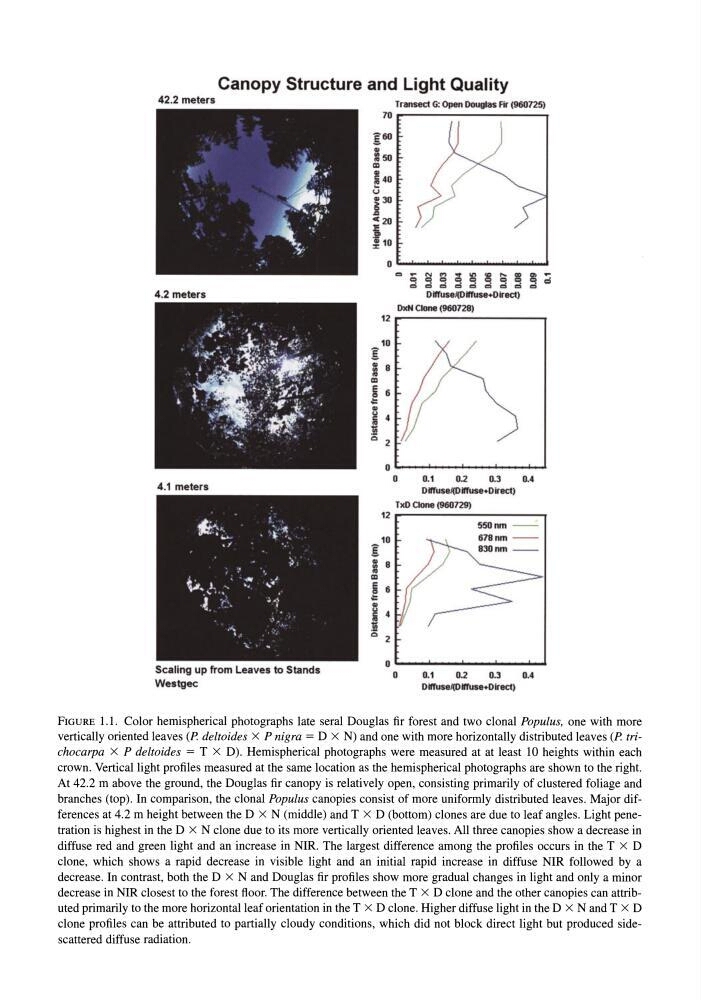
FIGURE 1.1. Color hemispherical photographs late seral Douglas fir forest and two clonal Populus, one with more
vertically oriented leaves (P. deltoides X P nigra = D X N) and one with more horizontally distributed leaves (P. trichocarpa X P deltoides = T X D). Hemispherical photographs were measured at at least 10 heights within each
crown. Vertical light profiles measured at the same location as the hemispherical photographs are shown to the right.
At 42.2 m above the ground, the Douglas fir canopy is relatively open, consisting primarily of clustered foliage and
branches (top). In comparison, the clonal Populus canopies consist of more uniformly distributed leaves. Major differences at 4.2 m height between the D X N (middle) and T X D (bottom) clones are due to leaf angles. Light penetration is highest in the D X N clone due to its more vertically oriented leaves. All three canopies show a decrease in
diffuse red and green light and an increase in NIR. The largest difference among the profiles occurs in the T X D
clone, which shows a rapid decrease in visible light and an initial rapid increase in diffuse NIR followed by a
decrease. In contrast, both the D X N and Douglas fir profiles show more gradual changes in light and only a minor
decrease in NIR closest to the forest floor. The difference between the T X D clone and the other canopies can attributed primarily to the more horizontal leaf orientation in the T X D clone. Higher diffuse light in the D X Nand T X D
clone profiles can be attributed to partially cloudy conditions, which did not block direct light but produced sidescattered diffuse radiation.
42.2 meters
4.2 meters
4.1 meters
Scaling up from Leaves to Stands
Westgec
g
=: OJ
CD
i
.:: .,
~
]i
.,
Transect G: Open DouglaS Fir (960725)
70r--------------------,
c ~ ~ ~ ~ ~ ~ ~ ~ ~ d
Dlft'usel(D lIruse.-D irect)
DxN Clone (960728)
12r--------------------,
10
8
6
4
2
0
0
0.1
0.2
0.3
Dlft'us~lft'use+Direct)
TxD Clone (9607291
0.4
12r--------------------,
550nm - -
618nm - -
830nm - -
0 ' - -..... _ ...... ---'-_.&....1
o
0.1
0.2
0.3
0.4
o lITuseI(DIIruse+Dlrect)
FIGURE 1.1. Color hemispherical photographs late seral Douglas fir forest and two clonal Populus, one with more
vertically oriented leaves (P. deltoides X P nigra = D X N) and one with more horizontally distributed leaves (P. trichocarpa X P deltoides = T X D). Hemispherical photographs were measured at at least 10 heights within each
crown. Vertical light profiles measured at the same location as the hemispherical photographs are shown to the right.
At 42.2 m above the ground, the Douglas fir canopy is relatively open, consisting primarily of clustered foliage and
branches (top). In comparison, the clonal Populus canopies consist of more uniformly distributed leaves. Major differences at 4.2 m height between the D X N (middle) and T X D (bottom) clones are due to leaf angles. Light penetration is highest in the D X N clone due to its more vertically oriented leaves. All three canopies show a decrease in
diffuse red and green light and an increase in NIR. The largest difference among the profiles occurs in the T X D
clone, which shows a rapid decrease in visible light and an initial rapid increase in diffuse NIR followed by a
decrease. In contrast, both the D X N and Douglas fir profiles show more gradual changes in light and only a minor
decrease in NIR closest to the forest floor. The difference between the T X D clone and the other canopies can attributed primarily to the more horizontal leaf orientation in the T X D clone. Higher diffuse light in the D X Nand T X D
clone profiles can be attributed to partially cloudy conditions, which did not block direct light but produced sidescattered diffuse radiation.