

26. Stoichiometric Analysis of Pelagic Ecosystems: The Biogeochemistry of Planktonic Food Webs
397
60
12
150
®
®
©
p < 0.Q1
2
r =0.9
'a 40
'a 8
-g 100
QI
QI
III
III
III
ca
.. "S~."
ca
ca
.!!
CD
CD
e
!
!
Q. 20
Q. 4
Q. 50
Z
Z
Z
,.,
.i'0
......
0
0
10
20
30
0
4
8
12
5
10
15
20
N:Pofalgae
N:P eliminated
Zooplankton N:P
(fOOd)
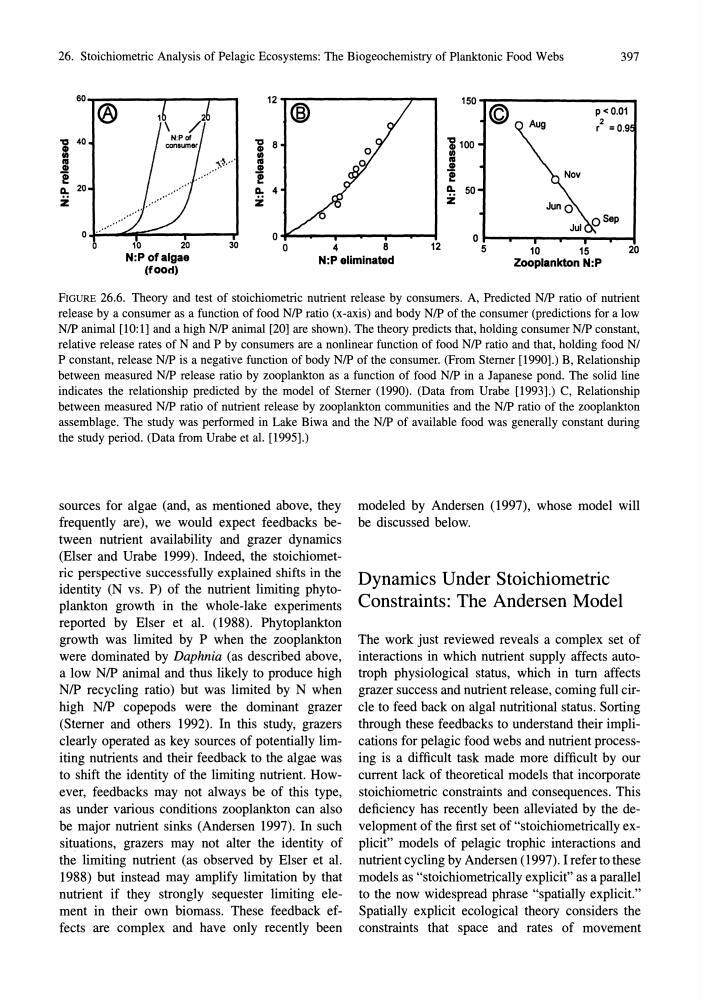
FIGURE 26.6. Theory and test of stoichiometric nutrient release by consumers. A, Predicted NIP ratio of nutrient
release by a consumer as a function of food NIP ratio (x-axis) and body NIP of the consumer (predictions for a low
NIP animal [10:1] and a high NIP animal [20] are shown). The theory predicts that, holding consumer NIP constant,
relative release rates of Nand P by consumers are a nonlinear function of food NIP ratio and that, holding food Nt
P constant, release NIP is a negative function of body NIP of the consumer. (From Sterner [1990].) B, Relationship
between measured NIP release ratio by zooplankton as a function of food NIP in a Japanese pond. The solid line
indicates the relationship predicted by the model of Sterner (1990). (Data from Urabe [1993].) C, Relationship
between measured NIP ratio of nutrient release by zooplankton communities and the NIP ratio of the zooplankton
assemblage. The study was performed in Lake Biwa and the NIP of available food was generally constant during
the study period. (Data from Urabe et al. [1995].)
sources for algae (and, as mentioned above, they
frequently are), we would expect feedbacks between nutrient availability and grazer dynamics
(Elser and Urabe 1999). Indeed, the stoichiometric perspective successfully explained shifts in the
identity (N vs. P) of the nutrient limiting phytoplankton growth in the whole-lake experiments
reported by Elser et al. (1988). Phytoplankton
growth was limited by P when the zooplankton
were dominated by Daphnia (as described above,
a low NIP animal and thus likely to produce high
NIP recycling ratio) but was limited by N when
high NIP copepods were the dominant grazer
(Sterner and others 1992). In this study, grazers
clearly operated as key sources of potentially limiting nutrients and their feedback to the algae was
to shift the identity of the limiting nutrient. However, feedbacks may not always be of this type,
as under various conditions zooplankton can also
be major nutrient sinks (Andersen 1997). In such
situations, grazers may not alter the identity of
the limiting nutrient (as observed by Elser et al.
1988) but instead may amplify limitation by that
nutrient if they strongly sequester limiting element in their own biomass. These feedback effects are complex and have only recently been
modeled by Andersen (1997), whose model will
be discussed below.
Dynamics Under Stoichiometric
Constraints: The Andersen Model
The work just reviewed reveals a complex set of
interactions in which nutrient supply affects autotroph physiological status, which in tum affects
grazer success and nutrient release, coming full circle to feed back on algal nutritional status. Sorting
through these feedbacks to understand their implications for pelagic food webs and nutrient processing is a difficult task made more difficult by our
current lack of theoretical models that incorporate
stoichiometric constraints and consequences. This
deficiency has recently been alleviated by the development of the first set of "stoichiometrically explicit" models of pelagic trophic interactions and
nutrient cycling by Andersen (1997). I refer to these
models as "stoichiometrically explicit" as a parallel
to the now widespread phrase "spatially explicit."
Spatially explicit ecological theory considers the
constraints that space and rates of movement
397
60
12
150
®
®
©
p < 0.Q1
2
r =0.9
'a 40
'a 8
-g 100
QI
QI
III
III
III
ca
.. "S~."
ca
ca
.!!
CD
CD
e
!
!
Q. 20
Q. 4
Q. 50
Z
Z
Z
,.,
.i'0
......
0
0
10
20
30
0
4
8
12
5
10
15
20
N:Pofalgae
N:P eliminated
Zooplankton N:P
(fOOd)
FIGURE 26.6. Theory and test of stoichiometric nutrient release by consumers. A, Predicted NIP ratio of nutrient
release by a consumer as a function of food NIP ratio (x-axis) and body NIP of the consumer (predictions for a low
NIP animal [10:1] and a high NIP animal [20] are shown). The theory predicts that, holding consumer NIP constant,
relative release rates of Nand P by consumers are a nonlinear function of food NIP ratio and that, holding food Nt
P constant, release NIP is a negative function of body NIP of the consumer. (From Sterner [1990].) B, Relationship
between measured NIP release ratio by zooplankton as a function of food NIP in a Japanese pond. The solid line
indicates the relationship predicted by the model of Sterner (1990). (Data from Urabe [1993].) C, Relationship
between measured NIP ratio of nutrient release by zooplankton communities and the NIP ratio of the zooplankton
assemblage. The study was performed in Lake Biwa and the NIP of available food was generally constant during
the study period. (Data from Urabe et al. [1995].)
sources for algae (and, as mentioned above, they
frequently are), we would expect feedbacks between nutrient availability and grazer dynamics
(Elser and Urabe 1999). Indeed, the stoichiometric perspective successfully explained shifts in the
identity (N vs. P) of the nutrient limiting phytoplankton growth in the whole-lake experiments
reported by Elser et al. (1988). Phytoplankton
growth was limited by P when the zooplankton
were dominated by Daphnia (as described above,
a low NIP animal and thus likely to produce high
NIP recycling ratio) but was limited by N when
high NIP copepods were the dominant grazer
(Sterner and others 1992). In this study, grazers
clearly operated as key sources of potentially limiting nutrients and their feedback to the algae was
to shift the identity of the limiting nutrient. However, feedbacks may not always be of this type,
as under various conditions zooplankton can also
be major nutrient sinks (Andersen 1997). In such
situations, grazers may not alter the identity of
the limiting nutrient (as observed by Elser et al.
1988) but instead may amplify limitation by that
nutrient if they strongly sequester limiting element in their own biomass. These feedback effects are complex and have only recently been
modeled by Andersen (1997), whose model will
be discussed below.
Dynamics Under Stoichiometric
Constraints: The Andersen Model
The work just reviewed reveals a complex set of
interactions in which nutrient supply affects autotroph physiological status, which in tum affects
grazer success and nutrient release, coming full circle to feed back on algal nutritional status. Sorting
through these feedbacks to understand their implications for pelagic food webs and nutrient processing is a difficult task made more difficult by our
current lack of theoretical models that incorporate
stoichiometric constraints and consequences. This
deficiency has recently been alleviated by the development of the first set of "stoichiometrically explicit" models of pelagic trophic interactions and
nutrient cycling by Andersen (1997). I refer to these
models as "stoichiometrically explicit" as a parallel
to the now widespread phrase "spatially explicit."
Spatially explicit ecological theory considers the
constraints that space and rates of movement